
Superseded
Standard amendment
Historical
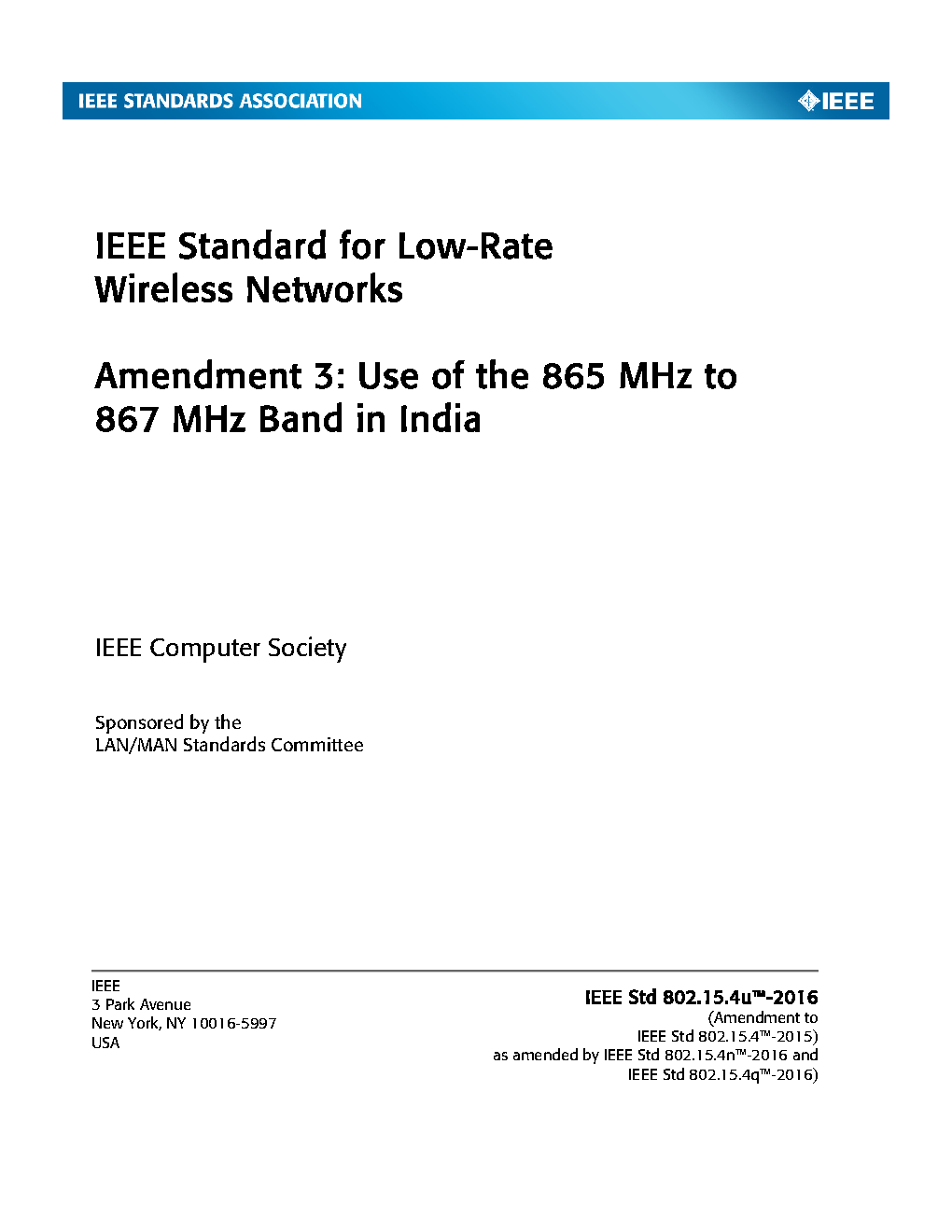
IEEE 802.15.4u:2016
IEEE Standard for Low-Rate Wireless Networks--Amendment 3: Use of the 865 MHz to 867 MHz Band in India

Summary
Amendment Standard - Superseded.
A physical (PHY) layer enabling the use of the 865 MHz to 867 MHz band in India is defined in this amendment. The supported data rate should be at least 40 kb/s and the typical line-of-sight range should be on the order of 5 km using an omni directional antenna. Included are any channel access and/or timing changes in the medium access control necessary to support this PHY layer.
This amendment defines a PHY layer enabling the use of the 865-867 MHz band in India. The supported data rate should be at least 40 kb/s per second and the typical Line of Sight (LOS) range should be on the order of 5 km using omni directional antenna. Included are any channel access and/or timing changes in the MAC necessary to support this PHY layer.
The standard provides for ultra low complexity, ultra low cost, ultra low power consumption, and low data rate wireless connectivity among inexpensive devices. In addition, one of the alternate PHYs provides precision ranging capability that is accurate to one meter. Multiple PHYs are defined to support a variety of frequency bands.
A physical (PHY) layer enabling the use of the 865 MHz to 867 MHz band in India is defined in this amendment. The supported data rate should be at least 40 kb/s and the typical line-of-sight range should be on the order of 5 km using an omni directional antenna. Included are any channel access and/or timing changes in the medium access control necessary to support this PHY layer.
This amendment defines a PHY layer enabling the use of the 865-867 MHz band in India. The supported data rate should be at least 40 kb/s per second and the typical Line of Sight (LOS) range should be on the order of 5 km using omni directional antenna. Included are any channel access and/or timing changes in the MAC necessary to support this PHY layer.
The standard provides for ultra low complexity, ultra low cost, ultra low power consumption, and low data rate wireless connectivity among inexpensive devices. In addition, one of the alternate PHYs provides precision ranging capability that is accurate to one meter. Multiple PHYs are defined to support a variety of frequency bands.
Notes
Superseded
Technical characteristics
| Publisher | Institute of Electrical and Electronics Engineers (IEEE) |
| Publication Date | 02/10/2017 |
| Edition | |
| Page Count | 18 |
| EAN | --- |
| ISBN | --- |
| Weight (in grams) | --- |
| Brochures |

|
Amendments modifies
Previous versions
12/12/2024
Active
Most Recent
09/07/2018
Superseded
Historical
27/06/2018
Superseded
Historical
30/06/2017
Superseded
Historical
14/04/2017
Superseded
Historical
10/02/2017
Superseded
Historical
29/04/2016
Superseded
Historical
29/04/2016
Superseded
Historical
27/02/2013
Superseded
Historical
17/04/2009
Superseded
Historical
01/10/2003
Superseded
Historical