
Superseded
Standard
Historical
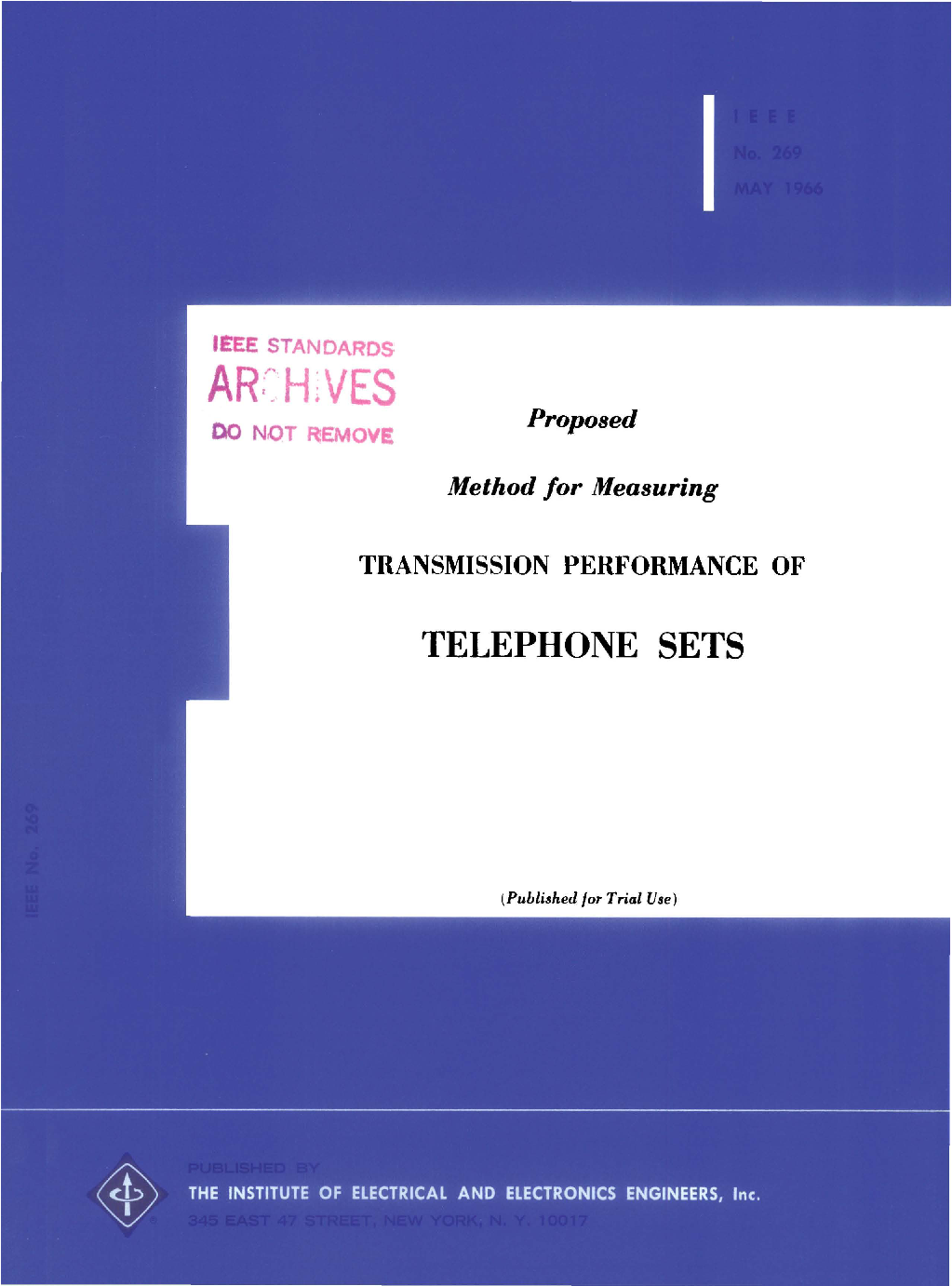
IEEE 269:1966
IEEE Proposed Method for Measuring Transmission Performance of Telephone Sets

Summary
- Superseded.
The method requires a suitable Artificial Mouth. It also specifies a standard Artificial Ear, standard circuits comprising direct-current power feed and connecting loops, and a standard pressure microphone. 2.3 This Standard is intended for use in measuring the transmission characteristic over the frequency range most useful for speech, e.g. 150 to 5000 hertz. It is to be used for single-frequency measurements and for measurements with continuously varying frequencies such as slow sweeps and warble bands. 2.4 It is suitable also for measuring the transmission performance of conventional telephone sets equipped with handsets using carbon transmitters and used with 2-wire circuits. It is not intended to be applicable to special devices such as noise-exclusion transmitters, distant-talking transmitters, insert-type receivers, or noise-exclusion receivers equipped with large ear pads. 2.5 This Standard is based on a standard pressure microphone to measure the sound field produced by the Artificial Mouth and to measure the pressure developed in the Artificial Ear. 2.6 Drawings and test procedures as well as other pertinent information have been included as an aid to designers in setting up the tests.
The purpose of this Standard is to describe a practical and reproducible method for measuring the transmission characteristics of a telephone set, and the components thereeof, by means of objective measurements in a test connection. Performance characteristics obtained using this method will approximate but will not duplicate performance under actual use conditions.
The method requires a suitable Artificial Mouth. It also specifies a standard Artificial Ear, standard circuits comprising direct-current power feed and connecting loops, and a standard pressure microphone. 2.3 This Standard is intended for use in measuring the transmission characteristic over the frequency range most useful for speech, e.g. 150 to 5000 hertz. It is to be used for single-frequency measurements and for measurements with continuously varying frequencies such as slow sweeps and warble bands. 2.4 It is suitable also for measuring the transmission performance of conventional telephone sets equipped with handsets using carbon transmitters and used with 2-wire circuits. It is not intended to be applicable to special devices such as noise-exclusion transmitters, distant-talking transmitters, insert-type receivers, or noise-exclusion receivers equipped with large ear pads. 2.5 This Standard is based on a standard pressure microphone to measure the sound field produced by the Artificial Mouth and to measure the pressure developed in the Artificial Ear. 2.6 Drawings and test procedures as well as other pertinent information have been included as an aid to designers in setting up the tests.
The purpose of this Standard is to describe a practical and reproducible method for measuring the transmission characteristics of a telephone set, and the components thereeof, by means of objective measurements in a test connection. Performance characteristics obtained using this method will approximate but will not duplicate performance under actual use conditions.
Notes
Superseded
Technical characteristics
| Publisher | Institute of Electrical and Electronics Engineers (IEEE) |
| Publication Date | 04/30/1966 |
| Edition | |
| Page Count | 24 |
| EAN | --- |
| ISBN | --- |
| Weight (in grams) | --- |
| Brochures |

|
No products.
Previous versions

13/02/2020
Active
Most Recent

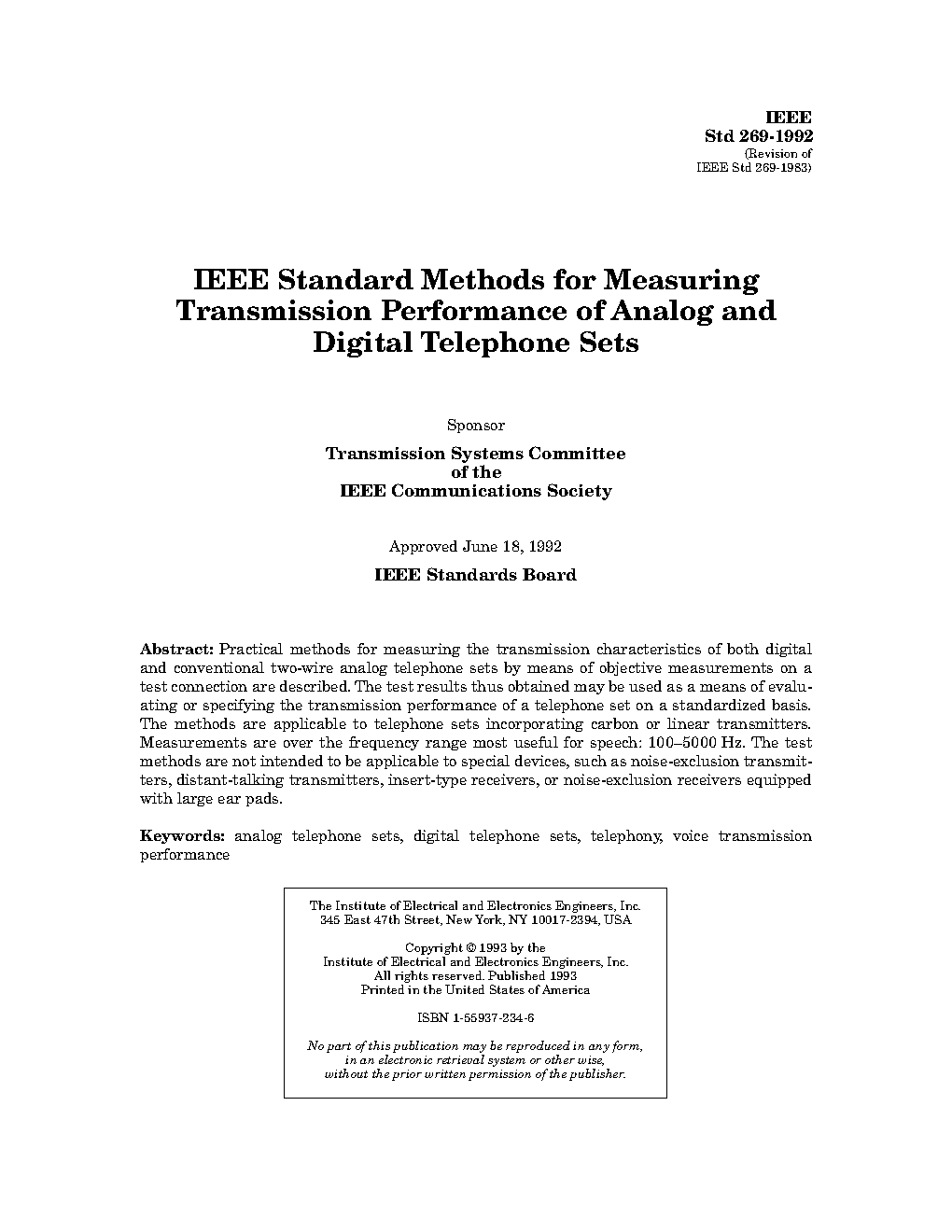
21/01/1993
Superseded
Historical
07/12/1983
Superseded
Historical
01/10/1971
Superseded
Historical
30/04/1966
Superseded
Historical