Superseded
, Confirmed
Standard amendment
Historical
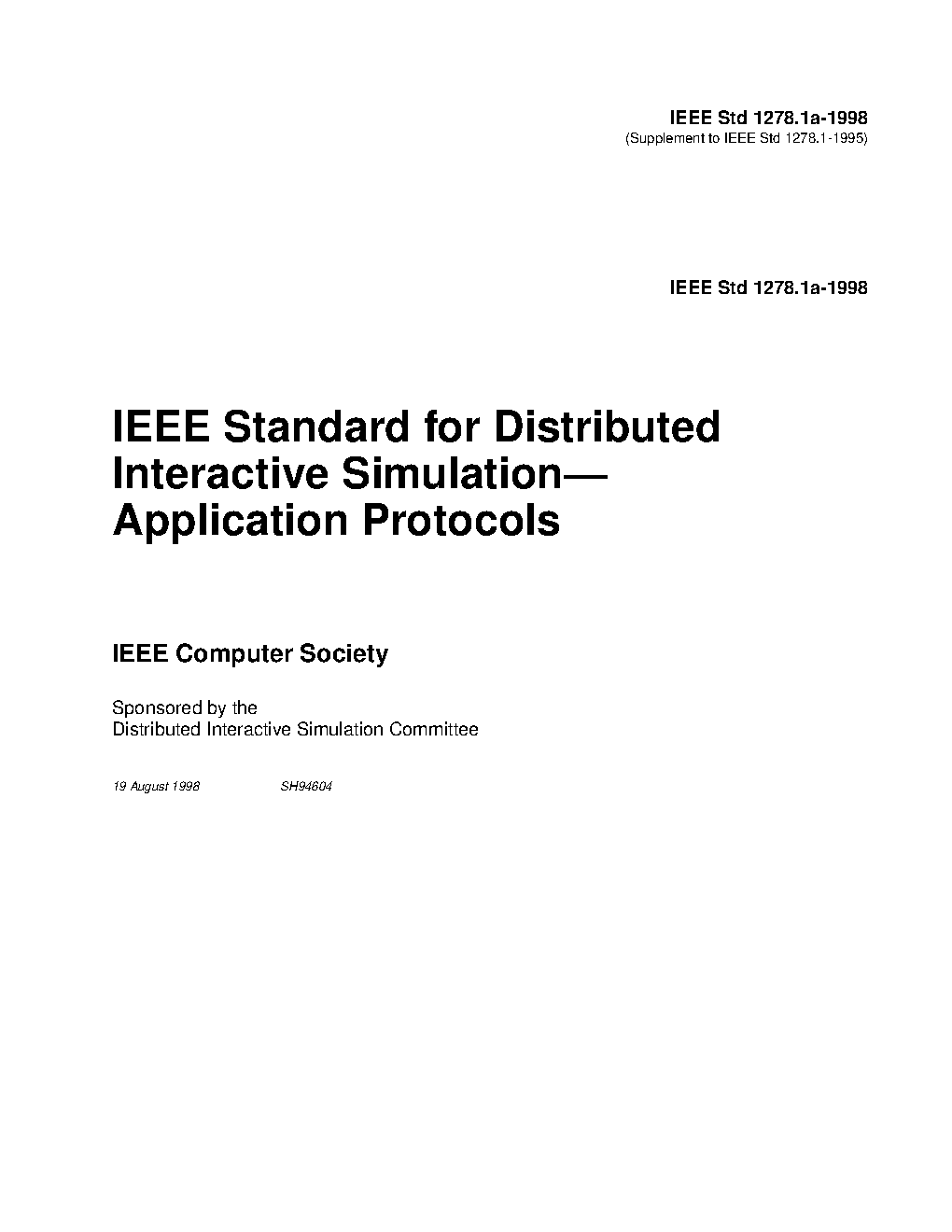
IEEE 1278.1a:1998 (R2002)
IEEE Standard for Distributed Interactive Simulation Application Protocols

Summary
Amendment Standard - Superseded.
Data messages, known as protocol data units (PDUs), that are exchanged on a network between simulation applications are defined. These PDUs are for interactions that take place within
specified domains called protocol families, which include Entity Information/Interaction, Warfare,
Logistics, Simulation Management, Distributed Emission Regeneration, Radio Communications,
Entity Management, Minefield, Synthetic Environment, Simulation Management with Reliability,
Live Entity Information/Interaction, and Non-Real Time.
This standard is part of a set of standards and recommended practices for DIS applications. Each standard and recommended practice in the set describes one or more of the elements that constitute the DIS environment. As a whole, the set of standards and recommended practices will define an interoperable simulated engagement environment. This particular standard addresses the application protocols. This standard defines the data messages, known as PDUs, that are exchanged on a network between simulation applications. The messages are organized within specified domains called protocol families. The protocol families included in this standard include Entity Information/Interaction, Warfare, Logistics, Simulation Management, Distributed Emission Regeneration, Radio Communications, Entity Management, Minefield, Synthetic Environment, Simulation Management with Reliability, Live Entity Information/Interaction, and Non-Real Time.
The current DIS application protocols do not support the functions and interactions as detailed in section 6. In this supplement the current standard will be extended to define protocols for the above areas which are critical to the overall growth of DIS.
Data messages, known as protocol data units (PDUs), that are exchanged on a network between simulation applications are defined. These PDUs are for interactions that take place within
specified domains called protocol families, which include Entity Information/Interaction, Warfare,
Logistics, Simulation Management, Distributed Emission Regeneration, Radio Communications,
Entity Management, Minefield, Synthetic Environment, Simulation Management with Reliability,
Live Entity Information/Interaction, and Non-Real Time.
This standard is part of a set of standards and recommended practices for DIS applications. Each standard and recommended practice in the set describes one or more of the elements that constitute the DIS environment. As a whole, the set of standards and recommended practices will define an interoperable simulated engagement environment. This particular standard addresses the application protocols. This standard defines the data messages, known as PDUs, that are exchanged on a network between simulation applications. The messages are organized within specified domains called protocol families. The protocol families included in this standard include Entity Information/Interaction, Warfare, Logistics, Simulation Management, Distributed Emission Regeneration, Radio Communications, Entity Management, Minefield, Synthetic Environment, Simulation Management with Reliability, Live Entity Information/Interaction, and Non-Real Time.
The current DIS application protocols do not support the functions and interactions as detailed in section 6. In this supplement the current standard will be extended to define protocols for the above areas which are critical to the overall growth of DIS.
Notes
Superseded
Technical characteristics
| Publisher | Institute of Electrical and Electronics Engineers (IEEE) |
| Publication Date | 08/19/1998 |
| Confirmation Date | 12/11/2002 |
| Edition | |
| Page Count | 216 |
| EAN | --- |
| ISBN | --- |
| Weight (in grams) | --- |
| Brochures |

|
Amendments modifies
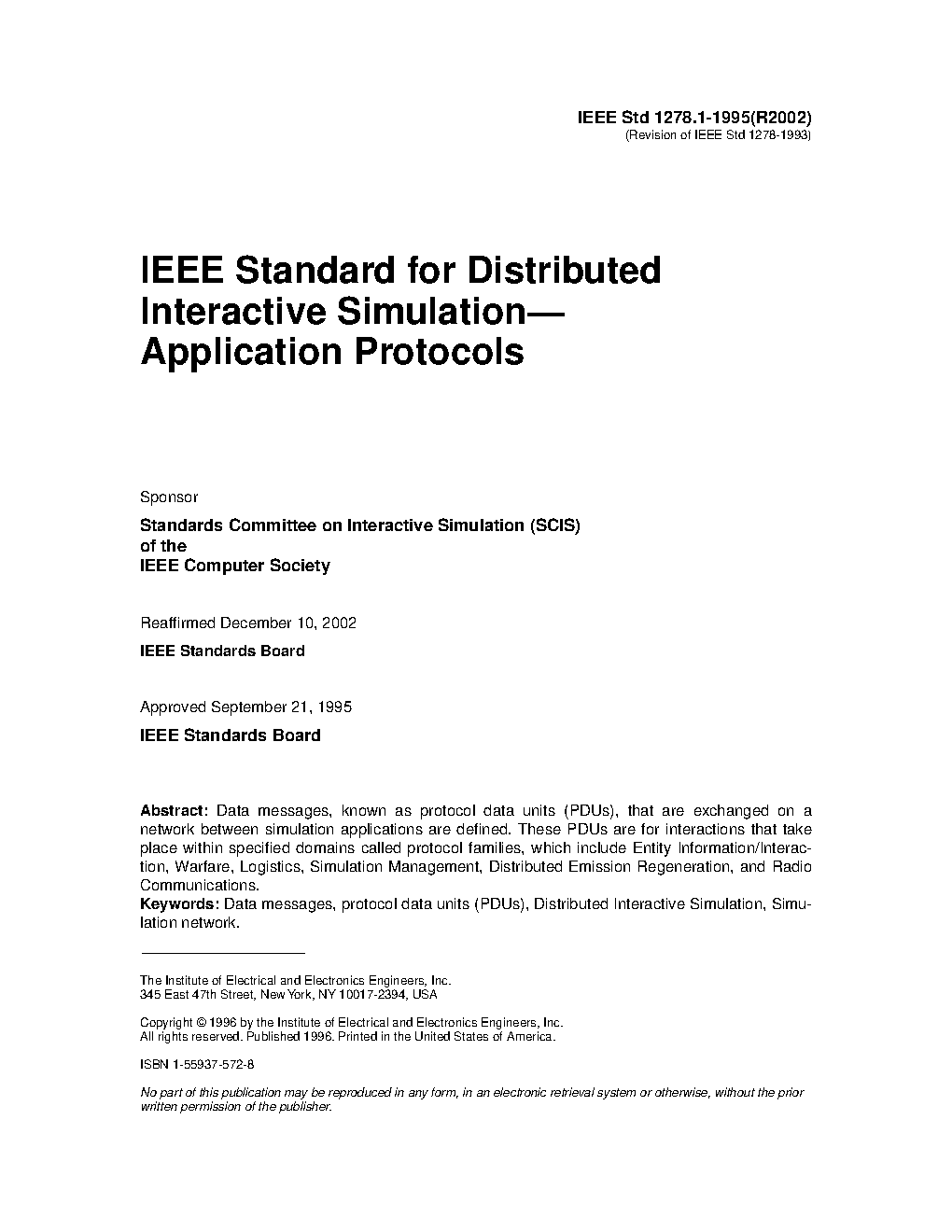
30/11/1995
Superseded
, Confirmed
Historical
Previous versions
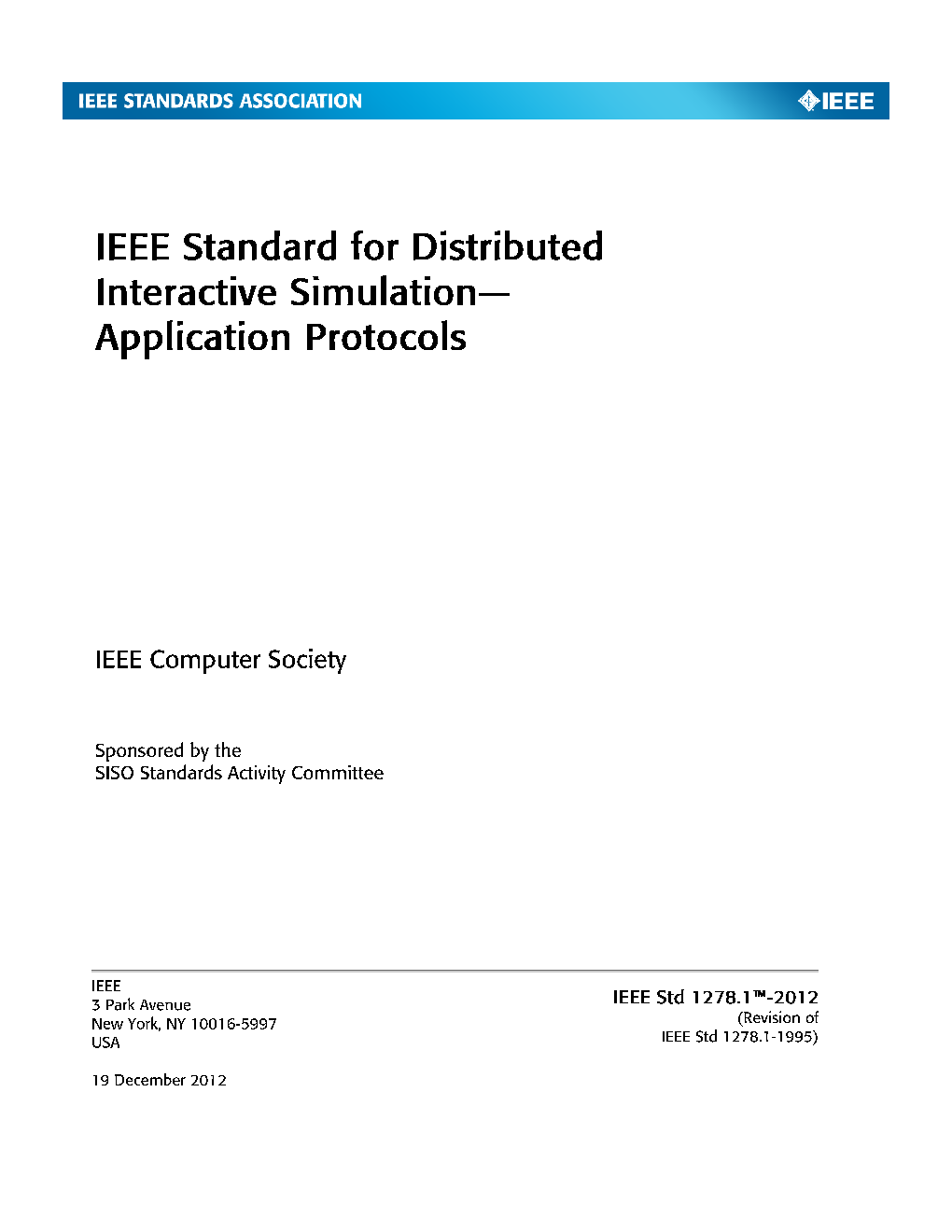
19/12/2012
Active
Most Recent
IEEE 1278.1a:1998 (R2002)
IEEE Standard for Distributed Interactive Simulation Application Protocols
19/08/1998
Superseded
, Confirmed
Historical
30/11/1995
Superseded
, Confirmed
Historical