
Active
Draft standard
Most Recent
IEEE PC62.41.2
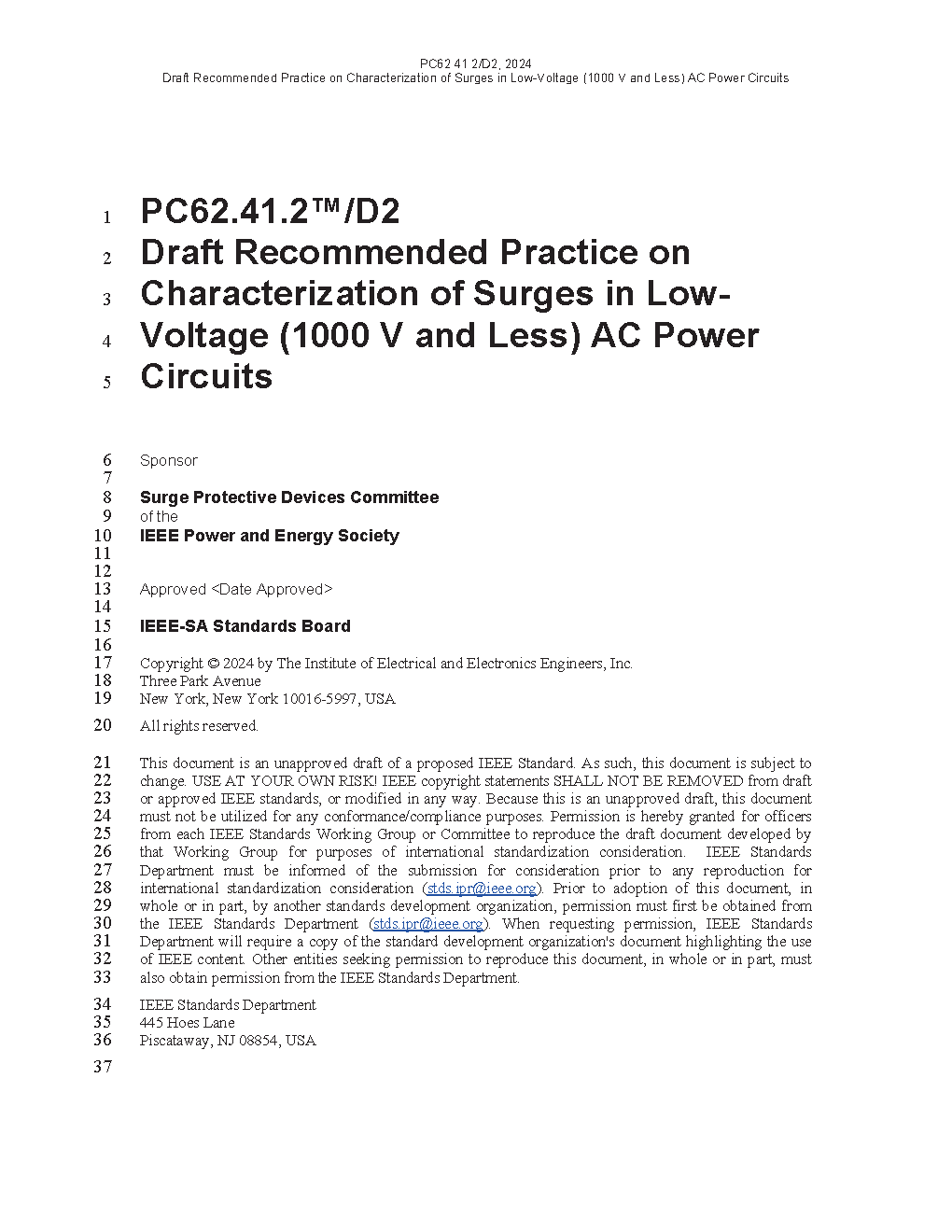
IEEE Draft Recommended Practice on Characterization of Surges in Low-Voltage (1000 V and less) AC Power Circuits

Summary
Revision Standard - Active - Draft.
The scope of this recommended practice is to characterize the surge environment at locations on ac power circuits described in IEEE Std C62.41.1 by means of standardized waveforms and other stress parameters. The surges considered in this recommended practice do not exceed one half-cycle of the normal mains waveform (fundamental frequency) in duration. They can be periodic or random events and can appear in any combination of line, neutral, or grounding conductors. They include surges with amplitudes, durations, or rates of change sufficient to cause equipment damage or operational upset. While surge protective devices (SPDs) acting primarily on the amplitude of the voltage or current are often applied to divert the damaging surges, the upsetting surges might require other remedies.
The purpose of this recommended practice is to offer to equipment designers and users a set of standard and additional surge-testing waveforms and stress levels derived from the surge environment described in the companion guide IEEE Std C62.41.1. The selection and specification of which waveform and what stress level should be considered for specific equipment remain the prerogative and responsibility of designers and users. This recommended practice is only the basis for making an informed decision made possible by a simplification of a complex database. This simplification will then allow consistent, repeatable, and cost-effective specification of surge performance for equipment connected to low-voltage ac power circuits.
The scope of this recommended practice is to characterize the surge environment at locations on ac power circuits described in IEEE Std C62.41.1 by means of standardized waveforms and other stress parameters. The surges considered in this recommended practice do not exceed one half-cycle of the normal mains waveform (fundamental frequency) in duration. They can be periodic or random events and can appear in any combination of line, neutral, or grounding conductors. They include surges with amplitudes, durations, or rates of change sufficient to cause equipment damage or operational upset. While surge protective devices (SPDs) acting primarily on the amplitude of the voltage or current are often applied to divert the damaging surges, the upsetting surges might require other remedies.
The purpose of this recommended practice is to offer to equipment designers and users a set of standard and additional surge-testing waveforms and stress levels derived from the surge environment described in the companion guide IEEE Std C62.41.1. The selection and specification of which waveform and what stress level should be considered for specific equipment remain the prerogative and responsibility of designers and users. This recommended practice is only the basis for making an informed decision made possible by a simplification of a complex database. This simplification will then allow consistent, repeatable, and cost-effective specification of surge performance for equipment connected to low-voltage ac power circuits.
Notes
Active
Technical characteristics
| Publisher | Institute of Electrical and Electronics Engineers (IEEE) |
| Publication Date | 10/25/2024 |
| Page Count | 46 |
| EAN | --- |
| ISBN | --- |
| Weight (in grams) | --- |
| Brochures |

|
No products.
Previous versions
11/04/2003
Withdrawn
Most Recent