
Active
Draft standard
Most Recent
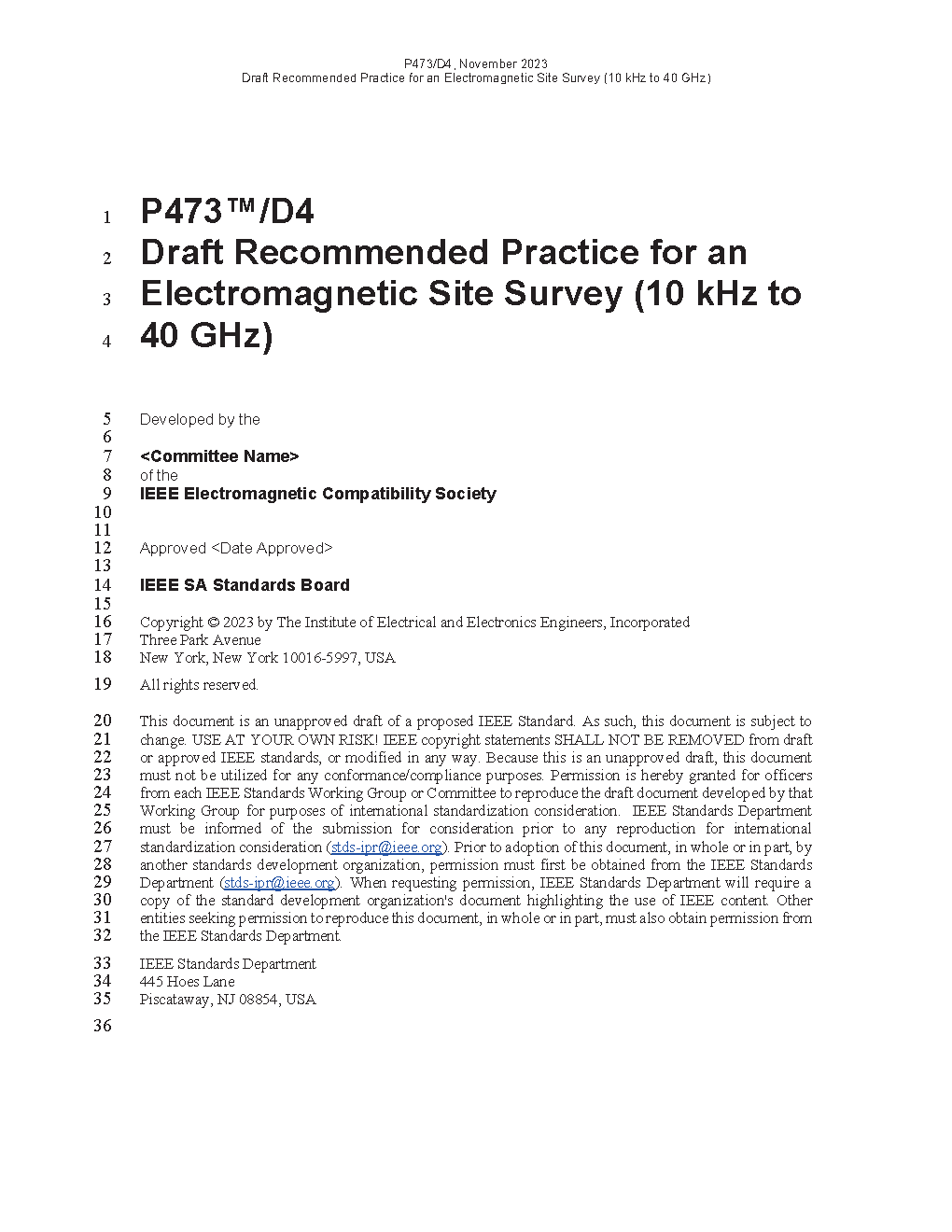
IEEE P473
IEEE Draft Recommended Practice for an Electromagnetic Site Survey (10 kHz to 40 GHz)

Summary
New IEEE Standard - Active - Draft.
This Recommended Practice provides information and guidance for characterizing radiated levels of electromagnetic (EM) noise or interference that may be present in various environments between 10 kHz and 40 GHz. It provides methods that may be used to plan for and execute the electromagnetic environment characterization of a particular environment or location. Characterizing the electromagnetic environment is traditionally referred to as a site survey. A site survey can be applicable to congested metropolitan environments, industrial settings, commercial buildings, open fields, remote geographical locations, in and around ships, aircraft, and vehicles, etc.
This recommended practice sets the framework for performing an Electromagnetic (EM) Site Survey in the frequency range of 10 kHz to 40 GHz. The EM Site Survey is intended to be a systematic, documented investigation of the measurable characteristics of the electromagnetic fields at one or more frequencies and locations as necessary during a designated time period, which yields results that are interpretable and communicable among subsequent investigators.
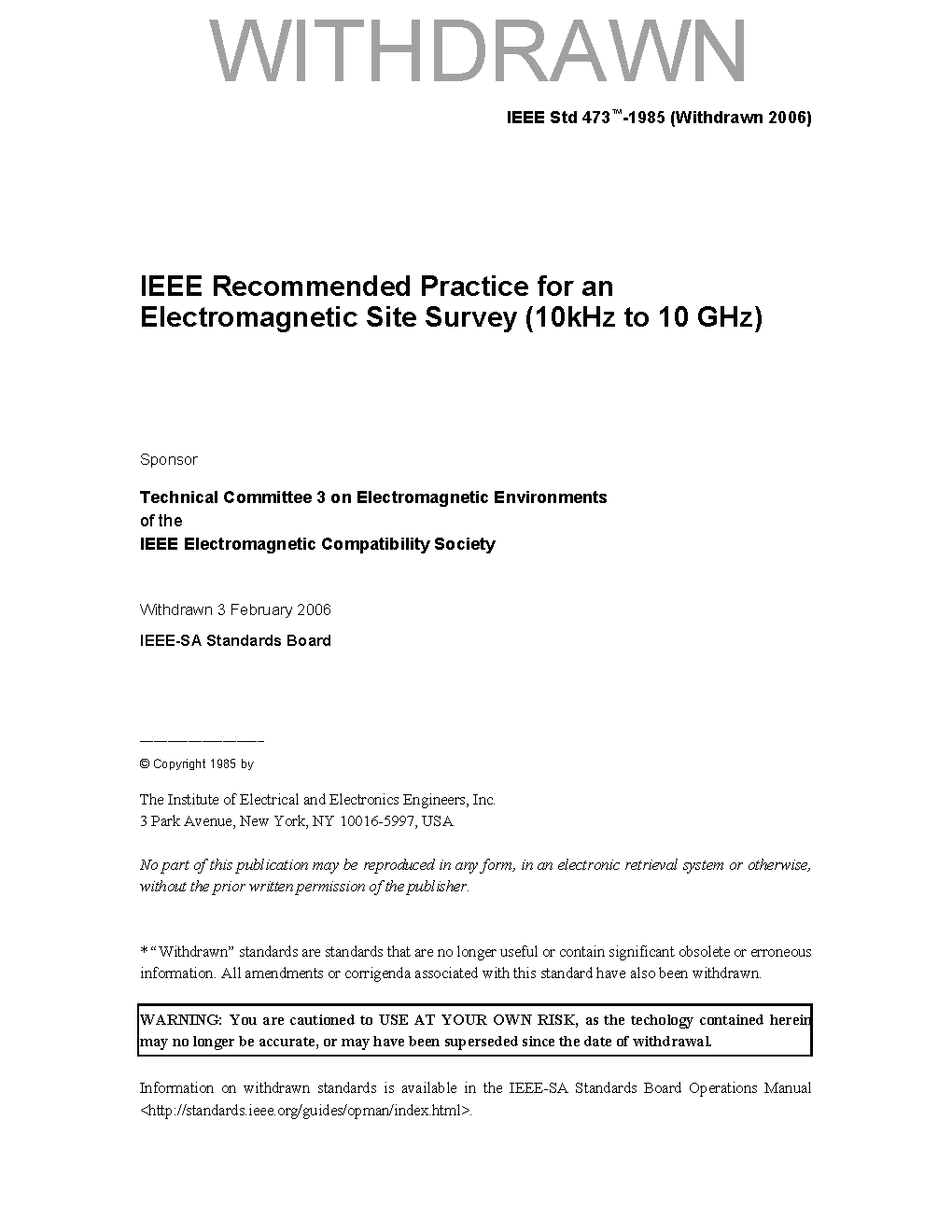
The purpose of this Recommended Practice is to provide the necessary background, guidance and methodology necessary to plan an electromagnetic site survey, perform the survey, document the results, and analyze its outcome. This new standard is based on the previously withdrawn IEEE Std 473-1985. It uses the core of IEEE Std 473-1985 but is updated to reflect the current test instrumentation, measurement techniques, and measurement environments.
This Recommended Practice provides information and guidance for characterizing radiated levels of electromagnetic (EM) noise or interference that may be present in various environments between 10 kHz and 40 GHz. It provides methods that may be used to plan for and execute the electromagnetic environment characterization of a particular environment or location. Characterizing the electromagnetic environment is traditionally referred to as a site survey. A site survey can be applicable to congested metropolitan environments, industrial settings, commercial buildings, open fields, remote geographical locations, in and around ships, aircraft, and vehicles, etc.
This recommended practice sets the framework for performing an Electromagnetic (EM) Site Survey in the frequency range of 10 kHz to 40 GHz. The EM Site Survey is intended to be a systematic, documented investigation of the measurable characteristics of the electromagnetic fields at one or more frequencies and locations as necessary during a designated time period, which yields results that are interpretable and communicable among subsequent investigators.
The purpose of this Recommended Practice is to provide the necessary background, guidance and methodology necessary to plan an electromagnetic site survey, perform the survey, document the results, and analyze its outcome. This new standard is based on the previously withdrawn IEEE Std 473-1985. It uses the core of IEEE Std 473-1985 but is updated to reflect the current test instrumentation, measurement techniques, and measurement environments.
Notes
Active
Technical characteristics
| Publisher | Institute of Electrical and Electronics Engineers (IEEE) |
| Publication Date | 11/23/2023 |
| Edition | |
| Page Count | 32 |
| EAN | --- |
| ISBN | --- |
| Weight (in grams) | --- |
| Brochures |

|
No products.
Previous versions
23/11/2023
Active
Most Recent
18/06/1985
Withdrawn
, Confirmed
Most Recent