

Active
Draft standard
Most Recent
IEEE P2874
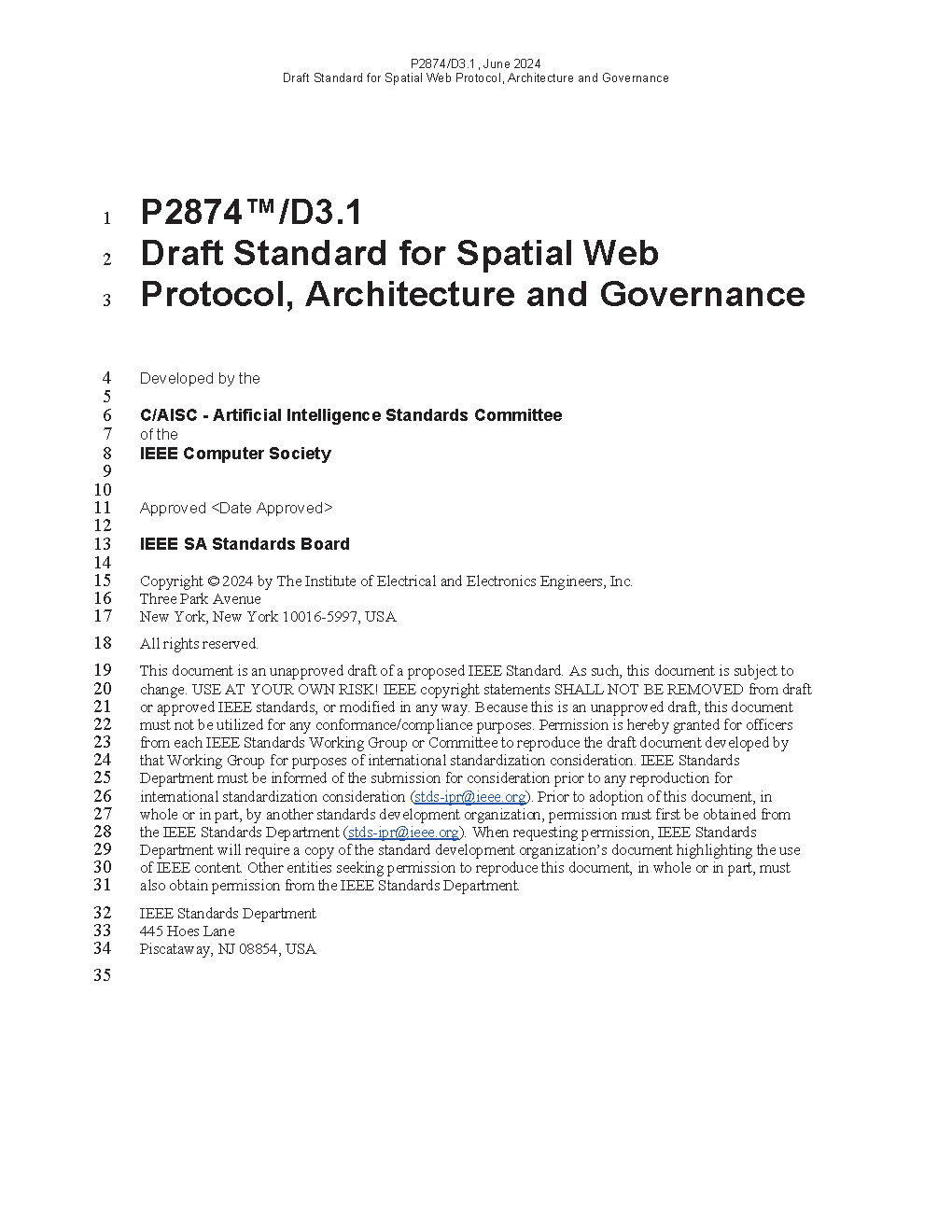
IEEE Draft Standard for Spatial Web Protocol, Architecture and Governance

Summary
New IEEE Standard - Active - Draft.
This standard describes the services, hypergraphs, protocols, and languages that enable interoperable, semantically compatible connections between network-connected hardware (e.g. autonomous drones, sensors, loT devices, robots) and software (e.g. user agents, services, platforms, applications, artificial intelligence systems) and includes specifications for: ?a functional layer stack capable of fulfilling spatially defined real-world and virtual requests for digital content respectful of governance authorities and self-sovereign identity ?a spatial range query and response format for requesting content or data about assets within a dimensional range ?a data ontology for describing objects, relationships, and activities ?a verifiable credentialing and certification method for permissioning create-retrieve-update-delete access to devices, locations, users, and data ?a human and machine-readable contracting language that enables the expression and automated execution of legal, financial, and physical activities This standard is identical in content to a base document developed by the Spatial Web Foundation and provided to the lEEE P2874 Spatial Web, Architecture and Governance Working Group for standardization.
This standard provides the key concepts of a Spatial Web framework, the relevant terms and their definitions, and a generalized system protocol, architecture, and governance that together serve as a reference model for Spatial Web components, systems, services and specifications.
As a reference model, this standard establishes the set of required modules and sub-modules and their minimum functions, the associated information content and the information models to be provided and/or supported by a Standards-based Spatial Web compliant implementation.
This standard defines requirements for a set of Implementation Specifications to be developed for the Spatial Web.
In addition, this standard identifies existing technologies and standards to be integrated into Spatial Web-compliant implementations.
The purpose of this standard is to provide a holistic and coherent technical framework for the implementation of a collaborative, interactive Spatial Web and shared world system.
This standard describes the services, hypergraphs, protocols, and languages that enable interoperable, semantically compatible connections between network-connected hardware (e.g. autonomous drones, sensors, loT devices, robots) and software (e.g. user agents, services, platforms, applications, artificial intelligence systems) and includes specifications for: ?a functional layer stack capable of fulfilling spatially defined real-world and virtual requests for digital content respectful of governance authorities and self-sovereign identity ?a spatial range query and response format for requesting content or data about assets within a dimensional range ?a data ontology for describing objects, relationships, and activities ?a verifiable credentialing and certification method for permissioning create-retrieve-update-delete access to devices, locations, users, and data ?a human and machine-readable contracting language that enables the expression and automated execution of legal, financial, and physical activities This standard is identical in content to a base document developed by the Spatial Web Foundation and provided to the lEEE P2874 Spatial Web, Architecture and Governance Working Group for standardization.
This standard provides the key concepts of a Spatial Web framework, the relevant terms and their definitions, and a generalized system protocol, architecture, and governance that together serve as a reference model for Spatial Web components, systems, services and specifications.
As a reference model, this standard establishes the set of required modules and sub-modules and their minimum functions, the associated information content and the information models to be provided and/or supported by a Standards-based Spatial Web compliant implementation.
This standard defines requirements for a set of Implementation Specifications to be developed for the Spatial Web.
In addition, this standard identifies existing technologies and standards to be integrated into Spatial Web-compliant implementations.
The purpose of this standard is to provide a holistic and coherent technical framework for the implementation of a collaborative, interactive Spatial Web and shared world system.
Notes
Active
Technical characteristics
| Publisher | Institute of Electrical and Electronics Engineers (IEEE) |
| Publication Date | 03/12/2025 |
| Page Count | 170 |
| EAN | --- |
| ISBN | --- |
| Weight (in grams) | --- |
| Brochures |

|
No products.
Previous versions
12/03/2025
Active
Most Recent
07/06/2024
Superseded
Historical