Active
Standard
Most Recent
IEEE N42.12:1994
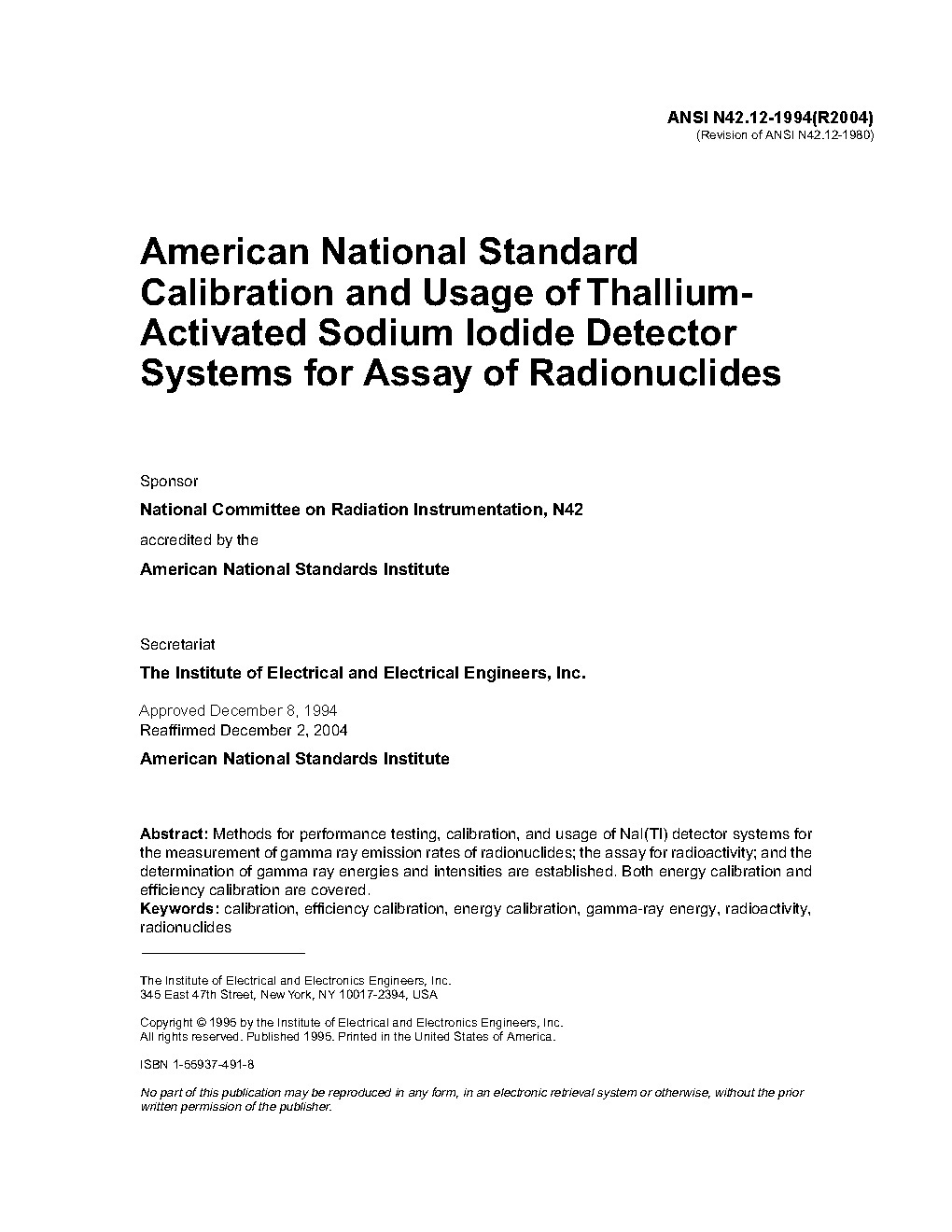
American National Standard Calibration and Usage of Thallium-Activated Sodium Iodide Detector Systems for Assay of Radionuclides

Summary
New IEEE Standard - Active.
Methods for performance testing, calibration, and usage of NaI(Tl) detector systems for the measurement of gamma ray emission rates of radionuclides; the assay for radioactivity; and the
determination of gamma ray energies and intensities are established. Both energy calibration and
efficiency calibration are covered.
This standard establishes methods for performance testing, calibration, and usage of thallium-activated sodium iodide [NaI(Tl)] detector systems for the measurement of gamma ray emission rates of radionuclides; the assay for radioactivity; and the determination of gamma ray energies and intensities. It covers both energy calibration and efficiency calibration. The following three techniques are considered:
a) Total spectrum counting (see 4.1) employs a system that counts all pulses above a low-energy
threshold (see 6.1, 6.2, and 6.3).
b) Single-channel analyzer (SCA) counting (see 4.2) employs a system with a counting “window,” which establishes upper and lower energy boundaries (see 6.1, 6.2, and 6.3).
c) Multichannel analyzer (MCA) counting (see 4.3) employs a system in which multiple counting windows are utilized. This technique allows measurements for which the continuum under the full energy peak may be subtracted without introducing unacceptable error.
In case of overlapping peaks in the spectrum, it is realized that an MCA with access to a spectrum-stripping program is necessary. Such cases are not covered by this standard.
The purpose of this document is to provide a standardized basis for the calibration and usage of sodium
iodide detector systems for the measurement of gamma ray emission rates of radionuclides. Typical applications include radionuclide identification and assay in various industrial, environmental, and medical applications. An NaI(Tl) detector system consists of three major components: a scintillating medium that produces a flash of light when ionizing radiation interacts with it; one or more photo multipliers, optically coupled to the scintillator, which converts the light flash to an amplified electrical impulse; and associated electronic instrumentation that powers the photomultiplier and processes the output signal. (See IEEE Std 398-1972. The theory of operation of NaI(Tl) detectors is presented in numerous publications, including [B3], [B5], and [B9] in clause 7
Methods for performance testing, calibration, and usage of NaI(Tl) detector systems for the measurement of gamma ray emission rates of radionuclides; the assay for radioactivity; and the
determination of gamma ray energies and intensities are established. Both energy calibration and
efficiency calibration are covered.
This standard establishes methods for performance testing, calibration, and usage of thallium-activated sodium iodide [NaI(Tl)] detector systems for the measurement of gamma ray emission rates of radionuclides; the assay for radioactivity; and the determination of gamma ray energies and intensities. It covers both energy calibration and efficiency calibration. The following three techniques are considered:
a) Total spectrum counting (see 4.1) employs a system that counts all pulses above a low-energy
threshold (see 6.1, 6.2, and 6.3).
b) Single-channel analyzer (SCA) counting (see 4.2) employs a system with a counting “window,” which establishes upper and lower energy boundaries (see 6.1, 6.2, and 6.3).
c) Multichannel analyzer (MCA) counting (see 4.3) employs a system in which multiple counting windows are utilized. This technique allows measurements for which the continuum under the full energy peak may be subtracted without introducing unacceptable error.
In case of overlapping peaks in the spectrum, it is realized that an MCA with access to a spectrum-stripping program is necessary. Such cases are not covered by this standard.
The purpose of this document is to provide a standardized basis for the calibration and usage of sodium
iodide detector systems for the measurement of gamma ray emission rates of radionuclides. Typical applications include radionuclide identification and assay in various industrial, environmental, and medical applications. An NaI(Tl) detector system consists of three major components: a scintillating medium that produces a flash of light when ionizing radiation interacts with it; one or more photo multipliers, optically coupled to the scintillator, which converts the light flash to an amplified electrical impulse; and associated electronic instrumentation that powers the photomultiplier and processes the output signal. (See IEEE Std 398-1972. The theory of operation of NaI(Tl) detectors is presented in numerous publications, including [B3], [B5], and [B9] in clause 7
Notes
Active
Technical characteristics
| Publisher | Institute of Electrical and Electronics Engineers (IEEE) |
| Publication Date | 01/26/1995 |
| Cancellation Date | 01/26/1995 |
| Page Count | 20 |
| EAN | --- |
| ISBN | --- |
| Weight (in grams) | --- |
| Brochures |

|
No products.
Previous versions
21/11/1980
Superseded
, Confirmed
Historical