
Active
Standard
Most Recent
IEEE/ISO/IEC 31320-1:2012
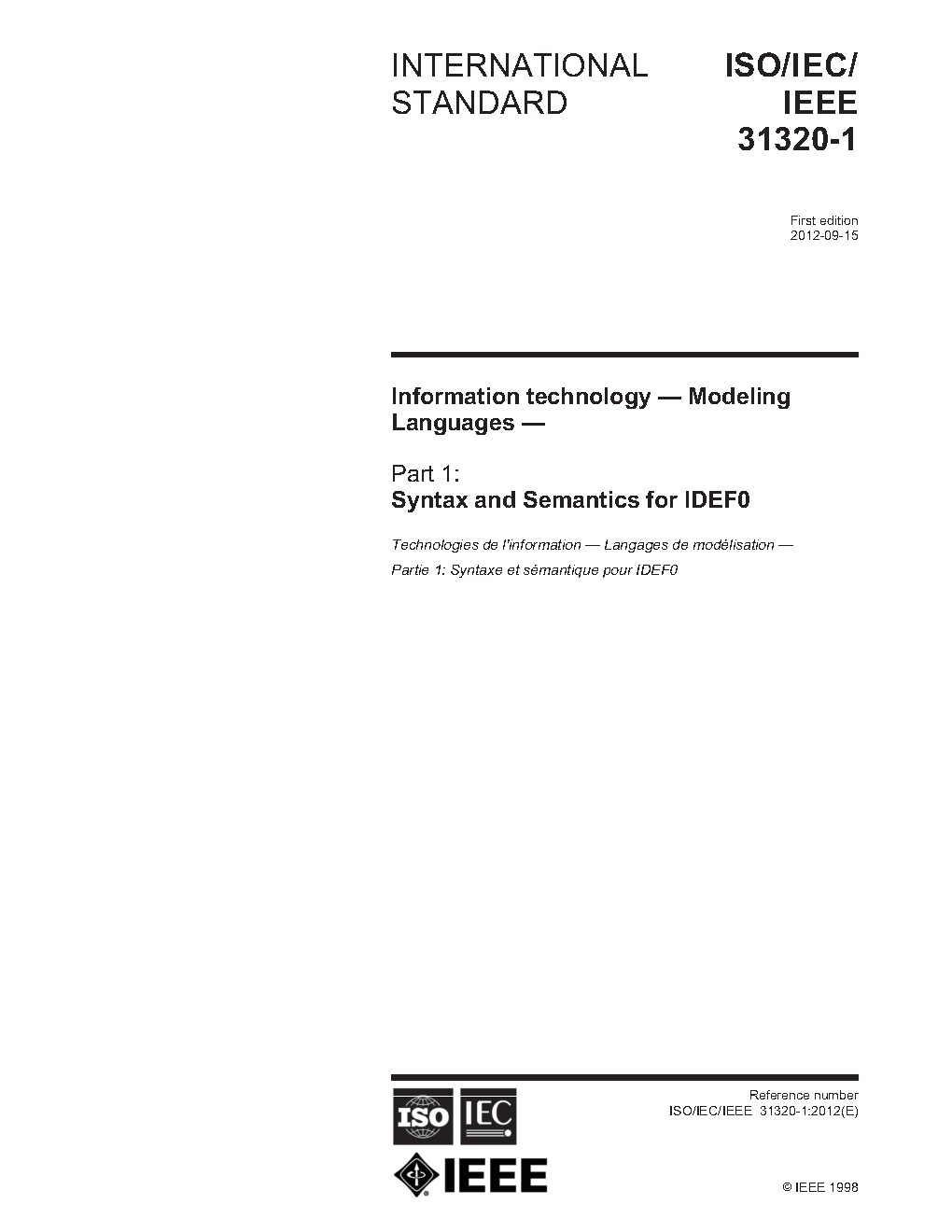
ISO/IEC/IEEE International Standard - Information technology -- Modeling Languages -- Part 1: Syntax and Semantics for IDEF0

Summary
Adoption Standard - Active.
IDEF0 function modeling is designed to represent the decisions, actions, and activities
of an existing or prospective organization or system. IDEF0 graphics and accom-panying texts
are presented in an organized and systematic way to gain understanding, support analysis,
provide logic for potential changes, specify requirements, and support system-level design and
integration activities. IDEF0 may be used to model a wide variety of systems, composed of
people, machines, materials, computers, and information of all varieties and structured by the
relationships among them, both automated and nonautomated. For new systems, IDEF0 may be
used first to define requirements and to specify functions to be carried out by the future system.
As the basis of this architecture, IDEF0 may then be used to design an implementation that
meets these requirements and performs these functions. For existing systems, IDEF0 can be
used to analyze the functions that the system performs and to record the means by which these
are done.
The body of the standard describes the modeling language (syntax and semantics) that supports the IDEF0 method for developing graphical representations of a system or subject area. The clauses that follow govern the physical construction of IDEF0 models that represent functions, functional relationships, and the physical and data objects required by those relationships. This part of the document is divided into 10 clauses. Clause 1 provides an overview of this part of the
standard. Clause 2 defines key terms. Clause 3 discusses the concept of an IDEF0 model. Clause 4 defines
the syntax of the IDEF0 language. Clause 5 defines the semantics of the language. Clause 6 describes the
different types of IDEF0 diagrams. Clause 7 presents the different types of IDEF0 model pages. Clause 8 provides details on the various features of an IDEF0 diagram. Clause 9 defines IDEF0 reference expressions. Finally, Clause 10 defines IDEF0 diagram feature references.
Documentation of best commercial practices and guides to recommended usage are beyond the scope of
this document.
The objectives of this part of the standard are to prescribe the construction and components of an IDEF0 model and to define the correct syntax and semantics for construction of an IDEF0 diagram within an IDEF0 model.
IDEF0 function modeling is designed to represent the decisions, actions, and activities
of an existing or prospective organization or system. IDEF0 graphics and accom-panying texts
are presented in an organized and systematic way to gain understanding, support analysis,
provide logic for potential changes, specify requirements, and support system-level design and
integration activities. IDEF0 may be used to model a wide variety of systems, composed of
people, machines, materials, computers, and information of all varieties and structured by the
relationships among them, both automated and nonautomated. For new systems, IDEF0 may be
used first to define requirements and to specify functions to be carried out by the future system.
As the basis of this architecture, IDEF0 may then be used to design an implementation that
meets these requirements and performs these functions. For existing systems, IDEF0 can be
used to analyze the functions that the system performs and to record the means by which these
are done.
The body of the standard describes the modeling language (syntax and semantics) that supports the IDEF0 method for developing graphical representations of a system or subject area. The clauses that follow govern the physical construction of IDEF0 models that represent functions, functional relationships, and the physical and data objects required by those relationships. This part of the document is divided into 10 clauses. Clause 1 provides an overview of this part of the
standard. Clause 2 defines key terms. Clause 3 discusses the concept of an IDEF0 model. Clause 4 defines
the syntax of the IDEF0 language. Clause 5 defines the semantics of the language. Clause 6 describes the
different types of IDEF0 diagrams. Clause 7 presents the different types of IDEF0 model pages. Clause 8 provides details on the various features of an IDEF0 diagram. Clause 9 defines IDEF0 reference expressions. Finally, Clause 10 defines IDEF0 diagram feature references.
Documentation of best commercial practices and guides to recommended usage are beyond the scope of
this document.
The objectives of this part of the standard are to prescribe the construction and components of an IDEF0 model and to define the correct syntax and semantics for construction of an IDEF0 diagram within an IDEF0 model.
Notes
Active
Technical characteristics
| Publisher | Institute of Electrical and Electronics Engineers (IEEE) |
| Publication Date | 10/30/2012 |
| Edition | |
| Page Count | 120 |
| EAN | --- |
| ISBN | --- |
| Weight (in grams) | --- |
| Brochures |

|
No products.