Active
, Confirmed
Standard
Most Recent
IEEE/ISO 11073-30300:2004 (R2010)
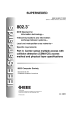
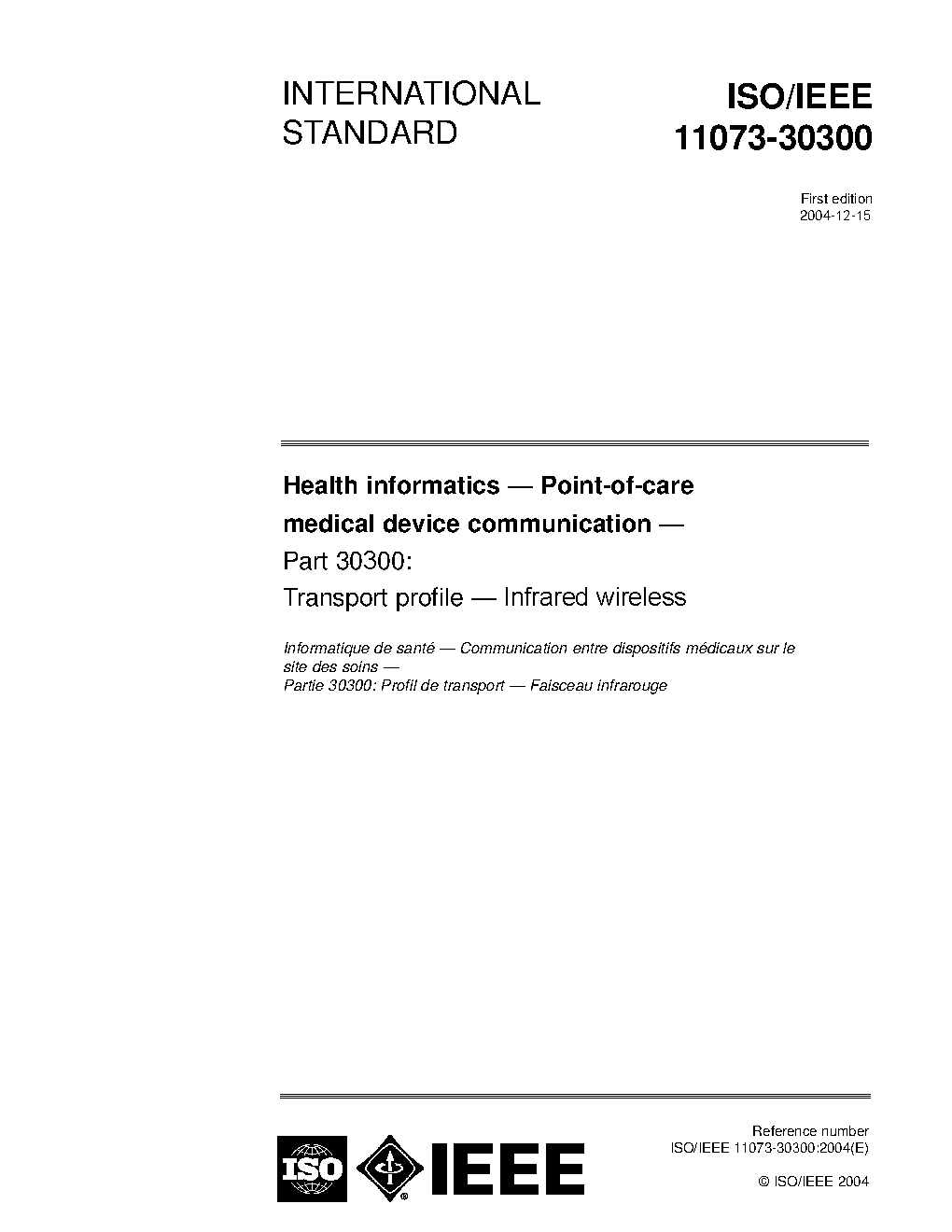
ISO/IEEE International Standard Health informatics - Point-of-care medical device communication - Transport profile - Infrared

Summary
New IEEE Standard - Active.
This standard establishes a connection-oriented transport profile and physical layer
suitable for medical device communications that use short-range infrared wireless. This standard
defines communications services and protocols that are consistent with specifications of the
Infrared Data Association (IrDA) and are optimized for point-of-care (POC) applications at or near
the patient.
The scope of this standard is to define an IrDA-based transport profile for medical device communication that uses short-range infrared, as a companion standard to ISO/IEEE 11073-30200, which specifies a cable connected physical layer. This standard also supports use cases consistent with industry practice for handheld personal digital assistants (PDAs) and network APs that support IrDA-infrared communication.
The purpose of this standard is to provide connection-oriented communication services and protocols consistent with IrDA specifications, using short-range infrared as the physical layer. This standard extends and complements ISO/IEEE 11073-30200, which specifies a cable-connected physical layer. The use of IrDA infrared is appropriate for mobile and portable point-of-care (POC) clinical lab instruments (e.g., glucose meters) and other medical devices that require intermittent point-and-shoot connectivity to a data repository.
This standard utilizes the work embodied in the Connectivity Industry Consortium (CIC) and
NCCLS POCT1 device and AP interface specification (Appendix A), which is part of an overall effort to
standardize communication for POC medical devices using a single transport protocol (IrDA Tiny Transport
Protocol [TinyTP]) running over two physical layers: cable-connected and infrared.
This standard establishes a connection-oriented transport profile and physical layer
suitable for medical device communications that use short-range infrared wireless. This standard
defines communications services and protocols that are consistent with specifications of the
Infrared Data Association (IrDA) and are optimized for point-of-care (POC) applications at or near
the patient.
The scope of this standard is to define an IrDA-based transport profile for medical device communication that uses short-range infrared, as a companion standard to ISO/IEEE 11073-30200, which specifies a cable connected physical layer. This standard also supports use cases consistent with industry practice for handheld personal digital assistants (PDAs) and network APs that support IrDA-infrared communication.
The purpose of this standard is to provide connection-oriented communication services and protocols consistent with IrDA specifications, using short-range infrared as the physical layer. This standard extends and complements ISO/IEEE 11073-30200, which specifies a cable-connected physical layer. The use of IrDA infrared is appropriate for mobile and portable point-of-care (POC) clinical lab instruments (e.g., glucose meters) and other medical devices that require intermittent point-and-shoot connectivity to a data repository.
This standard utilizes the work embodied in the Connectivity Industry Consortium (CIC) and
NCCLS POCT1 device and AP interface specification (Appendix A), which is part of an overall effort to
standardize communication for POC medical devices using a single transport protocol (IrDA Tiny Transport
Protocol [TinyTP]) running over two physical layers: cable-connected and infrared.
Notes
Active
Technical characteristics
| Publisher | Institute of Electrical and Electronics Engineers (IEEE) |
| Publication Date | 12/15/2004 |
| Confirmation Date | 03/25/2010 |
| Cancellation Date | 12/15/2004 |
| Edition | |
| Page Count | 73 |
| EAN | --- |
| ISBN | --- |
| Weight (in grams) | --- |
| Brochures |

|
No products.
Previous versions
15/12/2004
Active
, Confirmed
Most Recent