Active
Standard
Most Recent
IEEE/IEC 62704-3:2017
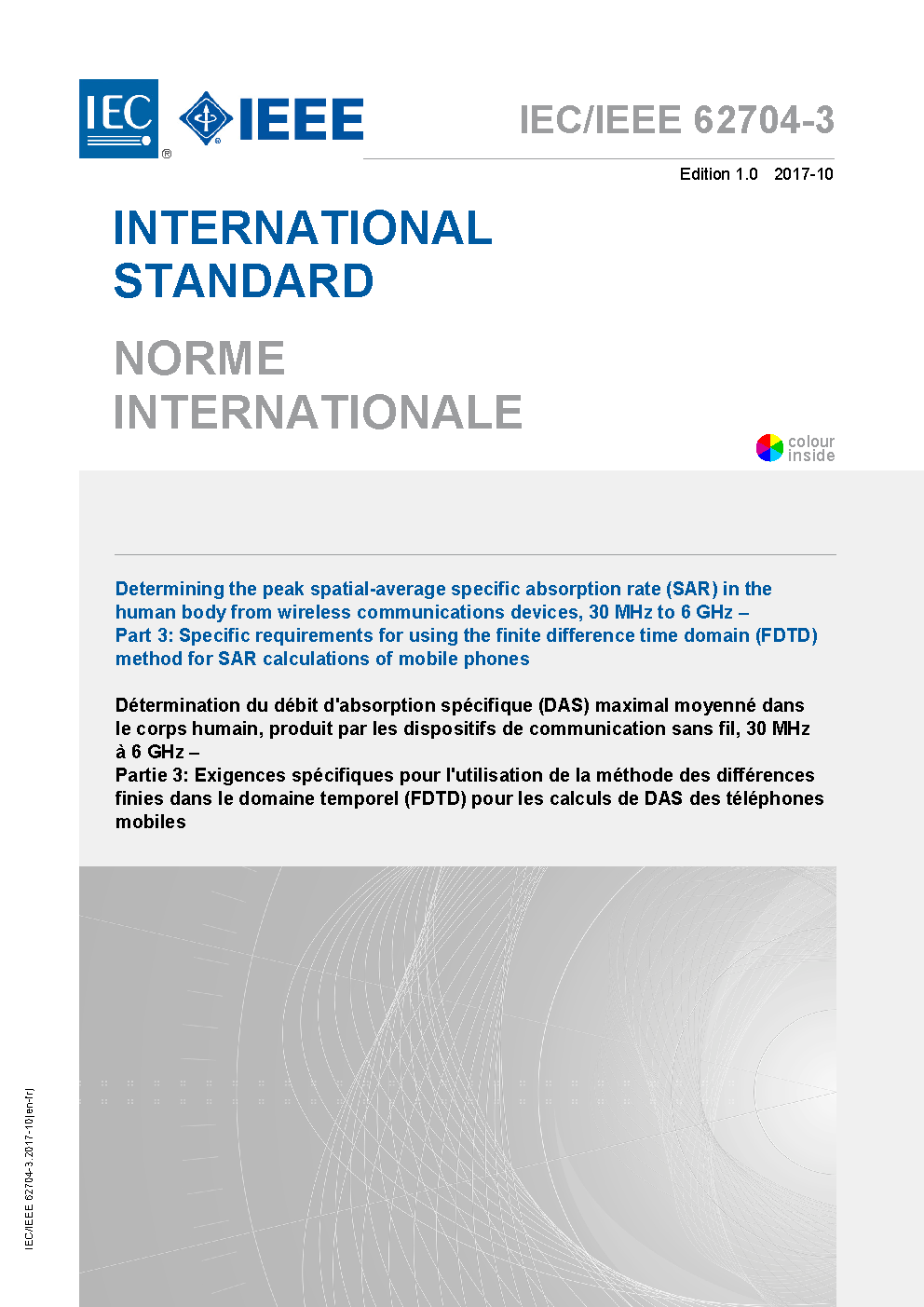
Determining the Peak Spatial-Average Specific Absorption Rate (SAR) in the Human Body from Wireless Communications Devices, 30 MHz - 6 GHz Part 3: Specific Requirements for Using the Finite Difference Time Domain (FDTD) Method for SAR Calculations of Mobile Phones

Summary
New IEEE Standard - Active.
The project defines the concepts, techniques, benchmark phone models, validation procedures, uncertainties and limitations of the finite difference time domain (FDTD) technique when used for determining the peak spatial-average specific absorption rate (SAR) in standardized head and body phantoms exposed to the electromagnetic fields generated by wireless communication devices, in particular pre-compliance assessment of mobile phones, in the frequency range from 30 MHz to 6 GHz. It recommends and provides guidance on the numerical modelling of mobile phones and benchmark results to verify the general approach for the numerical simulations of such devices. It defines acceptable modeling requirements, guidance on meshing and test positions of the mobile phone and the phantom models. This document does not recommend specific SAR limits since these are found in other documents, e.g., IEEE C95.1-2005 and ICNIRP.
This standard will not contain a purpose clause
The project defines the concepts, techniques, benchmark phone models, validation procedures, uncertainties and limitations of the finite difference time domain (FDTD) technique when used for determining the peak spatial-average specific absorption rate (SAR) in standardized head and body phantoms exposed to the electromagnetic fields generated by wireless communication devices, in particular pre-compliance assessment of mobile phones, in the frequency range from 30 MHz to 6 GHz. It recommends and provides guidance on the numerical modelling of mobile phones and benchmark results to verify the general approach for the numerical simulations of such devices. It defines acceptable modeling requirements, guidance on meshing and test positions of the mobile phone and the phantom models. This document does not recommend specific SAR limits since these are found in other documents, e.g., IEEE C95.1-2005 and ICNIRP.
This standard will not contain a purpose clause
Notes
Active
Technical characteristics
| Publisher | Institute of Electrical and Electronics Engineers (IEEE) |
| Publication Date | 10/27/2017 |
| Edition | |
| Page Count | 76 |
| EAN | --- |
| ISBN | --- |
| Weight (in grams) | --- |
| Brochures |

|
No products.