Active
Standard
Most Recent
IEEE C93.3:2017
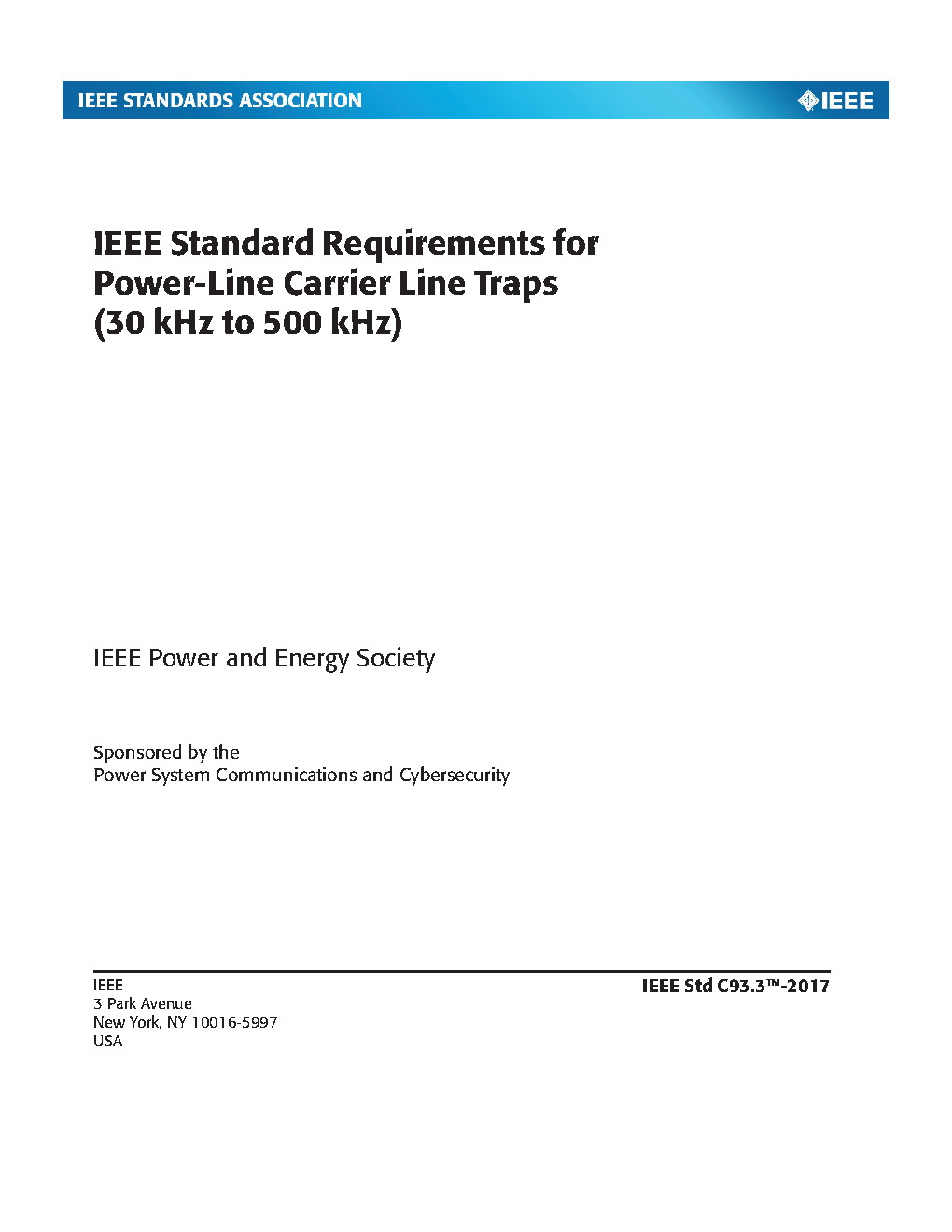
IEEE Standard Requirements for Power-Line Carrier Line Traps (30 kHz to 500 kHz)

Summary
New IEEE Standard - Active.
Line traps inserted into a power line to provide a high impedance at power-line-carrier frequencies (30 kHz to 500 kHz) are covered in this standard. The purpose is to isolate the carrier signal from system impedance changes due to faults or switching behind the point of insertion, and to guide the signal in the proper direction. The standard covers line traps in which the main coil is designed as a single-phase, air-cooled inductor of the dry type.
This standard applies to a line trap inserted into a power line to provide a high impedance at power line carrier frequencies (30 kHz to 500 kHz). The purpose is to isolate the carrier signal from system impedance changes due to faults or switching behind the point of insertion, and to guide the signal in the proper direction. The standard covers line traps in which the main coil is designed as a single-phase, air-cooled inductor of the dry type.
This standard is vital to the application of power line carrier systems on all power lines 69 kV and above. Power-line carrier systems are used for protection systems and other communications. The line trap is part of the system that allows the carrier signal to be coupled to the power line with optimal performance. Performance requirements will be established so that their interaction with the power system is known and performance can be predicted.
Line traps inserted into a power line to provide a high impedance at power-line-carrier frequencies (30 kHz to 500 kHz) are covered in this standard. The purpose is to isolate the carrier signal from system impedance changes due to faults or switching behind the point of insertion, and to guide the signal in the proper direction. The standard covers line traps in which the main coil is designed as a single-phase, air-cooled inductor of the dry type.
This standard applies to a line trap inserted into a power line to provide a high impedance at power line carrier frequencies (30 kHz to 500 kHz). The purpose is to isolate the carrier signal from system impedance changes due to faults or switching behind the point of insertion, and to guide the signal in the proper direction. The standard covers line traps in which the main coil is designed as a single-phase, air-cooled inductor of the dry type.
This standard is vital to the application of power line carrier systems on all power lines 69 kV and above. Power-line carrier systems are used for protection systems and other communications. The line trap is part of the system that allows the carrier signal to be coupled to the power line with optimal performance. Performance requirements will be established so that their interaction with the power system is known and performance can be predicted.
Notes
Active
Technical characteristics
| Publisher | Institute of Electrical and Electronics Engineers (IEEE) |
| Publication Date | 08/01/2017 |
| Edition | |
| Page Count | 46 |
| EAN | --- |
| ISBN | --- |
| Weight (in grams) | --- |
| Brochures |

|
Amendments replaces
01/01/1995
Superseded
Historical
Previous versions
01/08/2017
Active
Most Recent
01/01/1995
Superseded
Historical