
Superseded
, Confirmed
Standard
Historical
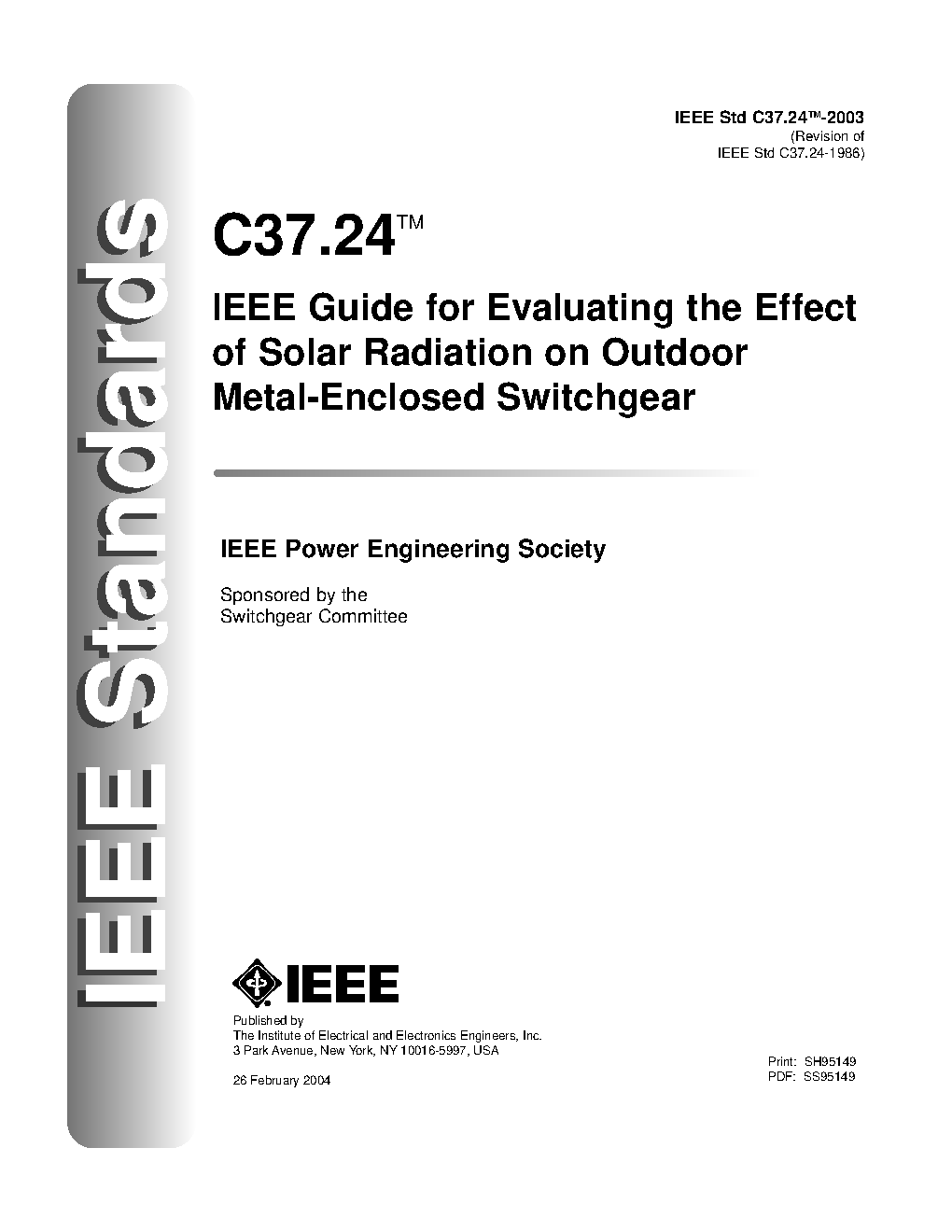
IEEE C37.24:2003 (R2008)
IEEE Guide for Evaluating the Effect of Solar Radiation on Outdoor Metal-Enclosed Switchgear

Summary
Revision Standard - Superseded.
This guide provides information to assist in evaluating the effect of solar radiation on outdoor metal-enclosed switchgear including metal-enclosed bus and control switchboards. Specific data are given in the form of a continuous current capability factor for specific maximum monthly normal temperatures at the installation location, to adjust the continuous current capability of outdoor metal-enclosed switchgear to the solar radiation condition required. Tables of maximum monthly normal temperatures at various locations in the US and Canada are provided.
The general information in this Guide is intended to assist in evaluating the effect of solar radiation on outdoor metal-enclosed switchgear and is applicable to outdoor metal-enclosed power switchgear, control switchboards and metal-enclosed bus. Specific data are given in current temperature relationship and tabulation form for outdoor metal-enclosed low-voltage power circuit breaker switchgear, outdoor metal-clad switchgear and outdoor metal-enclosed interrupter switchgear.
Switchgear will perform satisfactorily and have a reasonable life when operated within the temperature limits estab-lished in ANSI/IEEE C37.20.1, C37.20.2, C37.20.3, C37.21 and C37.23. These standards specify the temperature rise limits above a standard (maximum) ambient temperature of 40 ?C. This is satisfactory for indoor applications where the temperature rise is due entirely to heat release (internal losses). In outdoor applications, the limiting tem-peratures result from the net effect of internal losses and external influences, principally the sun, wind and local am-bient temperatures. All of these must be considered in determining the current-carrying capacity of outdoor metal-enclosed switchgear. The magnitude of these factors will vary geographically and from season to season. The time relationship of maxi-mum circuit loads with respect to maximum ambient temperature is important. It is not practical to design switch-gear on the basis that all adverse factors reach their maxima coincident with maximum loads. If this does not occur, full current ratings may be realized. Recommendations will be made to point out the cumulative effect of these various influences.
This guide provides information to assist in evaluating the effect of solar radiation on outdoor metal-enclosed switchgear including metal-enclosed bus and control switchboards. Specific data are given in the form of a continuous current capability factor for specific maximum monthly normal temperatures at the installation location, to adjust the continuous current capability of outdoor metal-enclosed switchgear to the solar radiation condition required. Tables of maximum monthly normal temperatures at various locations in the US and Canada are provided.
The general information in this Guide is intended to assist in evaluating the effect of solar radiation on outdoor metal-enclosed switchgear and is applicable to outdoor metal-enclosed power switchgear, control switchboards and metal-enclosed bus. Specific data are given in current temperature relationship and tabulation form for outdoor metal-enclosed low-voltage power circuit breaker switchgear, outdoor metal-clad switchgear and outdoor metal-enclosed interrupter switchgear.
Switchgear will perform satisfactorily and have a reasonable life when operated within the temperature limits estab-lished in ANSI/IEEE C37.20.1, C37.20.2, C37.20.3, C37.21 and C37.23. These standards specify the temperature rise limits above a standard (maximum) ambient temperature of 40 ?C. This is satisfactory for indoor applications where the temperature rise is due entirely to heat release (internal losses). In outdoor applications, the limiting tem-peratures result from the net effect of internal losses and external influences, principally the sun, wind and local am-bient temperatures. All of these must be considered in determining the current-carrying capacity of outdoor metal-enclosed switchgear. The magnitude of these factors will vary geographically and from season to season. The time relationship of maxi-mum circuit loads with respect to maximum ambient temperature is important. It is not practical to design switch-gear on the basis that all adverse factors reach their maxima coincident with maximum loads. If this does not occur, full current ratings may be realized. Recommendations will be made to point out the cumulative effect of these various influences.
Notes
Superseded
Technical characteristics
| Publisher | Institute of Electrical and Electronics Engineers (IEEE) |
| Publication Date | 02/26/2004 |
| Confirmation Date | 06/12/2008 |
| Edition | |
| Page Count | 30 |
| EAN | --- |
| ISBN | --- |
| Weight (in grams) | --- |
| Brochures |

|
Amendments replaces
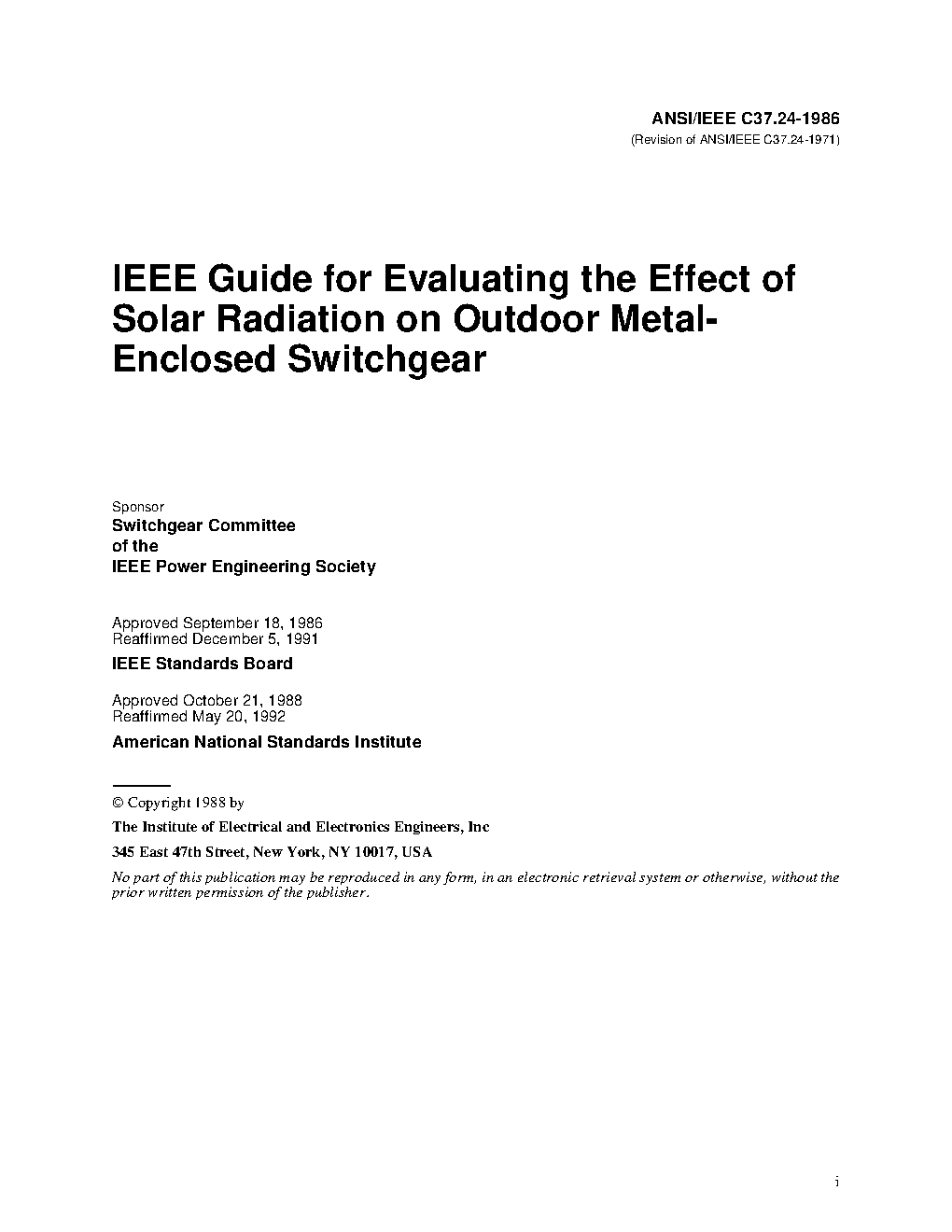
29/03/1988
Superseded
, Confirmed
Historical
Previous versions
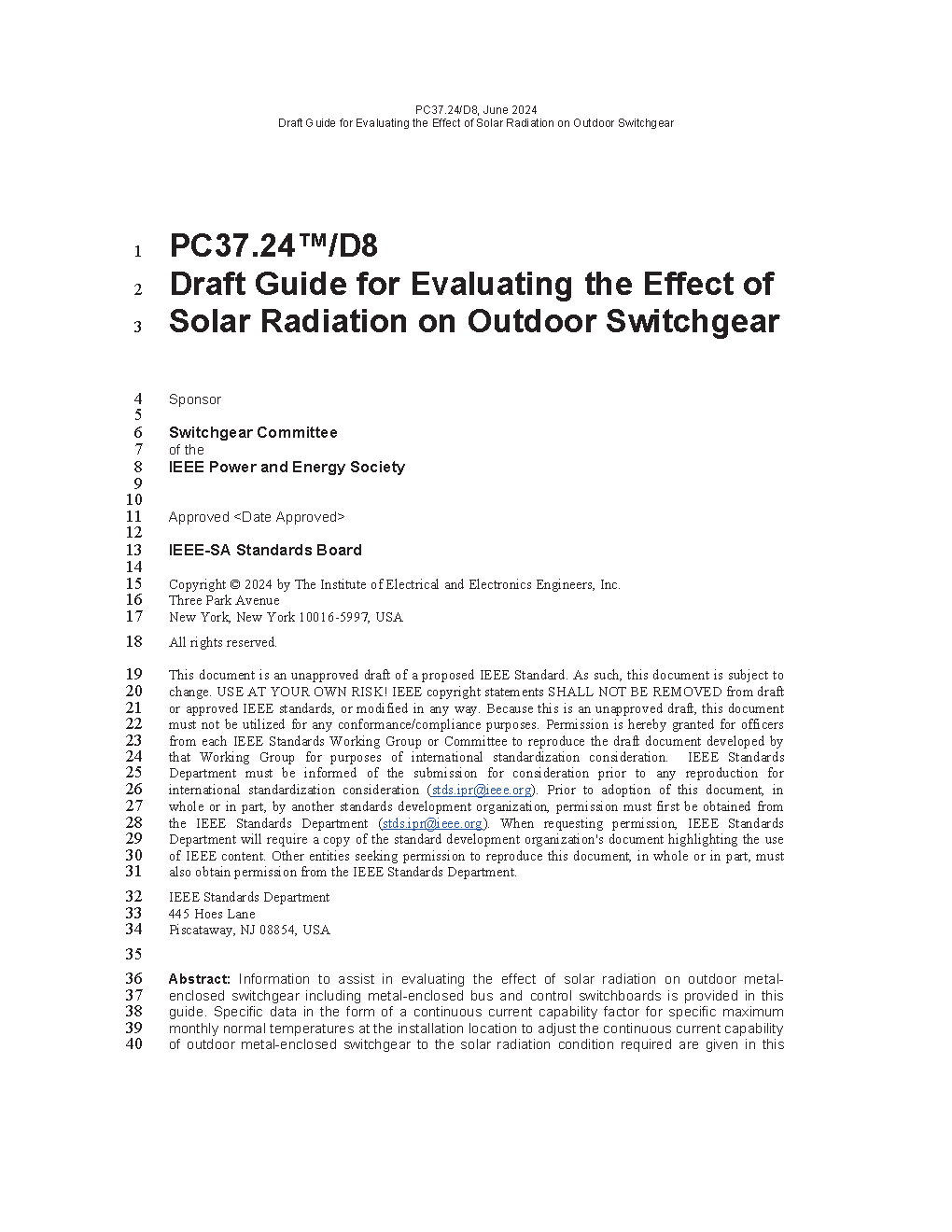
08/06/2024
Active
Most Recent
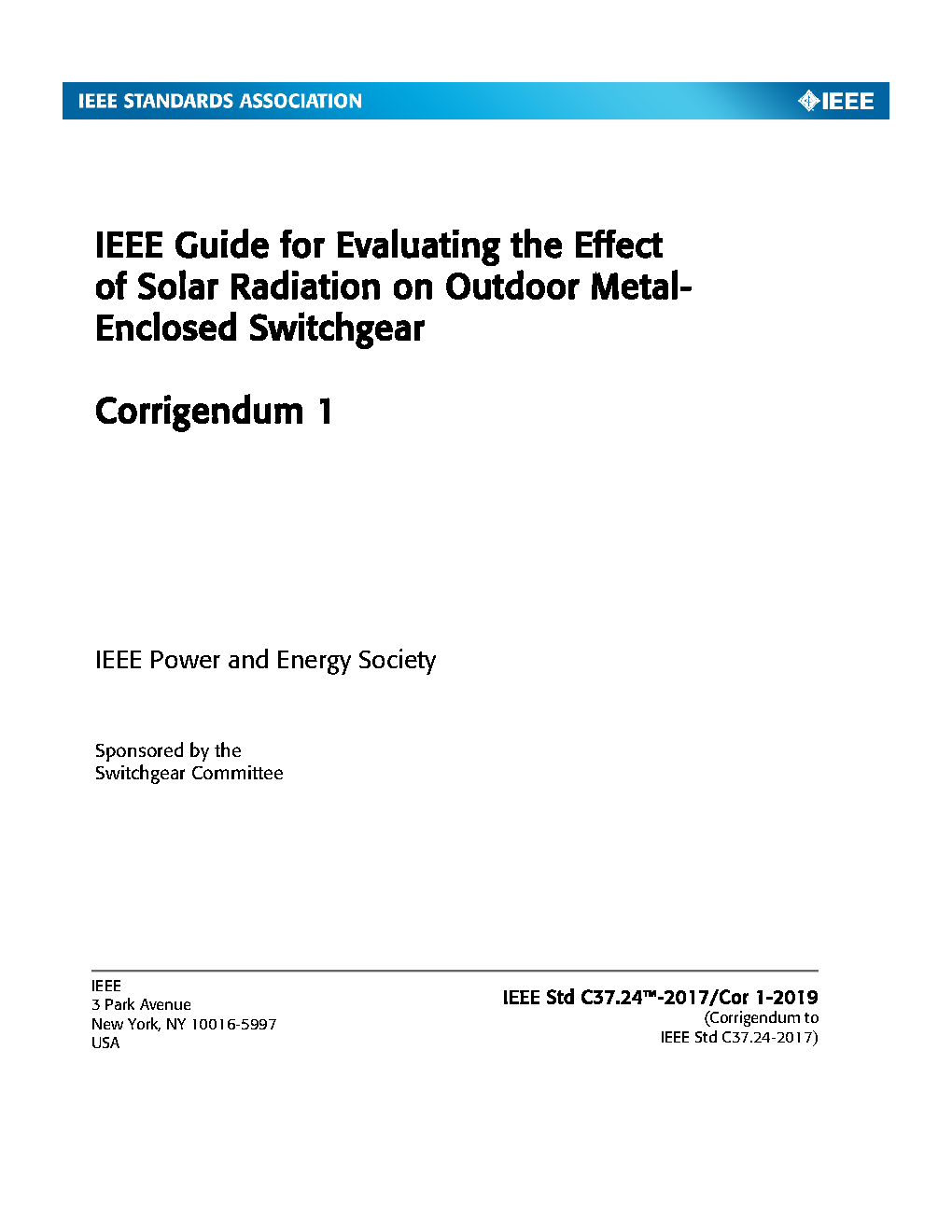

28/08/2017
Active
, Modified
Most Recent
26/02/2004
Superseded
, Confirmed
Historical
29/03/1988
Superseded
, Confirmed
Historical