
Superseded
, Confirmed
Standard
Historical
IEEE/ANSI N323:1978 (R1983)
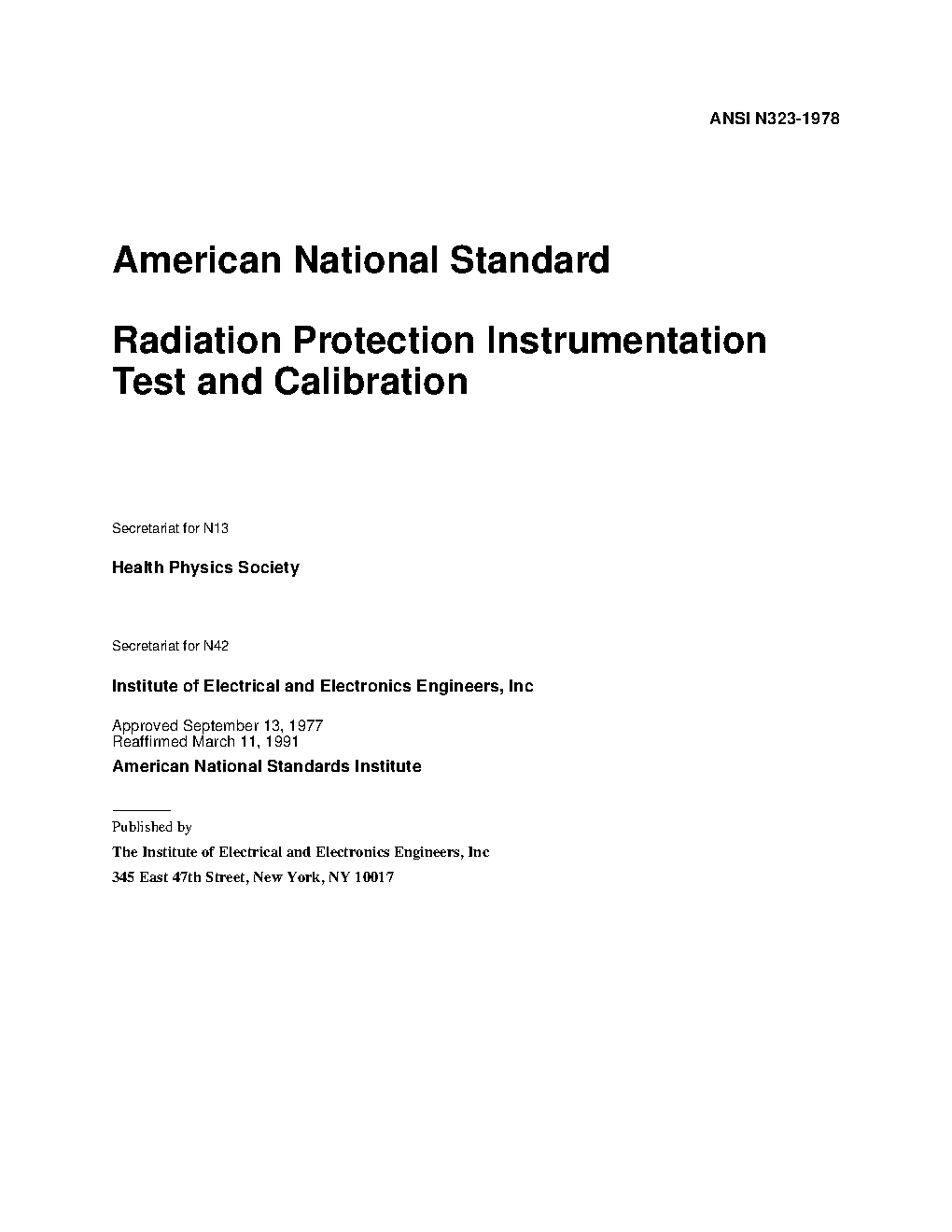
American National Standard Radiation Protection Instrumentation Test and Calibration

Summary
New IEEE Standard - Superseded.
Calibration methods for portable (hand-carried) radiation protection instruments used for detection and measurement of levels of ionizing radiation fields or levels of radioactive surface contamination are established. Included are conditions, equipment, and techniques for calibration as well as the degree of precision and accuracy required. Alpha, beta, photon, and neutron radiation is considered. Passive integrating dosimetric devices such as film, theremoluminescent, and chemical dosimeters are not covered, although the basic principles and intent may apply to them as well as to nonportable radiation detection instrumentation in general.
This standard establishes calibration methods for portable radiation protection instruments used for detection and measurement of levels of ionizing radiation fields or levels of radioactive surface contamination. For purposes of this standard, portable radiation protection instruments are those which are carried by hand to a specific facility or location for use. Although this standard is specific to portable radiation protection instrumentation, the basic calibration principles may be applicable to radiation detection instrumentation in general.
Included within the scope of this standard are conditions, equipment, and techniques for calibration as well as the degree of precision and accuracy required. Alpha, beta, photon, and neutron radiations are considered. Passive integrating dosimetric devices such as film, Thermoluminescent, and chemical dosimeters are outside the scope of this standard, but the basic principles and intent may apply. In cases where integrating capability is included along with rate measurement or detection, this standard shall apply.
Throughout these criteria, four verbs have been used to indicate the degree of rigor intended by the specific criterion.
“Shall” and “will” indicate a minimum criterion that must be met, while “should” and “would” indicate a criterion that is recommended as good practice and is to be applied when practical.
Calibration methods for portable (hand-carried) radiation protection instruments used for detection and measurement of levels of ionizing radiation fields or levels of radioactive surface contamination are established. Included are conditions, equipment, and techniques for calibration as well as the degree of precision and accuracy required. Alpha, beta, photon, and neutron radiation is considered. Passive integrating dosimetric devices such as film, theremoluminescent, and chemical dosimeters are not covered, although the basic principles and intent may apply to them as well as to nonportable radiation detection instrumentation in general.
This standard establishes calibration methods for portable radiation protection instruments used for detection and measurement of levels of ionizing radiation fields or levels of radioactive surface contamination. For purposes of this standard, portable radiation protection instruments are those which are carried by hand to a specific facility or location for use. Although this standard is specific to portable radiation protection instrumentation, the basic calibration principles may be applicable to radiation detection instrumentation in general.
Included within the scope of this standard are conditions, equipment, and techniques for calibration as well as the degree of precision and accuracy required. Alpha, beta, photon, and neutron radiations are considered. Passive integrating dosimetric devices such as film, Thermoluminescent, and chemical dosimeters are outside the scope of this standard, but the basic principles and intent may apply. In cases where integrating capability is included along with rate measurement or detection, this standard shall apply.
Throughout these criteria, four verbs have been used to indicate the degree of rigor intended by the specific criterion.
“Shall” and “will” indicate a minimum criterion that must be met, while “should” and “would” indicate a criterion that is recommended as good practice and is to be applied when practical.
Notes
Superseded
Technical characteristics
| Publisher | Institute of Electrical and Electronics Engineers (IEEE) |
| Publication Date | 05/26/1978 |
| Confirmation Date | 01/01/1983 |
| Edition | |
| Page Count | 22 |
| EAN | --- |
| ISBN | --- |
| Weight (in grams) | --- |
| Brochures |

|
No products.
Previous versions
26/05/1978
Superseded
, Confirmed
Historical