Superseded
Standard
Historical
IEEE/ANSI C63.5:1998
American National Standard for Calibration of Antennas Used for Radiated Emission Measurements in Electromagnetic Interference (EMI) Control Calibration of Antennas (9 kHz to 40 GHz)

Summary
New IEEE Standard - Superseded.
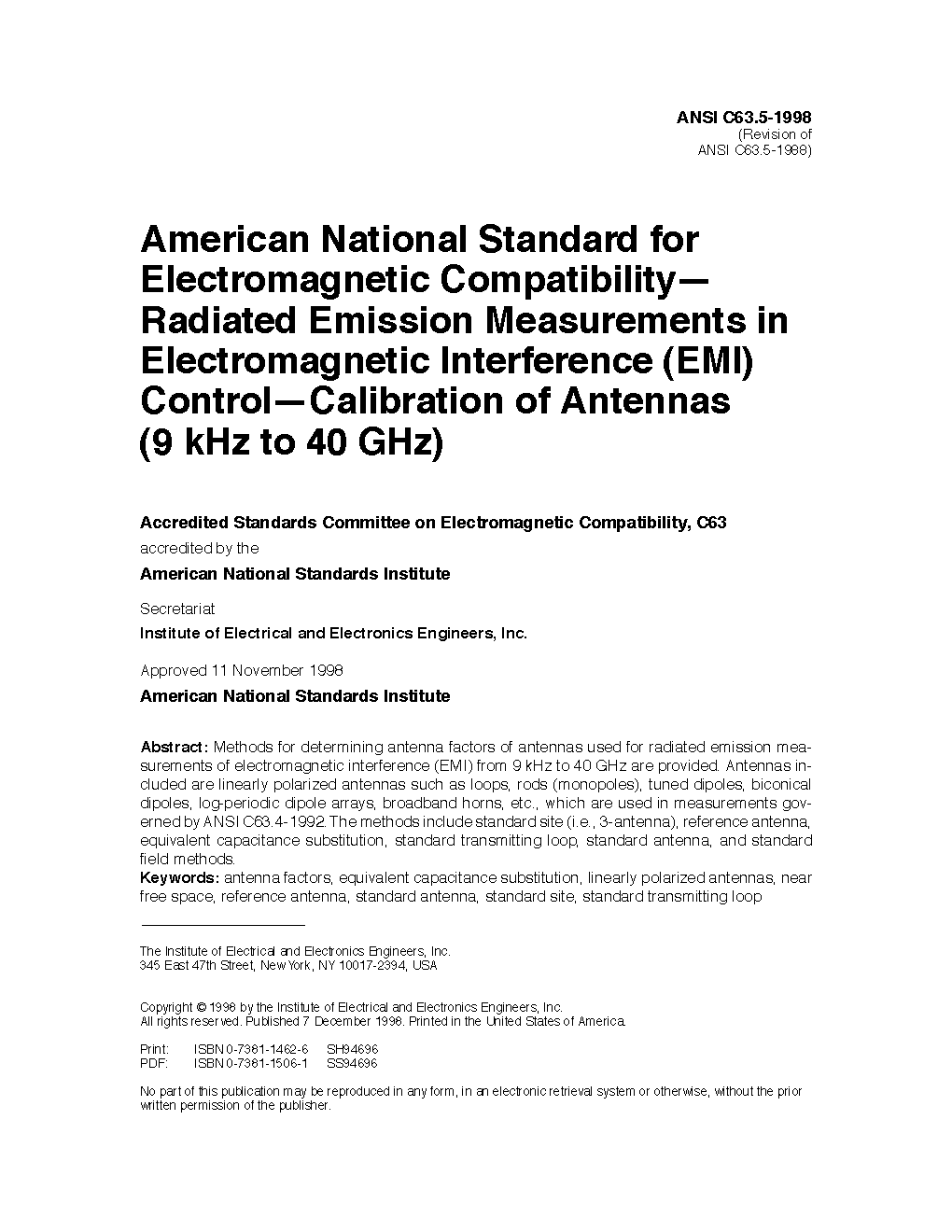
Methods for determining antenna factors of antennas used for radiated emission measurements of electromagnetic interference (EMI) from 9 kHz to 40 GHz are provided. Antennas included are linearly polarized antennas such as loops, rods (monopoles), tuned dipoles, biconicaldipoles, log-periodic dipole arrays, broadband horns, etc., which are used in measurements governed by ANSI C63.4-1992. The methods include standard site (i.e., 3-antenna), reference antenna, equivalent capacitance substitution, standard transmitting loop, standard antenna, and standard held methods.
This standard provides methods for determining antenna factors of antennas used for radiated emission measurements of electromagnetic interference (EMI) from 9 kHz to 40 GHz. Antennas included are linearly polarized antennas, such as loops, rods (monopoles), tuned dipoles, biconical dipoles, log-periodic dipole arrays, broadband horns, etc., that are used in measurements governed by ANSI C63.4-1992. The methods include standard site, reference antenna, equivalent capacitance substitution, standard transmitting loop, standard antenna, and standard Þeld methods. The latter three methods are incorporated by reference in 4.4. Harmonization of this standard with international standards is achieved by providing two sets of measurement geometries in the 30 MHz to 1000 MHz frequency range. One set of one measurement geometry is provided for calibrations to meet international requirements, and one set of four measurement geometries is provided for calibrations to meet US domestic requirements. The international measurement geometry and one of the four domestic measurement geometries are identical. The international geometry is the preferred calibration measurement geometry.
Methods for determining antenna factors of antennas used for radiated emission measurements of electromagnetic interference (EMI) from 9 kHz to 40 GHz are provided. Antennas included are linearly polarized antennas such as loops, rods (monopoles), tuned dipoles, biconicaldipoles, log-periodic dipole arrays, broadband horns, etc., which are used in measurements governed by ANSI C63.4-1992. The methods include standard site (i.e., 3-antenna), reference antenna, equivalent capacitance substitution, standard transmitting loop, standard antenna, and standard held methods.
This standard provides methods for determining antenna factors of antennas used for radiated emission measurements of electromagnetic interference (EMI) from 9 kHz to 40 GHz. Antennas included are linearly polarized antennas, such as loops, rods (monopoles), tuned dipoles, biconical dipoles, log-periodic dipole arrays, broadband horns, etc., that are used in measurements governed by ANSI C63.4-1992. The methods include standard site, reference antenna, equivalent capacitance substitution, standard transmitting loop, standard antenna, and standard Þeld methods. The latter three methods are incorporated by reference in 4.4. Harmonization of this standard with international standards is achieved by providing two sets of measurement geometries in the 30 MHz to 1000 MHz frequency range. One set of one measurement geometry is provided for calibrations to meet international requirements, and one set of four measurement geometries is provided for calibrations to meet US domestic requirements. The international measurement geometry and one of the four domestic measurement geometries are identical. The international geometry is the preferred calibration measurement geometry.
Notes
Superseded
Technical characteristics
| Publisher | Institute of Electrical and Electronics Engineers (IEEE) |
| Publication Date | 12/07/1998 |
| Edition | |
| Page Count | 40 |
| EAN | --- |
| ISBN | --- |
| Weight (in grams) | --- |
| Brochures |

|
No products.
Previous versions