
Superseded
, Confirmed
Standard
Historical
IEEE 998:1996 (R2002)
IEEE Guide for Direct Lightning Stroke Shielding of Substations

Summary
New IEEE Standard - Superseded.
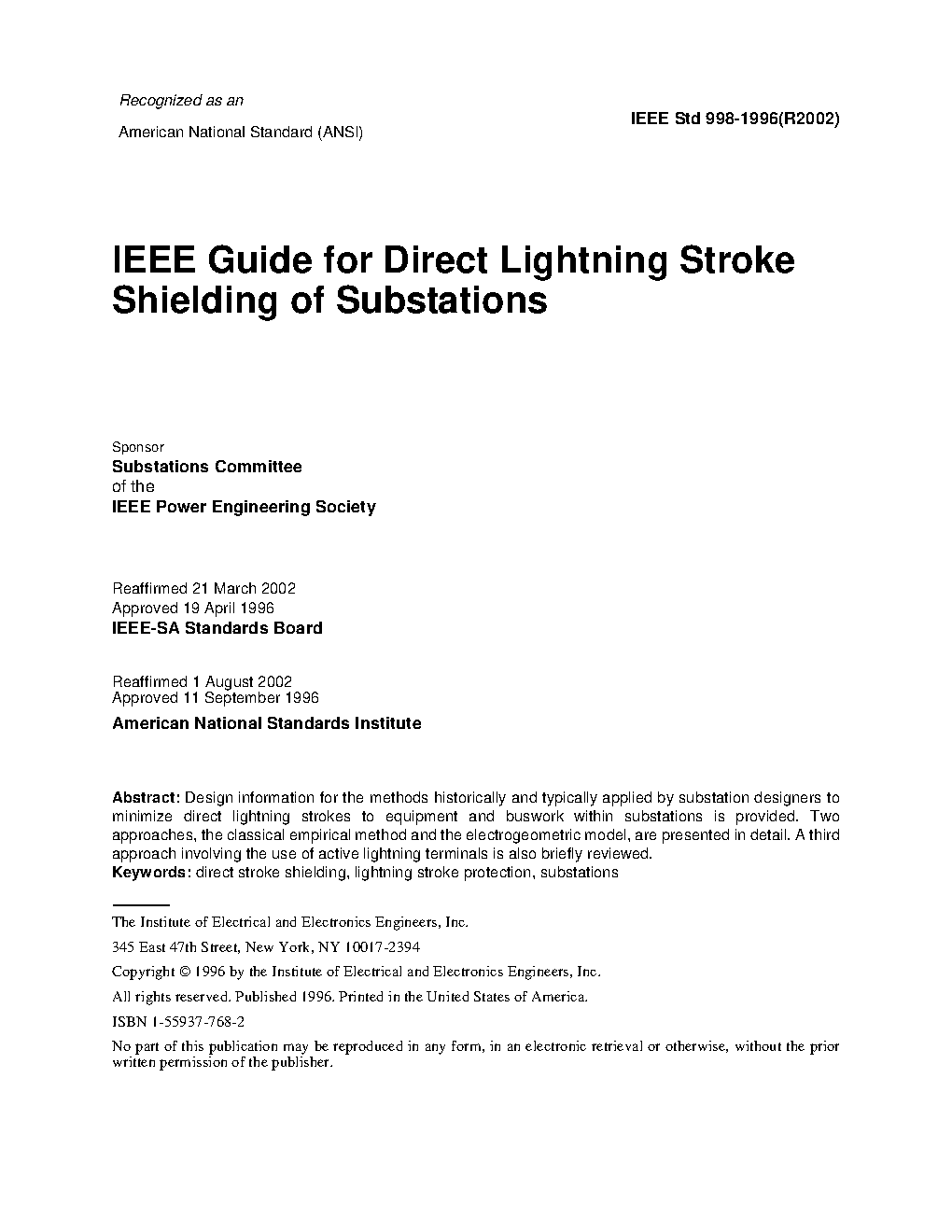
Design information for the methods historically and typically applied by substation designers to minimize direct lightning strokes to equipment and buswork within substations is provided. Two approaches, the classical empirical method and the electrogeometric model, are presented in detail. A third approach involving the use of active lightning terminals is also briefly reviewed.
The scope of this guide is the identiÞcation and discussion of design procedures to provide direct stroke shielding of
outdoor distribution, transmission, and generating plant substations. All known methods of shielding from direct
strokes were investigated during the preparation of this guide, and information is provided on two methods found to be
widely used:
a) The classical empirical method
b) The electrogeometric model
A third approach, which involves the use of active lightning terminals, is brießy reviewed in clause 6.
This guide does not purport to include all shielding methods that may have been developed. The guide also does not
address protection from surges entering a substation over power or communication lines or the personnel safety issues.
Users of this guide should thoroughly acquaint themselves with all factors that relate to the design of a particular
installation and use good engineering judgment in the application of the methods given here, particularly with respect
to the importance and value of the equipment being protected.
The intent of this guide is to provide design information for the methods historically and typically applied by
substation designers to minimize direct lightning strokes to equipment and buswork within substations. The general
nature of lightning is discussed in clause 2 and the problems associated with providing protection from direct strikes
are described in clause 3. The methods reviewed in this guide for designing a system of protection are explained in
clauses 4 and 5, and sample calculations are given in annex B to illustrate use of the methods. Clause 7 contains an
extensive bibliography for further study of the subject.
Design information for the methods historically and typically applied by substation designers to minimize direct lightning strokes to equipment and buswork within substations is provided. Two approaches, the classical empirical method and the electrogeometric model, are presented in detail. A third approach involving the use of active lightning terminals is also briefly reviewed.
The scope of this guide is the identiÞcation and discussion of design procedures to provide direct stroke shielding of
outdoor distribution, transmission, and generating plant substations. All known methods of shielding from direct
strokes were investigated during the preparation of this guide, and information is provided on two methods found to be
widely used:
a) The classical empirical method
b) The electrogeometric model
A third approach, which involves the use of active lightning terminals, is brießy reviewed in clause 6.
This guide does not purport to include all shielding methods that may have been developed. The guide also does not
address protection from surges entering a substation over power or communication lines or the personnel safety issues.
Users of this guide should thoroughly acquaint themselves with all factors that relate to the design of a particular
installation and use good engineering judgment in the application of the methods given here, particularly with respect
to the importance and value of the equipment being protected.
The intent of this guide is to provide design information for the methods historically and typically applied by
substation designers to minimize direct lightning strokes to equipment and buswork within substations. The general
nature of lightning is discussed in clause 2 and the problems associated with providing protection from direct strikes
are described in clause 3. The methods reviewed in this guide for designing a system of protection are explained in
clauses 4 and 5, and sample calculations are given in annex B to illustrate use of the methods. Clause 7 contains an
extensive bibliography for further study of the subject.
Notes
Superseded
Technical characteristics
| Publisher | Institute of Electrical and Electronics Engineers (IEEE) |
| Publication Date | 11/30/1995 |
| Confirmation Date | 03/21/2002 |
| Edition | |
| Page Count | 176 |
| EAN | --- |
| ISBN | --- |
| Weight (in grams) | --- |
| Brochures |

|
No products.
Previous versions
30/07/2024
Active
Most Recent
30/04/2013
Withdrawn
Most Recent
30/11/1995
Superseded
, Confirmed
Historical