Superseded
, Confirmed
Standard
Historical
IEEE 980:1994 (R2001)
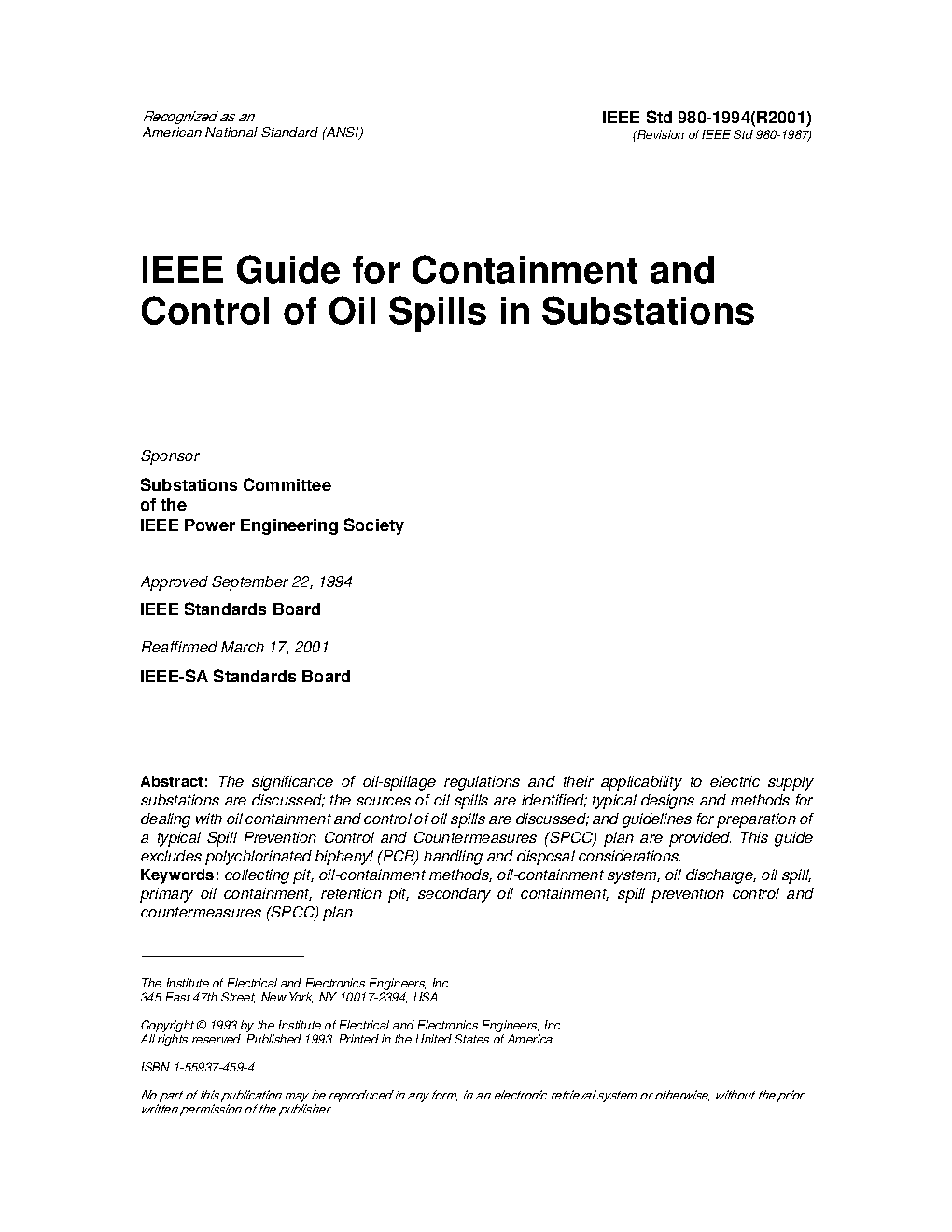
IEEE Guide for Containment and Control of Oil Spills in Substations

Summary
Revision Standard - Superseded.
The significance of oil-spillage regulations and their applicability to electric supply substations are discussed; the sources of oil spills are identified; typical designs and methods for dealing with oil containment and control of oil spills are discussed; and guidelines for preparation of a typical Spill Prevention Control and Countermeasures (SPCC) plan are provided. This guide excludes polychlorinated biphenyl (PCB) handling and disposal considerations.
This guide discusses the significance of oil-spillage regulations and their applicability to electric supply substations; identifies the sources of oil spills; discusses typical designs and methods for dealing with oil containment and control of oil spills; and provides guidelines for preparation of a typical Spill Prevention Control and Countermeasure (SPCC) plan. This guide excludes polychlorinated biphenyl (PCB) handling and disposal considerations.
It is not the intent of this guide to interpret the applicability of the governmental regulations or the oil-containment systems presented. Such interpretation is left to each individual user. The guide is intended to identify concerns, offer solutions, and let users make their own evaluations.
This guide applies only to insulating oil containing less than 50 ppm of PCB, which is considered to be non-PCB oil. Non-PCB oils have a PCB content that has been designated by the U.S. Environmental Protection Agency (EPA) as nonhazardous to the public, and they are not deemed to be toxic substances. While the effectiveness of the containment methods described in this guide is generally not affected by the PCB content of the oil, the regulations governing cleanup and handling of oil spills containing PCB are much more restrictive.
Containment and control of oil spills at electric supply substations is a concern for most electric utilities. The environmental impact of oil spills and their cleanup is governed by several federal, state, and local regulations, necessitating increased attention in substations to the need for secondary oil containment, and an SPCC plan. Beyond the threat to the environment, cleanup costs associated with oil spills continue to escalate, and the adverse community response to any spill is becoming increasingly unacceptable.
This guide identifies the applicable governmental regulations, the sources of oil spills, and the typical methods used to contain and control them. It discusses the need for an SPCC plan and provides the typical plan requirements. It documents survey-reported considerations for oil-spill containment, control, and cleanup; the methods used; and their effectiveness. In June 1992 an IEEE questionnaire was sent to 190 utilities in the U.S. and Canada, surveying their experiences. Of these utilities, 59 responded. Where relevant, the survey results are referenced in the body of this
guide.
The significance of oil-spillage regulations and their applicability to electric supply substations are discussed; the sources of oil spills are identified; typical designs and methods for dealing with oil containment and control of oil spills are discussed; and guidelines for preparation of a typical Spill Prevention Control and Countermeasures (SPCC) plan are provided. This guide excludes polychlorinated biphenyl (PCB) handling and disposal considerations.
This guide discusses the significance of oil-spillage regulations and their applicability to electric supply substations; identifies the sources of oil spills; discusses typical designs and methods for dealing with oil containment and control of oil spills; and provides guidelines for preparation of a typical Spill Prevention Control and Countermeasure (SPCC) plan. This guide excludes polychlorinated biphenyl (PCB) handling and disposal considerations.
It is not the intent of this guide to interpret the applicability of the governmental regulations or the oil-containment systems presented. Such interpretation is left to each individual user. The guide is intended to identify concerns, offer solutions, and let users make their own evaluations.
This guide applies only to insulating oil containing less than 50 ppm of PCB, which is considered to be non-PCB oil. Non-PCB oils have a PCB content that has been designated by the U.S. Environmental Protection Agency (EPA) as nonhazardous to the public, and they are not deemed to be toxic substances. While the effectiveness of the containment methods described in this guide is generally not affected by the PCB content of the oil, the regulations governing cleanup and handling of oil spills containing PCB are much more restrictive.
Containment and control of oil spills at electric supply substations is a concern for most electric utilities. The environmental impact of oil spills and their cleanup is governed by several federal, state, and local regulations, necessitating increased attention in substations to the need for secondary oil containment, and an SPCC plan. Beyond the threat to the environment, cleanup costs associated with oil spills continue to escalate, and the adverse community response to any spill is becoming increasingly unacceptable.
This guide identifies the applicable governmental regulations, the sources of oil spills, and the typical methods used to contain and control them. It discusses the need for an SPCC plan and provides the typical plan requirements. It documents survey-reported considerations for oil-spill containment, control, and cleanup; the methods used; and their effectiveness. In June 1992 an IEEE questionnaire was sent to 190 utilities in the U.S. and Canada, surveying their experiences. Of these utilities, 59 responded. Where relevant, the survey results are referenced in the body of this
guide.
Notes
Superseded
Technical characteristics
| Publisher | Institute of Electrical and Electronics Engineers (IEEE) |
| Publication Date | 11/30/1992 |
| Confirmation Date | 03/17/2001 |
| Edition | |
| Page Count | 48 |
| EAN | --- |
| ISBN | --- |
| Weight (in grams) | --- |
| Brochures |

|
Amendments replaces
19/10/1987
Superseded
Historical
Previous versions
20/04/2022
Active
Most Recent
19/12/2013
Superseded
Historical
30/11/1992
Superseded
, Confirmed
Historical
19/10/1987
Superseded
Historical