
Superseded
, Confirmed
Standard
Historical
IEEE 810:1987 (R2001)
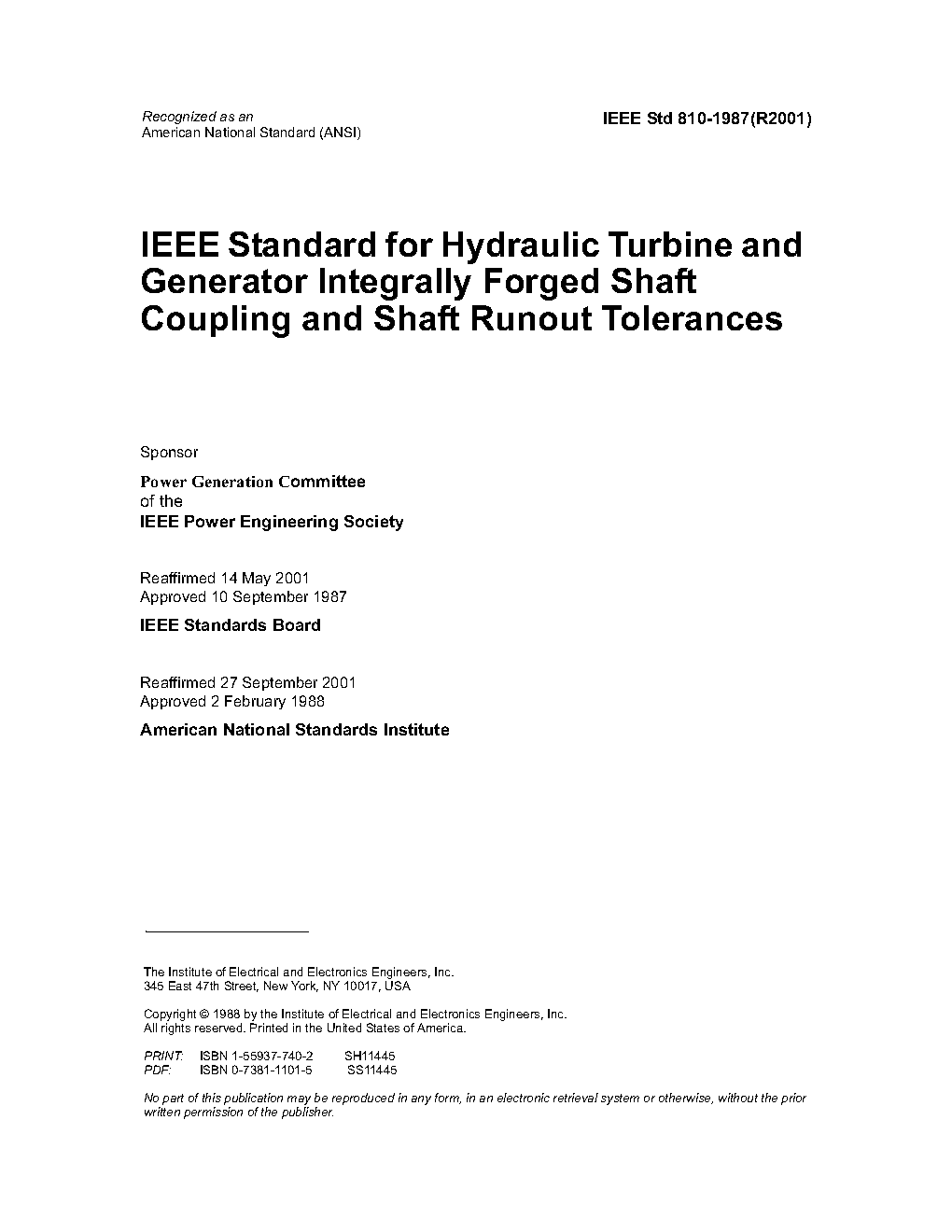
IEEE Standard for Hydraulic Turbine and Generator Integrally Forged Shaft Couplings and Shaft Runout Tolerances

Summary
New IEEE Standard - Superseded.
This recommended practice provides a single source of implementation instructions that, when used with related recommended practices concerning unique identification principles and definitions, component function identifiers, and system descriptions, provide a basis for uniquely identifying systems, structures, and components of nuclear and fossil-fueled power plant projects (electric power generating stations) and related facilities. Hydro and other types of power plants are not included. The standard is part of a series of recommended practices, entitled the Energy Industry Identification Systems (EIIS), the purpose of which is to present a common language of communication which will permit a user to correlate a system, structure, or component with that of another organization for the purposes of reporting, comparison, or general communication. A significant feature of this concept is that the unique identification code identifies the function at the component level and not the hardware itself.
This standard applies to the dimensions of integrally forged shaft couplings and to the shaft runout tolerances. Shafts and couplings included in this standard are used for both horizontal and vertical connections between generators and turbines in hydroelectric installations.
This standard does not include data on fabricated shafts, shaft stresses, and bolt tensioning. Industry experience suggests that the torque capacity of shafts having diameters greater than 72 inches is usually better provided by fabricated rather than forged shafts.
This recommended practice provides a single source of implementation instructions that, when used with related recommended practices concerning unique identification principles and definitions, component function identifiers, and system descriptions, provide a basis for uniquely identifying systems, structures, and components of nuclear and fossil-fueled power plant projects (electric power generating stations) and related facilities. Hydro and other types of power plants are not included. The standard is part of a series of recommended practices, entitled the Energy Industry Identification Systems (EIIS), the purpose of which is to present a common language of communication which will permit a user to correlate a system, structure, or component with that of another organization for the purposes of reporting, comparison, or general communication. A significant feature of this concept is that the unique identification code identifies the function at the component level and not the hardware itself.
This standard applies to the dimensions of integrally forged shaft couplings and to the shaft runout tolerances. Shafts and couplings included in this standard are used for both horizontal and vertical connections between generators and turbines in hydroelectric installations.
This standard does not include data on fabricated shafts, shaft stresses, and bolt tensioning. Industry experience suggests that the torque capacity of shafts having diameters greater than 72 inches is usually better provided by fabricated rather than forged shafts.
Notes
Superseded
Technical characteristics
| Publisher | Institute of Electrical and Electronics Engineers (IEEE) |
| Publication Date | 11/30/1987 |
| Confirmation Date | 05/14/2001 |
| Edition | |
| Page Count | 20 |
| EAN | --- |
| ISBN | --- |
| Weight (in grams) | --- |
| Brochures |

|
No products.
Previous versions
30/12/2015
Active
Most Recent
30/11/1987
Superseded
, Confirmed
Historical