
Superseded
Standard amendment
Historical
IEEE 802.1Qcc:2018
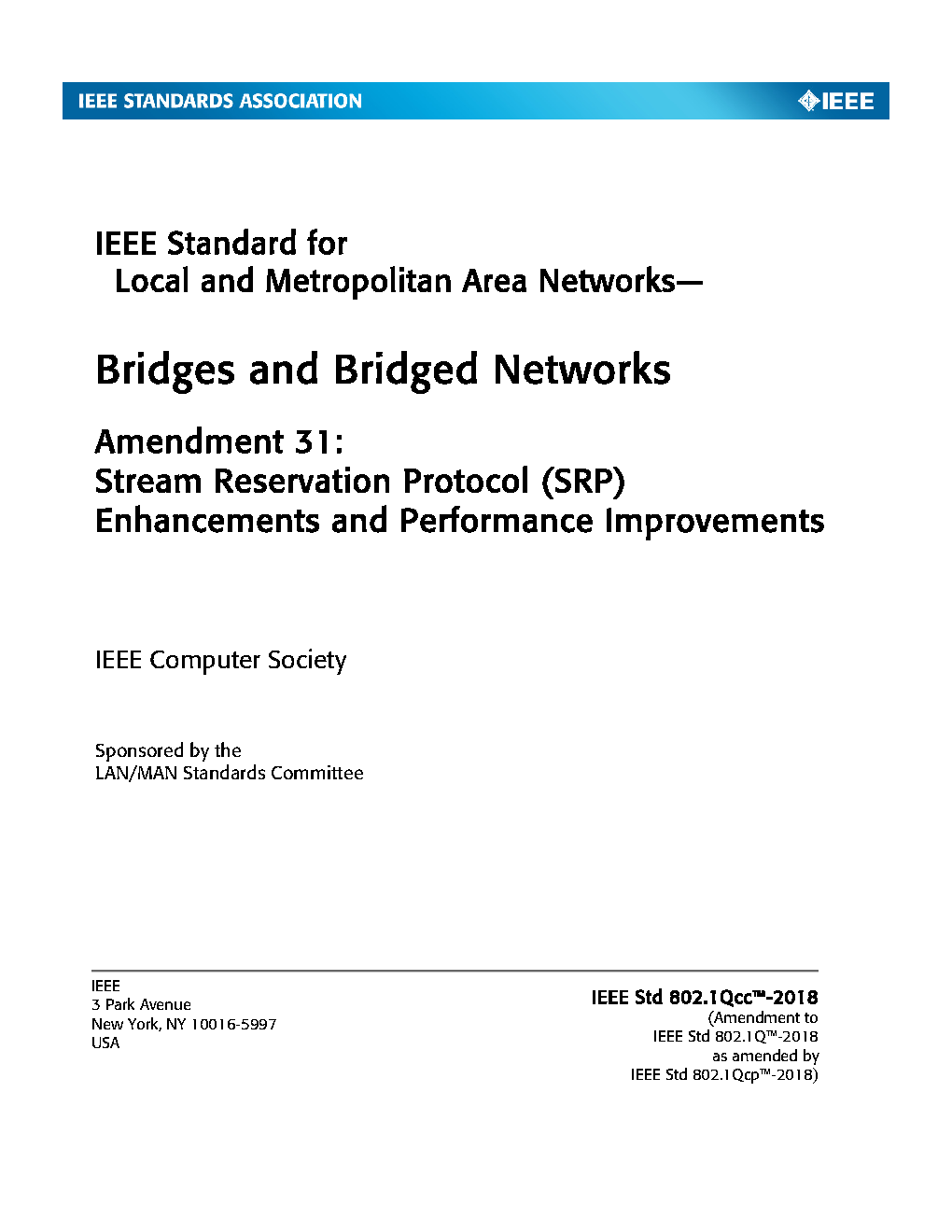
IEEE Standard for Local and Metropolitan Area Networks--Bridges and Bridged Networks -- Amendment 31: Stream Reservation Protocol (SRP) Enhancements and Performance Improvements

Summary
Amendment Standard - Superseded.
Enhancements to the configuration of time-sensitive streams are provided by this amendment to IEEE Std 802.1Q-2018.
This standard specifies Media Access Control (MAC) Bridges that interconnect individual Local Area Networks (LANs), each supporting the IEEE 802 MAC service using a different or identical media access control method, to provide Bridged Local Area Networks and Virtual LANs (VLANs).
This amendment describes new protocols, procedures and managed objects for bridges and end stations, which are compatible with existing mechanisms, and provide:
- Support for more streams. The current worst case limit is less than 500 streams; there are use cases that require two orders of magnitude greater than this.
- Mechanisms that allow Stream Reservation class (SR class) parameters to be configured
- Inclusion of additional parameters and mechanisms in the stream reservation protocol that support additional applications, such as higher reliability, latency requirements, and latency changes due to network reconfiguration.
- Support for higher layer streaming sessions, such as Real-Time Protocol (RTP)-based sessions.
- Deterministic stream reservation convergence.
- User Network Interface (UNI) for routing and reservations.
Enhancements to the configuration of time-sensitive streams are provided by this amendment to IEEE Std 802.1Q-2018.
This standard specifies Media Access Control (MAC) Bridges that interconnect individual Local Area Networks (LANs), each supporting the IEEE 802 MAC service using a different or identical media access control method, to provide Bridged Local Area Networks and Virtual LANs (VLANs).
This amendment describes new protocols, procedures and managed objects for bridges and end stations, which are compatible with existing mechanisms, and provide:
- Support for more streams. The current worst case limit is less than 500 streams; there are use cases that require two orders of magnitude greater than this.
- Mechanisms that allow Stream Reservation class (SR class) parameters to be configured
- Inclusion of additional parameters and mechanisms in the stream reservation protocol that support additional applications, such as higher reliability, latency requirements, and latency changes due to network reconfiguration.
- Support for higher layer streaming sessions, such as Real-Time Protocol (RTP)-based sessions.
- Deterministic stream reservation convergence.
- User Network Interface (UNI) for routing and reservations.
Notes
Superseded
Technical characteristics
| Publisher | Institute of Electrical and Electronics Engineers (IEEE) |
| Publication Date | 10/31/2018 |
| Edition | |
| Page Count | 208 |
| EAN | --- |
| ISBN | --- |
| Weight (in grams) | --- |
| Brochures |

|
Amendments modifies

IEEE 802.1Q:2018
IEEE Standard for Local and Metropolitan Area Networks—Bridges and Bridged Networks
06/07/2018
Superseded
Historical
Previous versions
22/12/2022
Active
Most Recent
22/07/2022
Superseded
Historical


IEEE 802.1Q:2018
IEEE Standard for Local and Metropolitan Area Networks—Bridges and Bridged Networks
06/07/2018
Superseded
Historical






19/12/2014
Superseded
Historical



19/05/2006
Superseded
Historical
07/05/2003
Superseded
Historical
08/03/1999
Superseded
, Confirmed
Historical