Active
Standard amendment
Most Recent
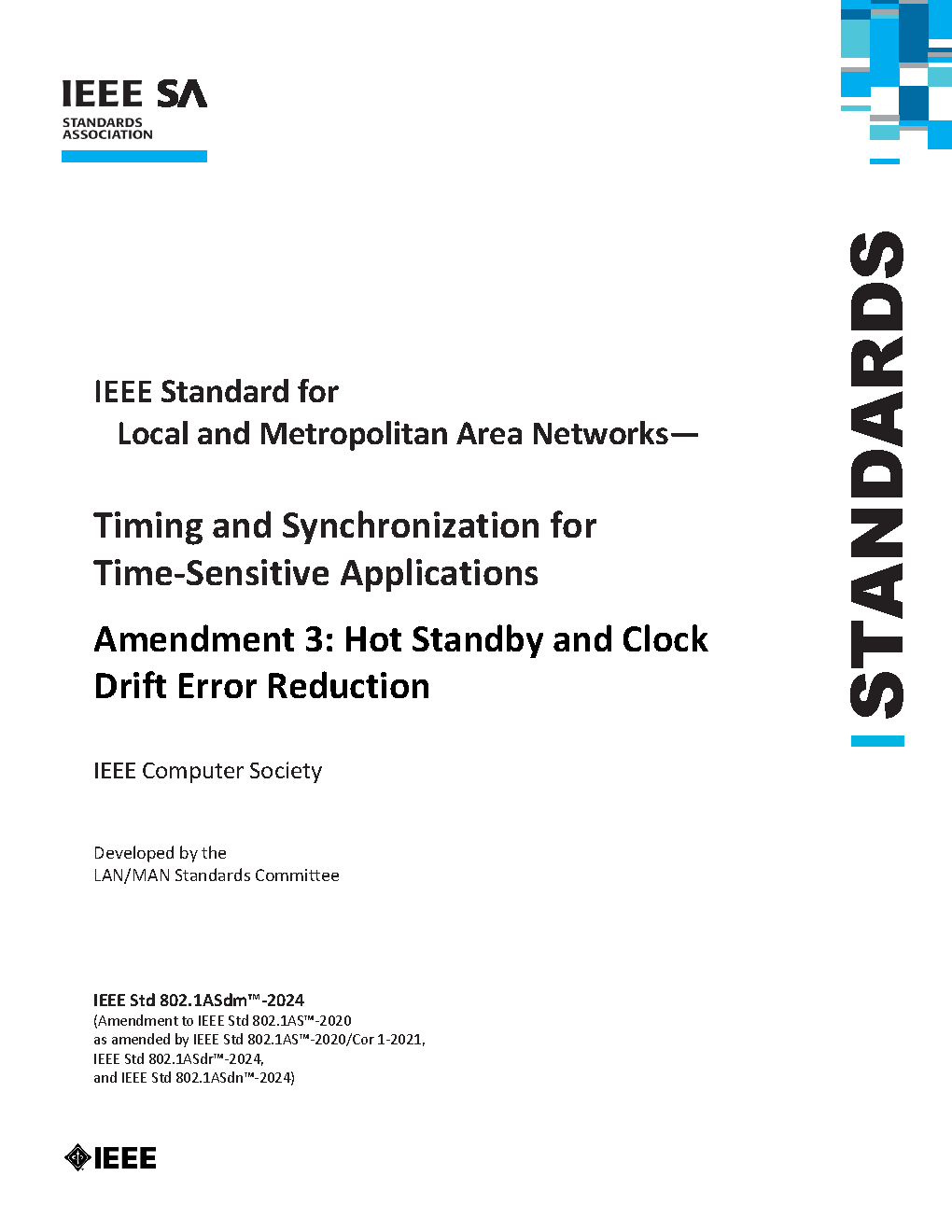
IEEE 802.1ASdm:2024
IEEE Draft Standard for Local and Metropolitan Area Networks - Timing and Synchronization for Time-Sensitive Applications - Amendment: Hot Standby and Clock Drift Error Reduction

Summary
Amendment Standard - Active - Draft.
This amendment to IEEE Std 802.1ASTM-2020 specifies hot standby, and addresses errors and omissions in the description of existing functionality.
This amendment specifies protocols, procedures, and managed objects for hot standby without use of the Best Master Clock Algorithm (BMCA), for time-aware systems, including: - A function that transforms the synchronized times of two generalized Precision Time Protocol (gPTP) domains into one synchronized time for use by applications; - A function that directs the synchronized time of one gPTP domain into a different gPTP domain; and - Mechanisms that determine whether a gPTP domain has sufficient quality to be used for hot standby. This amendment specifies a Type-Length-Value (TLV) to enable 1 ?s time synchronization accuracy over 100 network hops. This amendment also addresses errors and omissions in the description of existing functionality.
This standard enables systems to meet the respective jitter, wander, and time-synchronization requirements for time-sensitive applications, including those that involve multiple streams delivered to multiple end stations. To facilitate the widespread use of packet networks for these applications, synchronization information is one of the components needed at each network element where time-sensitive application data are mapped or demapped or a time-sensitive function is performed. This standard leverages the work of the IEEE 1588 Working Group by developing the additional specifications needed to address these requirements.
This amendment to IEEE Std 802.1ASTM-2020 specifies hot standby, and addresses errors and omissions in the description of existing functionality.
This amendment specifies protocols, procedures, and managed objects for hot standby without use of the Best Master Clock Algorithm (BMCA), for time-aware systems, including: - A function that transforms the synchronized times of two generalized Precision Time Protocol (gPTP) domains into one synchronized time for use by applications; - A function that directs the synchronized time of one gPTP domain into a different gPTP domain; and - Mechanisms that determine whether a gPTP domain has sufficient quality to be used for hot standby. This amendment specifies a Type-Length-Value (TLV) to enable 1 ?s time synchronization accuracy over 100 network hops. This amendment also addresses errors and omissions in the description of existing functionality.
This standard enables systems to meet the respective jitter, wander, and time-synchronization requirements for time-sensitive applications, including those that involve multiple streams delivered to multiple end stations. To facilitate the widespread use of packet networks for these applications, synchronization information is one of the components needed at each network element where time-sensitive application data are mapped or demapped or a time-sensitive function is performed. This standard leverages the work of the IEEE 1588 Working Group by developing the additional specifications needed to address these requirements.
Notes
Active
Technical characteristics
| Publisher | Institute of Electrical and Electronics Engineers (IEEE) |
| Publication Date | 10/04/2024 |
| Page Count | 164 |
| EAN | --- |
| ISBN | --- |
| Weight (in grams) | --- |
| Brochures |

|
No products.
Previous versions


19/06/2020
Active
, Modified
Most Recent