Active
Standard
Most Recent
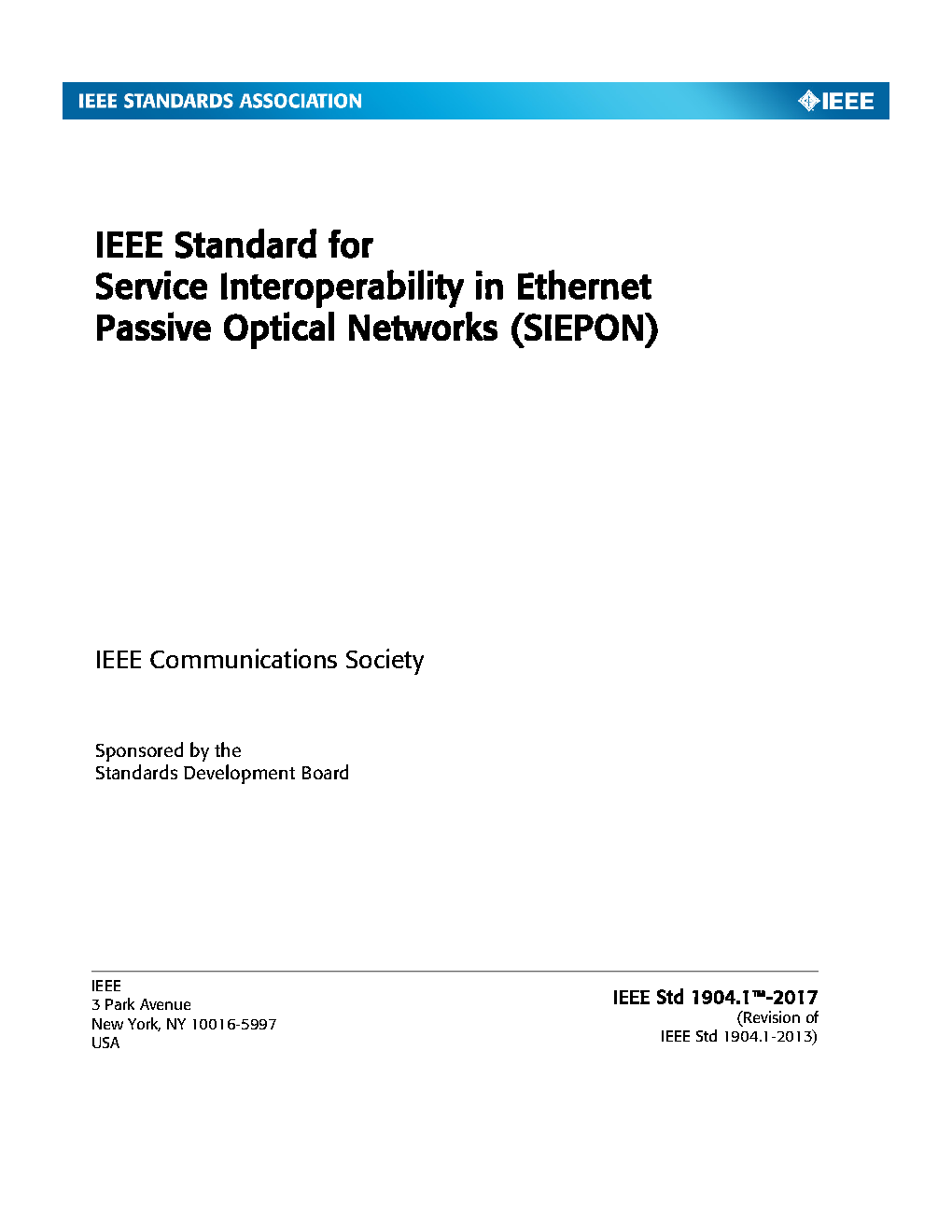
IEEE 1904.1:2017
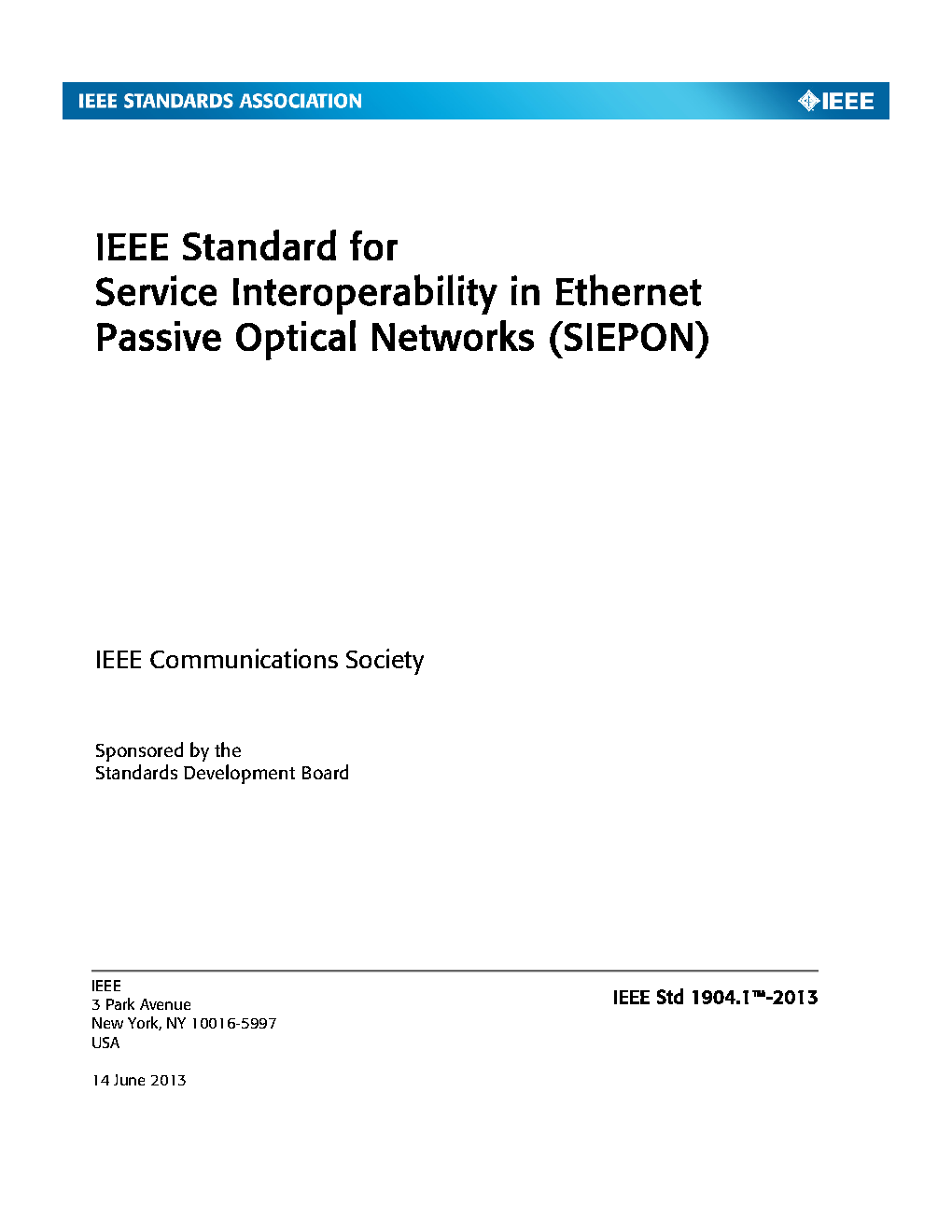
IEEE Standard for Service Interoperability in Ethernet Passive Optical Networks (SIEPON)

Summary
Revision Standard - Active.
The system-level requirements needed to ensure service-level, multi-vendor interoperability of Ethernet Passive Optical Network (EPON) equipment is described. The existing IEEE 802.3 and IEEE 802.1 standards, which ensure the interoperability at the Physical Layer (PHY) and Data Link Layer, are complemented by the specifications. Specifically included in this specification are - EPON system-level interoperability specifications covering equipment functionality, traffic engineering, and service-level quality of service/class of service (QoS/CoS) mechanisms; - Management specifications covering equipment management, service management, and EPON power-saving mechanism.
This standard describes the system-level requirements needed to provide service-level, multi-vendor interoperability of Ethernet Passive Optical Network (EPON) equipment. The specifications complementthe existing IEEE 802.3 and IEEE 802.1 standards, which enable the interoperability at the Physical Layer and Data Link Layer.1 Specifically included in this specification are - EPON system-level interoperability specifications covering equipment functionality, traffic engineering, and service-level quality of service/class of service (QoS/CoS) mechanisms; - Management specifications covering equipment management, service management, and power utilization.
The purpose of this standard is to build upon the IEEE 802.3ah (1G-EPON) and IEEE 802.3av (10GEPON) Physical Layer and Data Link Layer standards and create a system-level and network-level standard, thus allowing full "plug-and-play" interoperability of the transport, service, and control planes in a multi-vendor environment.
The system-level requirements needed to ensure service-level, multi-vendor interoperability of Ethernet Passive Optical Network (EPON) equipment is described. The existing IEEE 802.3 and IEEE 802.1 standards, which ensure the interoperability at the Physical Layer (PHY) and Data Link Layer, are complemented by the specifications. Specifically included in this specification are - EPON system-level interoperability specifications covering equipment functionality, traffic engineering, and service-level quality of service/class of service (QoS/CoS) mechanisms; - Management specifications covering equipment management, service management, and EPON power-saving mechanism.
This standard describes the system-level requirements needed to provide service-level, multi-vendor interoperability of Ethernet Passive Optical Network (EPON) equipment. The specifications complementthe existing IEEE 802.3 and IEEE 802.1 standards, which enable the interoperability at the Physical Layer and Data Link Layer.1 Specifically included in this specification are - EPON system-level interoperability specifications covering equipment functionality, traffic engineering, and service-level quality of service/class of service (QoS/CoS) mechanisms; - Management specifications covering equipment management, service management, and power utilization.
The purpose of this standard is to build upon the IEEE 802.3ah (1G-EPON) and IEEE 802.3av (10GEPON) Physical Layer and Data Link Layer standards and create a system-level and network-level standard, thus allowing full "plug-and-play" interoperability of the transport, service, and control planes in a multi-vendor environment.
Notes
Active
Technical characteristics
| Publisher | Institute of Electrical and Electronics Engineers (IEEE) |
| Publication Date | 07/24/2017 |
| Cancellation Date | 07/24/2017 |
| Edition | |
| Page Count | 893 |
| EAN | --- |
| ISBN | --- |
| Weight (in grams) | --- |
| Brochures |

|
Amendments replaces
20/09/2013
Superseded
Historical
Previous versions
24/07/2017
Active
Most Recent
20/09/2013
Superseded
Historical