Superseded
Standard
Historical
IEEE 1801:2009
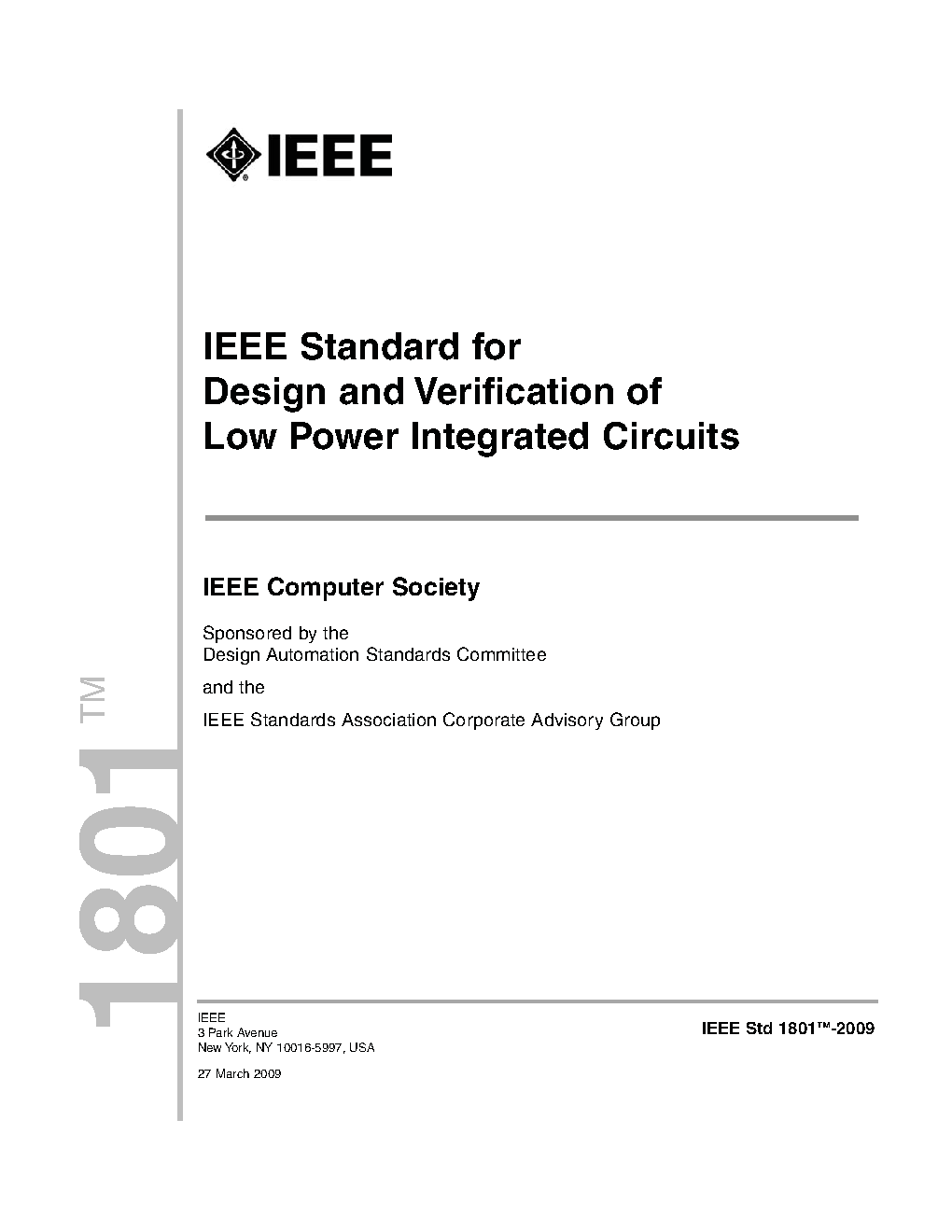
IEEE Standard for Design and Verification of Low Power Integrated Circuits

Summary
New IEEE Standard - Superseded.
The power supplied to elements in an electronic design affects the way circuits operate. Although this is obvious when stated, today’s set of high-level design languages have not had a consistent way to concisely represent the regions of a design with different power provisions, nor the states of those regions or domains. This standard provides an HDL-independent way of annotating a design with power intent. In addition, the level-shifting and isolation between power domains may be described for a specific implementation, from high-level constraints to particular configurations. When the logic in a power domain receives different power supply levels, the logic state of portions of the design may be preserved with various state-retention strategies. This standard provides mechanisms for the refined and specific description of intent, effect, and implementation of various retention strategies. Incorporating components into designs is greatly assisted by the encapsulation and specification of the characteristics of the power environment of the design and the power requirements and capabilities of the components; this information encapsulation mechanism is also described in this standard. The analysis of the various power modes of a design is enabled with a combination of the description of the power modes and the collection, generation, and propagation of switching information.
This standard establishes a format used to define the low power design intent for electronic systems and
electronic intellectual property. The format provides the ability to specify the supply network, switches,
isolation, retention and other aspects relevant to power management of an electronic system. The standard
defines the relationship between the low power design specification and the logic design specification
captured via other formats (e.g., standard hardware description languages).
The standard provides portability of low power design specifications that can be used with a variety of
commercial products throughout an electronic system design, analysis, verification and implementation
flow.
The power supplied to elements in an electronic design affects the way circuits operate. Although this is obvious when stated, today’s set of high-level design languages have not had a consistent way to concisely represent the regions of a design with different power provisions, nor the states of those regions or domains. This standard provides an HDL-independent way of annotating a design with power intent. In addition, the level-shifting and isolation between power domains may be described for a specific implementation, from high-level constraints to particular configurations. When the logic in a power domain receives different power supply levels, the logic state of portions of the design may be preserved with various state-retention strategies. This standard provides mechanisms for the refined and specific description of intent, effect, and implementation of various retention strategies. Incorporating components into designs is greatly assisted by the encapsulation and specification of the characteristics of the power environment of the design and the power requirements and capabilities of the components; this information encapsulation mechanism is also described in this standard. The analysis of the various power modes of a design is enabled with a combination of the description of the power modes and the collection, generation, and propagation of switching information.
This standard establishes a format used to define the low power design intent for electronic systems and
electronic intellectual property. The format provides the ability to specify the supply network, switches,
isolation, retention and other aspects relevant to power management of an electronic system. The standard
defines the relationship between the low power design specification and the logic design specification
captured via other formats (e.g., standard hardware description languages).
The standard provides portability of low power design specifications that can be used with a variety of
commercial products throughout an electronic system design, analysis, verification and implementation
flow.
Notes
Superseded
Technical characteristics
| Publisher | Institute of Electrical and Electronics Engineers (IEEE) |
| Publication Date | 03/27/2009 |
| Edition | |
| Page Count | 218 |
| EAN | --- |
| ISBN | --- |
| Weight (in grams) | --- |
| Brochures |

|
No products.
Previous versions
04/03/2025
Active
Most Recent

29/03/2019
Superseded
Historical
25/03/2016
Superseded
Historical
30/09/2014
Superseded
Historical
29/05/2013
Superseded
Historical
27/03/2009
Superseded
Historical