
Withdrawn
Standard
Most Recent
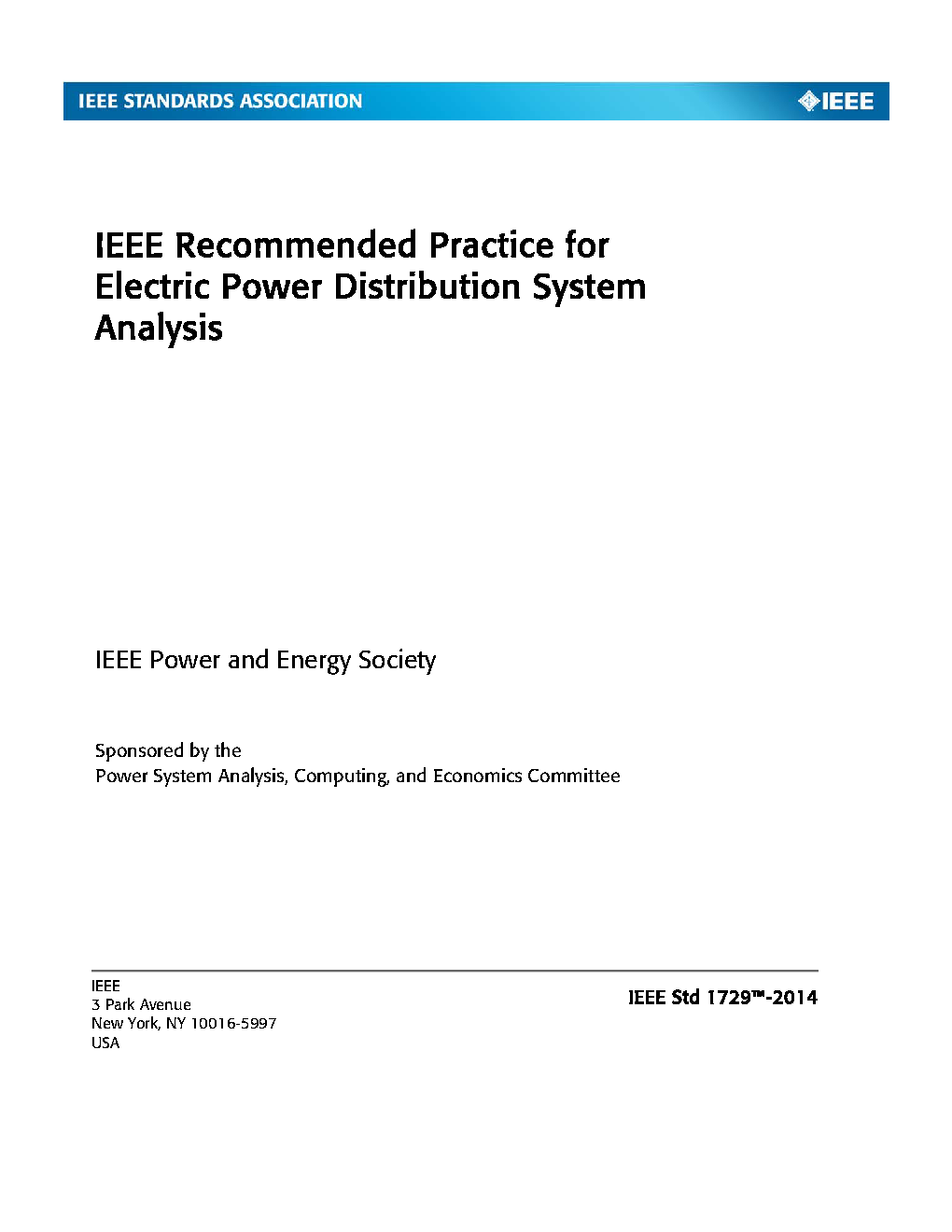
IEEE 1729:2014
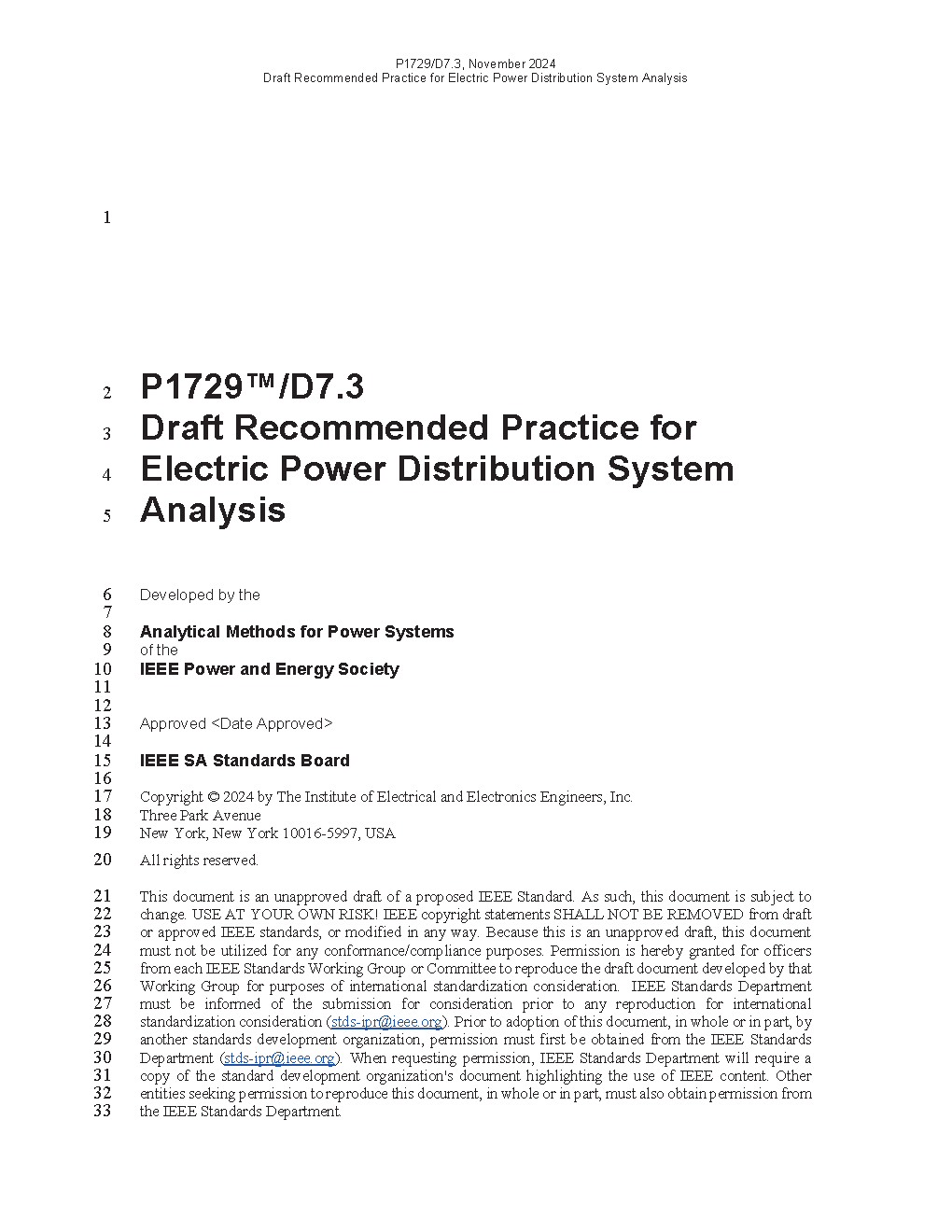
IEEE Recommended Practice for Electric Power Distribution System Analysis

Summary
New IEEE Standard - Active.
The aim of this recommended practice is to expand the use of IEEE power distribution test feeders into a broader space of software developers, software users, and researchers. The need for new distribution software functionality evolves quickly in areas such as distributed resource modeling, load response to voltage and frequency, reliability improvement, neutral-earth voltage, harmonics, active controls, interoperability, etc. By leveraging and expanding the set of test feeders, more attention can focus on providing the new functionality. The scope of the recommended practice includes steady-state, event-based, probabilistic, stochastic, and dynamic analysis of medium-voltage (up to 35 kV) electric utility power distribution systems. Industrial and commercial power distribution systems, harmonic analysis, and electromagnetic transient analysis are all excluded.
The scope of the standard includes steady-state, event-based, probabilistic, stochastic, and dynamic analysis of medium-voltage (up to 35 kV) electric utility power distribution systems. Industrial and commercial power distribution systems, harmonic analysis, and electromagnetic transient analysis are all excluded.
Many commercial software products and academic research projects continue to use analysis methods appropriate for transmission systems, but not for distribution systems. Many research papers submitted for publication still address questions that have been well-settled by previous work. The purpose of this Recommended Practice is to focus research attention on areas where legitimate needs exist, and to identify methods that should not be used in software products.
The aim of this recommended practice is to expand the use of IEEE power distribution test feeders into a broader space of software developers, software users, and researchers. The need for new distribution software functionality evolves quickly in areas such as distributed resource modeling, load response to voltage and frequency, reliability improvement, neutral-earth voltage, harmonics, active controls, interoperability, etc. By leveraging and expanding the set of test feeders, more attention can focus on providing the new functionality. The scope of the recommended practice includes steady-state, event-based, probabilistic, stochastic, and dynamic analysis of medium-voltage (up to 35 kV) electric utility power distribution systems. Industrial and commercial power distribution systems, harmonic analysis, and electromagnetic transient analysis are all excluded.
The scope of the standard includes steady-state, event-based, probabilistic, stochastic, and dynamic analysis of medium-voltage (up to 35 kV) electric utility power distribution systems. Industrial and commercial power distribution systems, harmonic analysis, and electromagnetic transient analysis are all excluded.
Many commercial software products and academic research projects continue to use analysis methods appropriate for transmission systems, but not for distribution systems. Many research papers submitted for publication still address questions that have been well-settled by previous work. The purpose of this Recommended Practice is to focus research attention on areas where legitimate needs exist, and to identify methods that should not be used in software products.
Notes
Active
Technical characteristics
| Publisher | Institute of Electrical and Electronics Engineers (IEEE) |
| Publication Date | 12/05/2014 |
| Cancellation Date | 03/27/2025 |
| Edition | |
| Page Count | 20 |
| EAN | --- |
| ISBN | --- |
| Weight (in grams) | --- |
| Brochures |

|
No products.
Previous versions
27/11/2024
Active
Most Recent
05/12/2014
Withdrawn
Most Recent