
Superseded
Standard
Historical
IEEE 1647:2008
IEEE Standard for the Functional Verification Language e

Summary
Revision Standard - Superseded.
The e functional verification language is an application-specific programming language, aimed at automating the task of verifying a hardware or software design with respect to its specification. Verification environments written in e provide a model of the environment in which the design is expected to function, including the kinds of erroneous conditions the design needs to withstand. A typical verification environment is capable of generating user-controlled test inputs with statistically interesting characteristics. Such an environment can check the validity of the design responses. Functional coverage metrics are used to control the verification effort and gauge the quality of the design. e verification environments can be used throughout the design cycle, from a high-level architectural model to a fully realized system. A definition of the e language syntax and semantics and how tool developers and verification engineers should use them are contained in this standard.
The scope of this standard is the definition of the e functional verification language. This standard aims to serve as an authoritative source for the definition of:
a) syntax and semantics of e language constructs
b) the e language interaction with standard simulation languages
c) e language libraries
This revision extends the standard to cover novel verification-related features.
This standard serves the community involved with functional verification of electronic designs using the e language. It provides an implementation independent definition of the e language and facilitates the development of e language based design automation tools. The revision project extends the standard to include novel verification related features. The revision project extends the standard to include novel verification related features.
The e functional verification language is an application-specific programming language, aimed at automating the task of verifying a hardware or software design with respect to its specification. Verification environments written in e provide a model of the environment in which the design is expected to function, including the kinds of erroneous conditions the design needs to withstand. A typical verification environment is capable of generating user-controlled test inputs with statistically interesting characteristics. Such an environment can check the validity of the design responses. Functional coverage metrics are used to control the verification effort and gauge the quality of the design. e verification environments can be used throughout the design cycle, from a high-level architectural model to a fully realized system. A definition of the e language syntax and semantics and how tool developers and verification engineers should use them are contained in this standard.
The scope of this standard is the definition of the e functional verification language. This standard aims to serve as an authoritative source for the definition of:
a) syntax and semantics of e language constructs
b) the e language interaction with standard simulation languages
c) e language libraries
This revision extends the standard to cover novel verification-related features.
This standard serves the community involved with functional verification of electronic designs using the e language. It provides an implementation independent definition of the e language and facilitates the development of e language based design automation tools. The revision project extends the standard to include novel verification related features. The revision project extends the standard to include novel verification related features.
Notes
Superseded
Technical characteristics
| Publisher | Institute of Electrical and Electronics Engineers (IEEE) |
| Publication Date | 08/03/2008 |
| Edition | |
| Page Count | 470 |
| EAN | --- |
| ISBN | --- |
| Weight (in grams) | --- |
| Brochures |

|
Amendments replaces
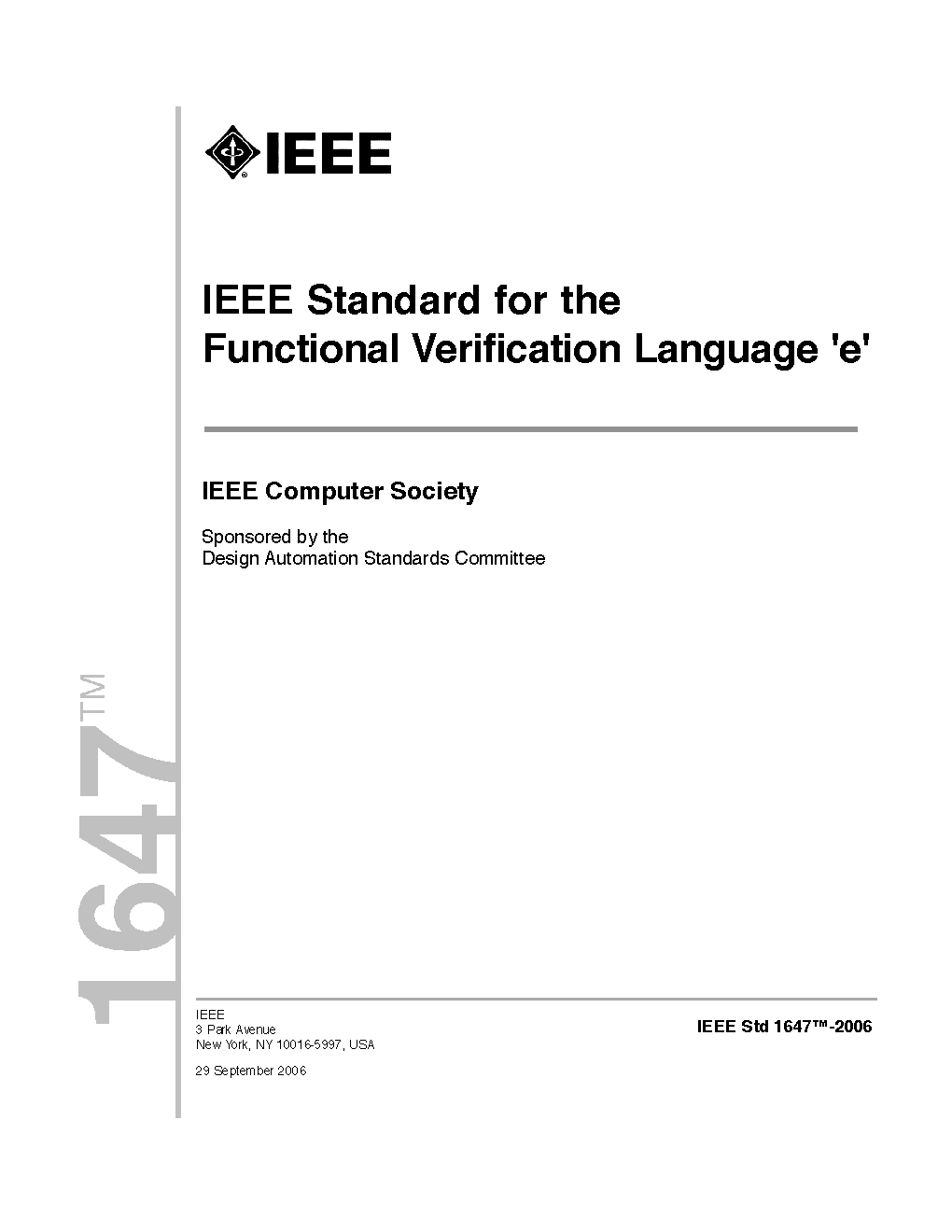
29/09/2006
Superseded
Historical
Previous versions
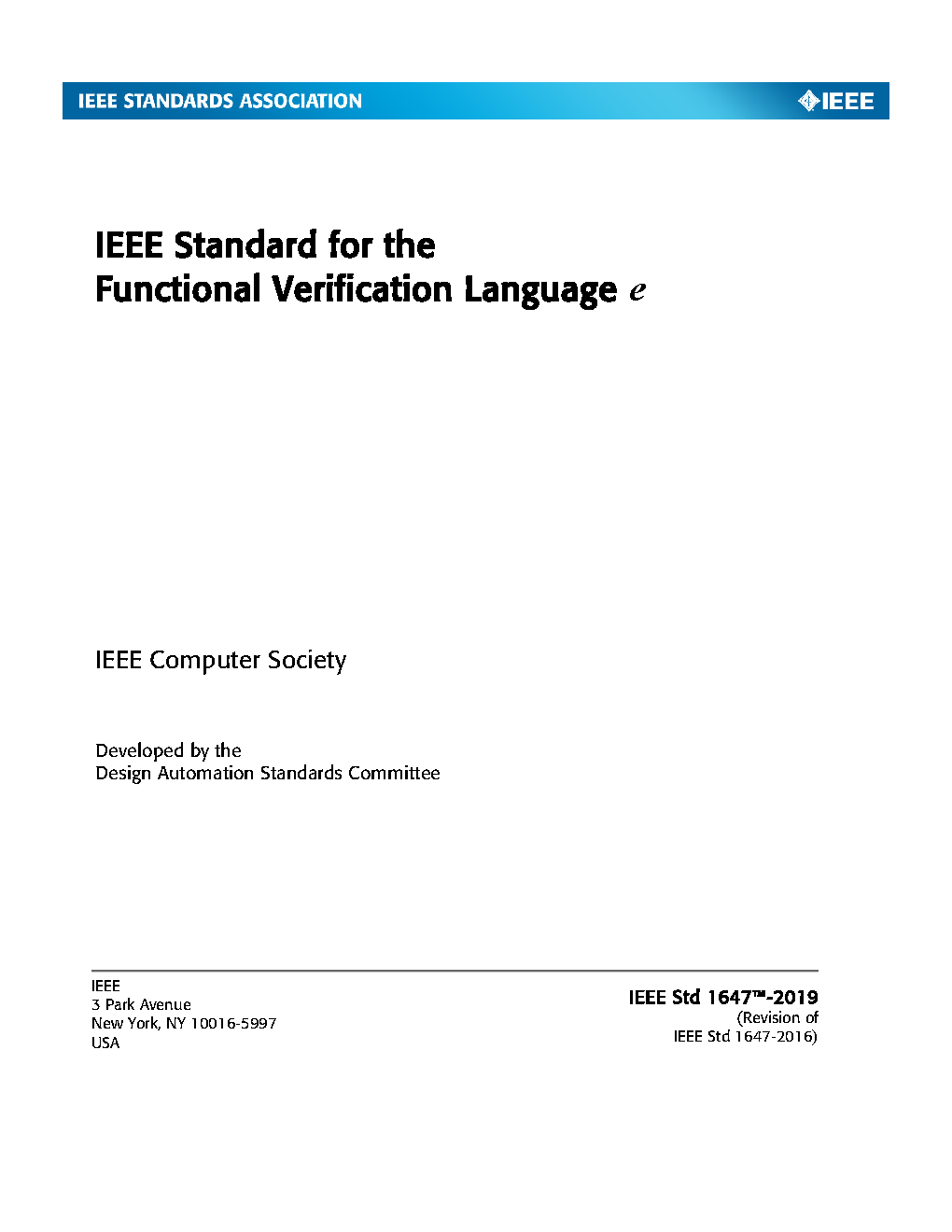
09/08/2019
Active
Most Recent
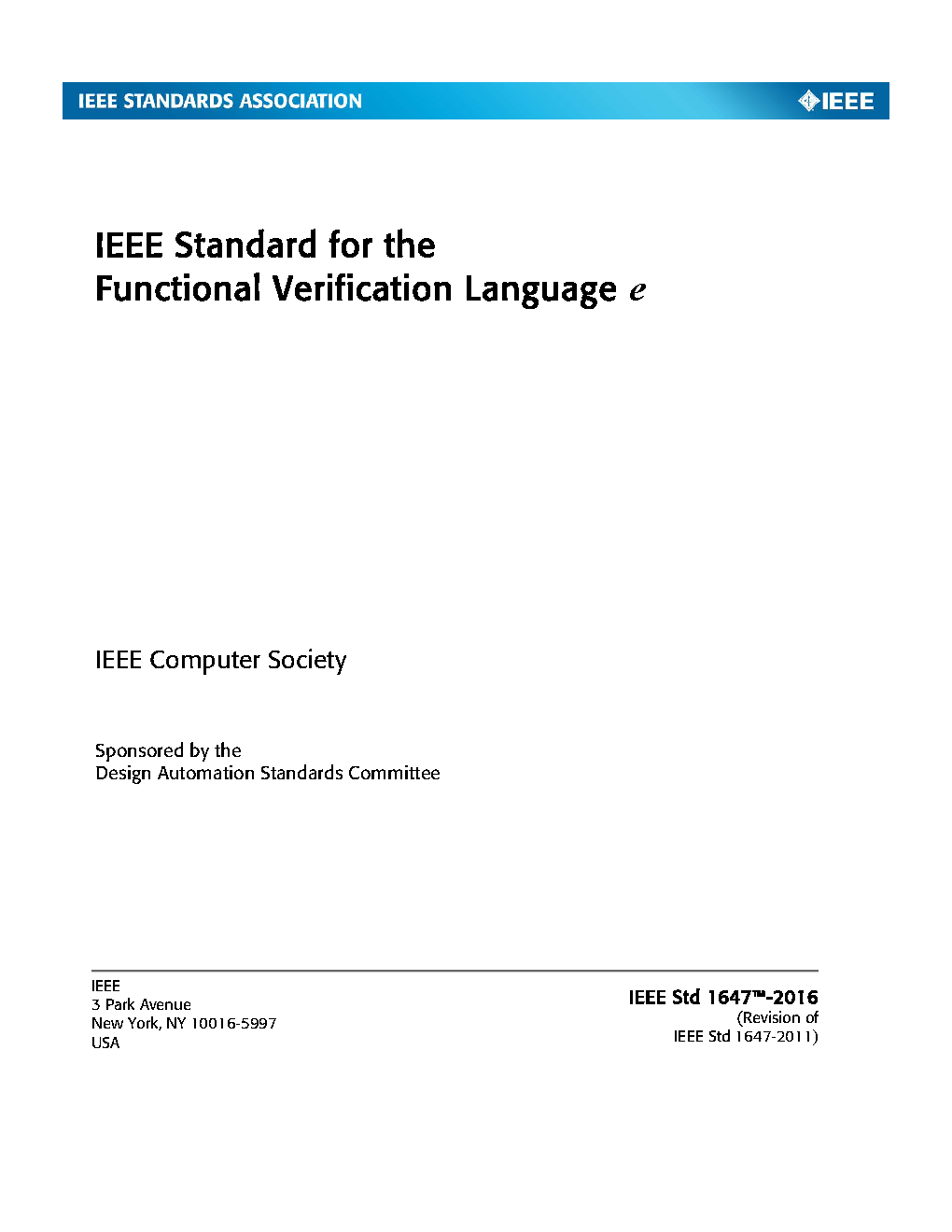
06/01/2017
Superseded
Historical

26/08/2011
Superseded
Historical
03/08/2008
Superseded
Historical
29/09/2006
Superseded
Historical