Active
Standard
Most Recent
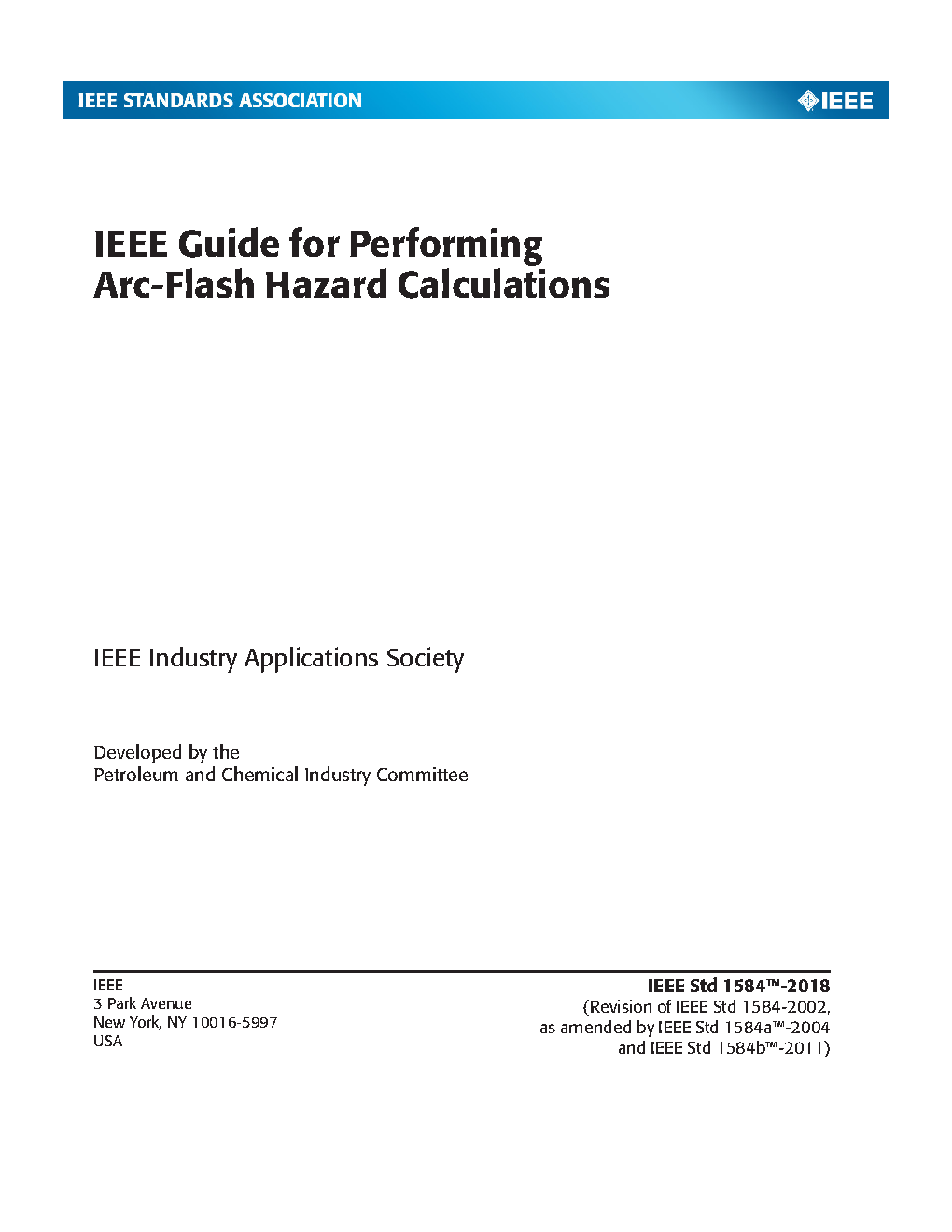
IEEE 1584:2018
IEEE Guide for Performing Arc-Flash Hazard Calculations

Summary
Revision Standard - Active.
This guide provides mathematical models for designers and facility operators to apply in determining the arc-flash hazard distance and the incident energy to which workers could be exposed during their work on or near electrical equipment.
This guide provides models and an analytical process to enable calculation of the predicted incident thermal energy and the arc-flash boundary. The process covers the collection of field data if applicable, consideration of power system operating scenarios, and calculation parameters. Applications include electrical equipment and conductors for three-phase alternating current (ac) voltages from 208 V to 15 kV. Calculations for single-phase ac systems and direct current (dc) systems are not a part of this guide, but some guidance and references are provided for those applications. Recommendations for personal protective equipment (PPE) to mitigate arc-flash hazards are not included in this guide.
The purpose of the guide is to enable qualified person(s) to analyze power systems for the purpose of calculating the incident energy to which employees could be exposed during operations and maintenance work. Contractors and facility owners can use this information to help provide appropriate protection for employees in accordance with the requirements of applicable electrical workplace safety standards.
This guide provides mathematical models for designers and facility operators to apply in determining the arc-flash hazard distance and the incident energy to which workers could be exposed during their work on or near electrical equipment.
This guide provides models and an analytical process to enable calculation of the predicted incident thermal energy and the arc-flash boundary. The process covers the collection of field data if applicable, consideration of power system operating scenarios, and calculation parameters. Applications include electrical equipment and conductors for three-phase alternating current (ac) voltages from 208 V to 15 kV. Calculations for single-phase ac systems and direct current (dc) systems are not a part of this guide, but some guidance and references are provided for those applications. Recommendations for personal protective equipment (PPE) to mitigate arc-flash hazards are not included in this guide.
The purpose of the guide is to enable qualified person(s) to analyze power systems for the purpose of calculating the incident energy to which employees could be exposed during operations and maintenance work. Contractors and facility owners can use this information to help provide appropriate protection for employees in accordance with the requirements of applicable electrical workplace safety standards.
Notes
Active
Technical characteristics
| Publisher | Institute of Electrical and Electronics Engineers (IEEE) |
| Publication Date | 11/30/2018 |
| Edition | |
| Page Count | 134 |
| EAN | --- |
| ISBN | --- |
| Weight (in grams) | --- |
| Brochures |

|
Amendments replaces

23/09/2002
Superseded
Historical
Previous versions
30/11/2018
Active
Most Recent
25/08/2011
Superseded
Historical
29/11/2004
Superseded
Historical
23/09/2002
Superseded
Historical