
Superseded
Standard
Historical
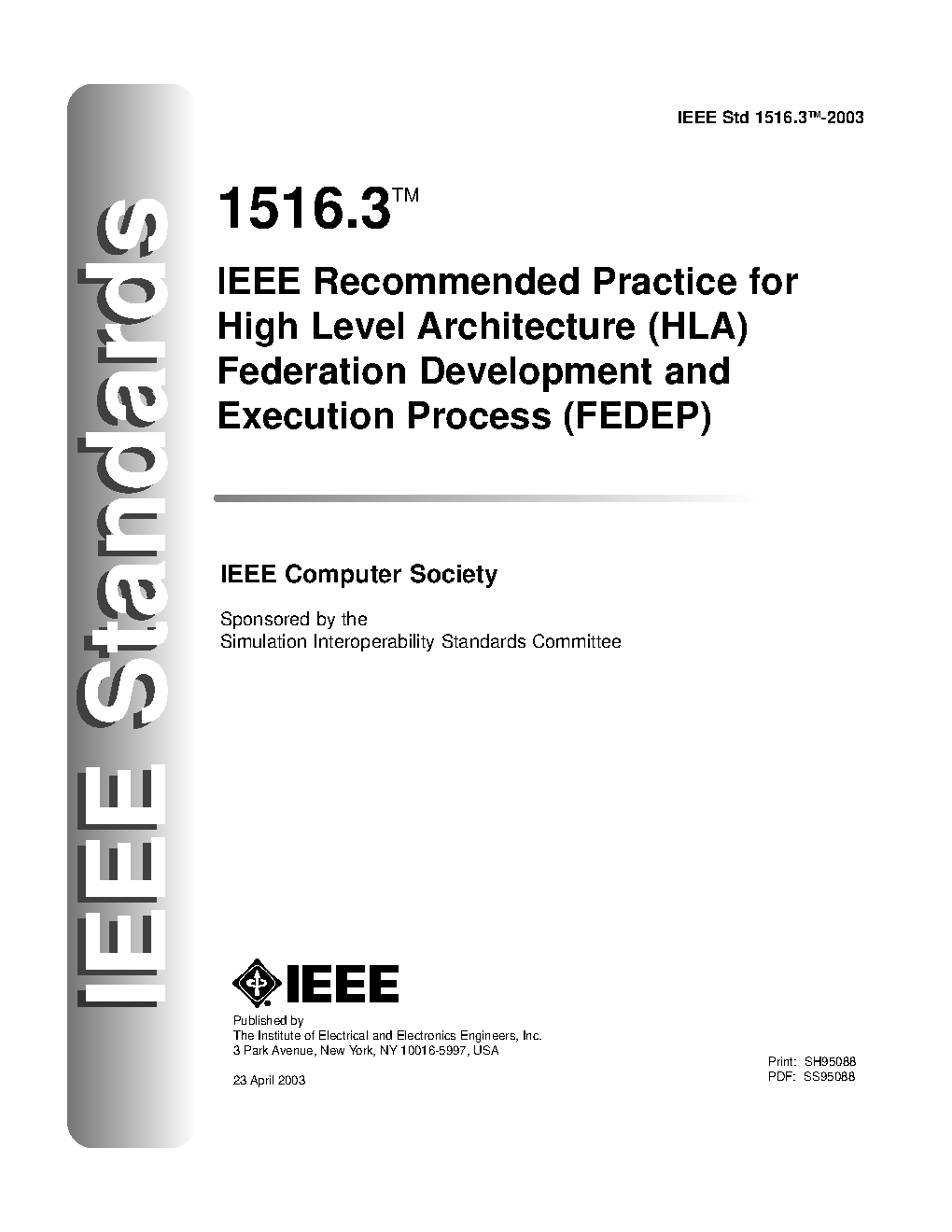
IEEE 1516.3:2003
IEEE Recommended Practice for High Level Architecture (HLA) Federation Development and Execution Process (FEDEP)

Summary
New IEEE Standard - Superseded.
The processes and procedures that should be followed by users of the High Level Archi-tecture (HLA) to develop and execute federations are defined in this recommended practice. Thisrecommended practice is not intended to replace low-level management and systems engineeringpractices native to HLA user organizations, but is rather intended as a higher-level framework intowhich such practices can be integrated and tailored for specific uses.
This document defines the processes and procedures that should be followed by users of the High Level Architecture (HLA) to develop and execute federations. It is not intended to replace low-level management and systems engineering practices native to HLA user organizations, but is rather intended as a higher-level framework into which such practices can be integrated and tailored for specific uses.
The High Level Architecture (HLA) has been developed to provide a common architecture for modeling and simulation. An HLA federation is a named set of software applications (federates) that interact via the services of the HLA Runtime Infrastructure (RTI) in accordance with a common object model in order to achieve some objective (or set of objectives). The purpose of this document is to provide the HLA user community with a recommended practice for how HLA federations are developed and executed.
The processes and procedures that should be followed by users of the High Level Archi-tecture (HLA) to develop and execute federations are defined in this recommended practice. Thisrecommended practice is not intended to replace low-level management and systems engineeringpractices native to HLA user organizations, but is rather intended as a higher-level framework intowhich such practices can be integrated and tailored for specific uses.
This document defines the processes and procedures that should be followed by users of the High Level Architecture (HLA) to develop and execute federations. It is not intended to replace low-level management and systems engineering practices native to HLA user organizations, but is rather intended as a higher-level framework into which such practices can be integrated and tailored for specific uses.
The High Level Architecture (HLA) has been developed to provide a common architecture for modeling and simulation. An HLA federation is a named set of software applications (federates) that interact via the services of the HLA Runtime Infrastructure (RTI) in accordance with a common object model in order to achieve some objective (or set of objectives). The purpose of this document is to provide the HLA user community with a recommended practice for how HLA federations are developed and executed.
Notes
Superseded
Technical characteristics
| Publisher | Institute of Electrical and Electronics Engineers (IEEE) |
| Publication Date | 04/21/2003 |
| Edition | |
| Page Count | 40 |
| EAN | --- |
| ISBN | --- |
| Weight (in grams) | --- |
| Brochures |

|
No products.
Previous versions
21/04/2003
Superseded
Historical