Withdrawn
Standard
Most Recent
IEEE 1363.2:2008
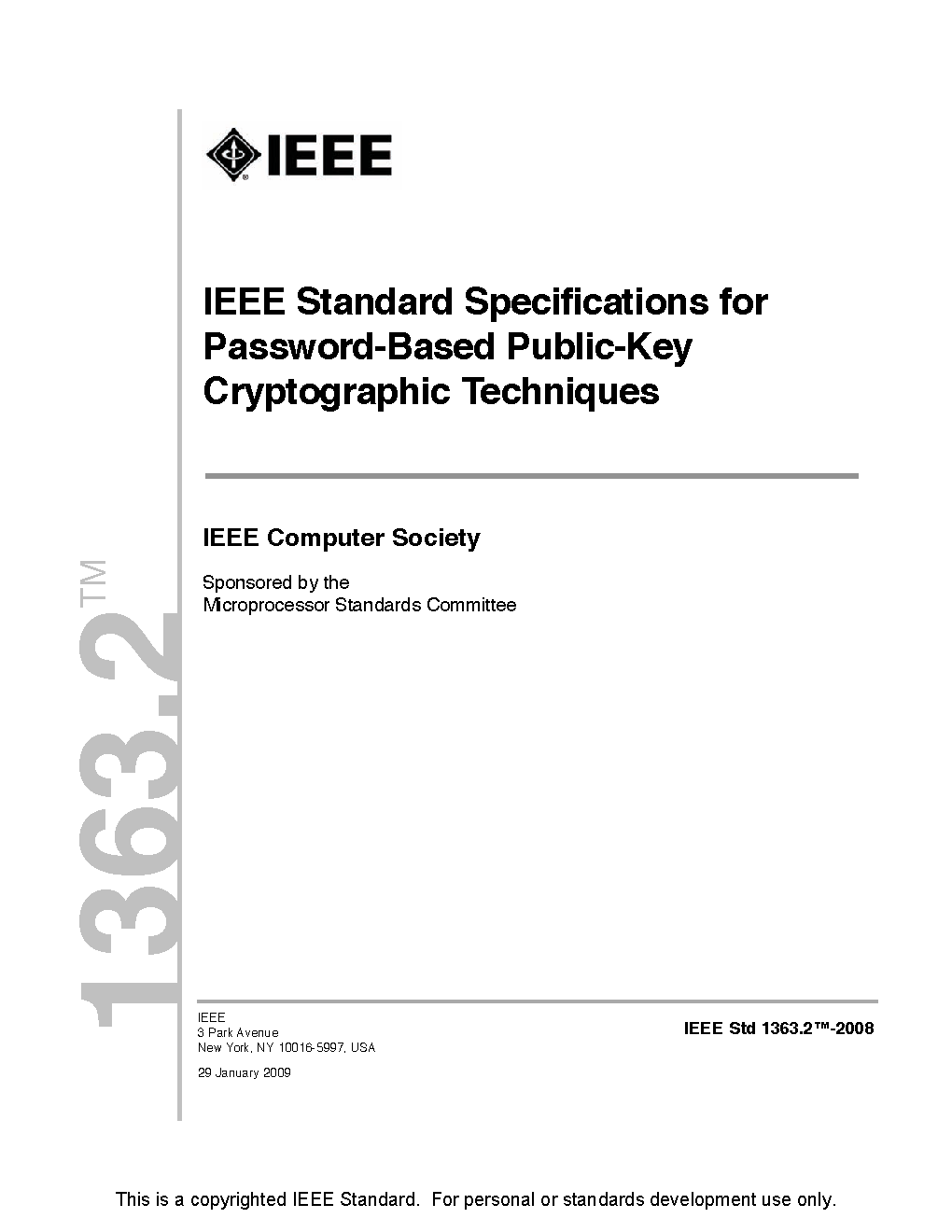
IEEE Standard Specification for Password-Based Public-Key Cryptographic Techniques

Summary
New IEEE Standard - Inactive-Reserved.
This standard covers specifications of public-key cryptographic techniques for password-based authentication and key establishment, supplemental to the techniques described in IEEE Std 1363-2000 and IEEE Std 1363a-2004. It is intended as a companion standard to IEEE Std 1363-2000 and IEEE Std 1363a-2004. It includes specifications of primitives and schemes designed to utilize passwords and other low-grade secrets as a basis for securing electronic transactions, including schemes for password-authenticated key agreement and password-authenticated key retrieval.
This standard covers specifications of common public-key cryptographic techniques for performing password-based authentication and key establishment, supplemental to the techniques described in IEEE Std 1363-2000 and IEEE Std 1363a-2004. It includes specifications of primitives and schemes designed to utilize passwords and other low-grade secrets as a basis for securing electronic transactions, including schemes for password-authenticated key agreement and password-authenticated key retrieval.
Ensuring privacy and authenticity in personal electronic transactions is a process that necessarily involves human beings. Memorized secrets are an important factor in human authentication. Many common cryptographic methods for authentication require large, random high-grade secret keys; yet, the secrets that human beings can conveniently memorize and reliably reproduce tend to be low-grade secrets. Passwords are widely used low-grade secrets that are typically not-so-random and relatively small, and introduce risks of brute-force attack when inappropriately used as cryptographic keys.
This standard covers specifications of public-key cryptographic techniques for password-based authentication and key establishment, supplemental to the techniques described in IEEE Std 1363-2000 and IEEE Std 1363a-2004. It is intended as a companion standard to IEEE Std 1363-2000 and IEEE Std 1363a-2004. It includes specifications of primitives and schemes designed to utilize passwords and other low-grade secrets as a basis for securing electronic transactions, including schemes for password-authenticated key agreement and password-authenticated key retrieval.
This standard covers specifications of common public-key cryptographic techniques for performing password-based authentication and key establishment, supplemental to the techniques described in IEEE Std 1363-2000 and IEEE Std 1363a-2004. It includes specifications of primitives and schemes designed to utilize passwords and other low-grade secrets as a basis for securing electronic transactions, including schemes for password-authenticated key agreement and password-authenticated key retrieval.
Ensuring privacy and authenticity in personal electronic transactions is a process that necessarily involves human beings. Memorized secrets are an important factor in human authentication. Many common cryptographic methods for authentication require large, random high-grade secret keys; yet, the secrets that human beings can conveniently memorize and reliably reproduce tend to be low-grade secrets. Passwords are widely used low-grade secrets that are typically not-so-random and relatively small, and introduce risks of brute-force attack when inappropriately used as cryptographic keys.
Notes
Inactive-Reserved
Technical characteristics
| Publisher | Institute of Electrical and Electronics Engineers (IEEE) |
| Publication Date | 01/29/2009 |
| Cancellation Date | 11/07/2019 |
| Edition | |
| Page Count | 140 |
| EAN | --- |
| ISBN | --- |
| Weight (in grams) | --- |
| Brochures |

|
No products.
Previous versions
29/01/2009
Withdrawn
Most Recent