
Superseded
Standard Corrigendum
Historical
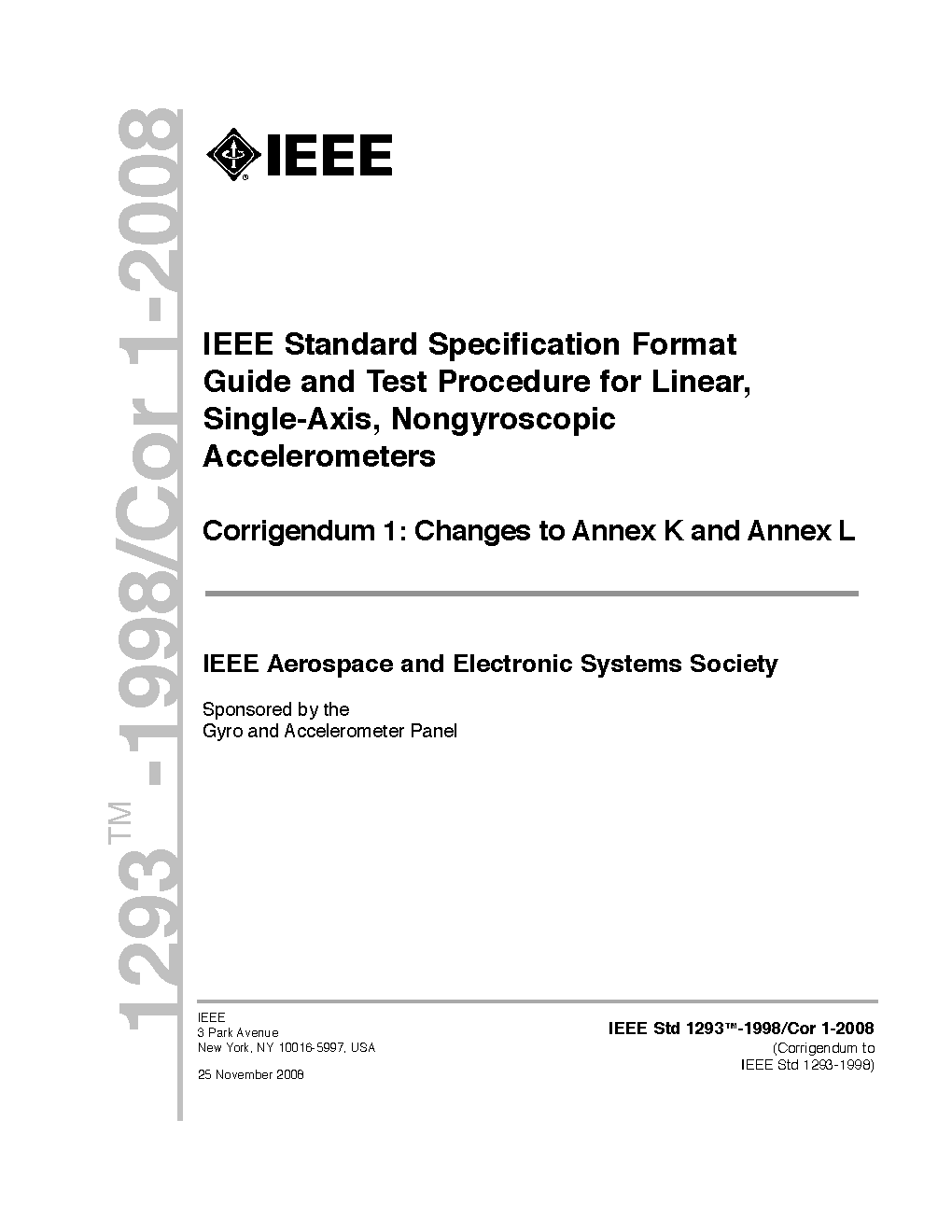
IEEE 1293-1998/Cor 1:2008
IEEE Standard Specification Format Guide and Test Procedure for Linear,Single-Axis, Nongyroscopic Accelerometers Corrigendum 1: Changes to Annex K and Annex L

Summary
Corrigendum Standard - Superseded.
Corrigendum to IEEE Std 1293-1998. Specification and test requirements for linear, single-axis, nongyroscopic accelerometers for use as a sensor in attitude control systems, linear displacement measuring systems, and linear rate measuring systems are defined. The specification format guide and test procedure standard applies to force-rebalance accelerometers (pendulous or translational proof
mass), vibrating beam accelerometers (VBAs), and micromechanical accelerometers that range
from lesser accuracy to high accuracy devices.
This specification defines the requirements for a linear, single-axis, nongyroscopic accelerometer. The accelerometer is used as a sensing element to provide an electrical signal proportional to acceleration or velocity change with a transfer function that is nominally low-pass (rathere that bandpass). The output is [an analog voltage current, a binary pulse train, a ternary pulse train, pulse width modulated, a frequency output,...] representing [acceleration, velocity change].
Clarification of data modeling and analysis.
Corrigendum to IEEE Std 1293-1998. Specification and test requirements for linear, single-axis, nongyroscopic accelerometers for use as a sensor in attitude control systems, linear displacement measuring systems, and linear rate measuring systems are defined. The specification format guide and test procedure standard applies to force-rebalance accelerometers (pendulous or translational proof
mass), vibrating beam accelerometers (VBAs), and micromechanical accelerometers that range
from lesser accuracy to high accuracy devices.
This specification defines the requirements for a linear, single-axis, nongyroscopic accelerometer. The accelerometer is used as a sensing element to provide an electrical signal proportional to acceleration or velocity change with a transfer function that is nominally low-pass (rathere that bandpass). The output is [an analog voltage current, a binary pulse train, a ternary pulse train, pulse width modulated, a frequency output,...] representing [acceleration, velocity change].
Clarification of data modeling and analysis.
Notes
Superseded
Technical characteristics
| Publisher | Institute of Electrical and Electronics Engineers (IEEE) |
| Publication Date | 11/25/2008 |
| Edition | |
| Page Count | 13 |
| EAN | --- |
| ISBN | --- |
| Weight (in grams) | --- |
| Brochures |

|
Amendments modifies
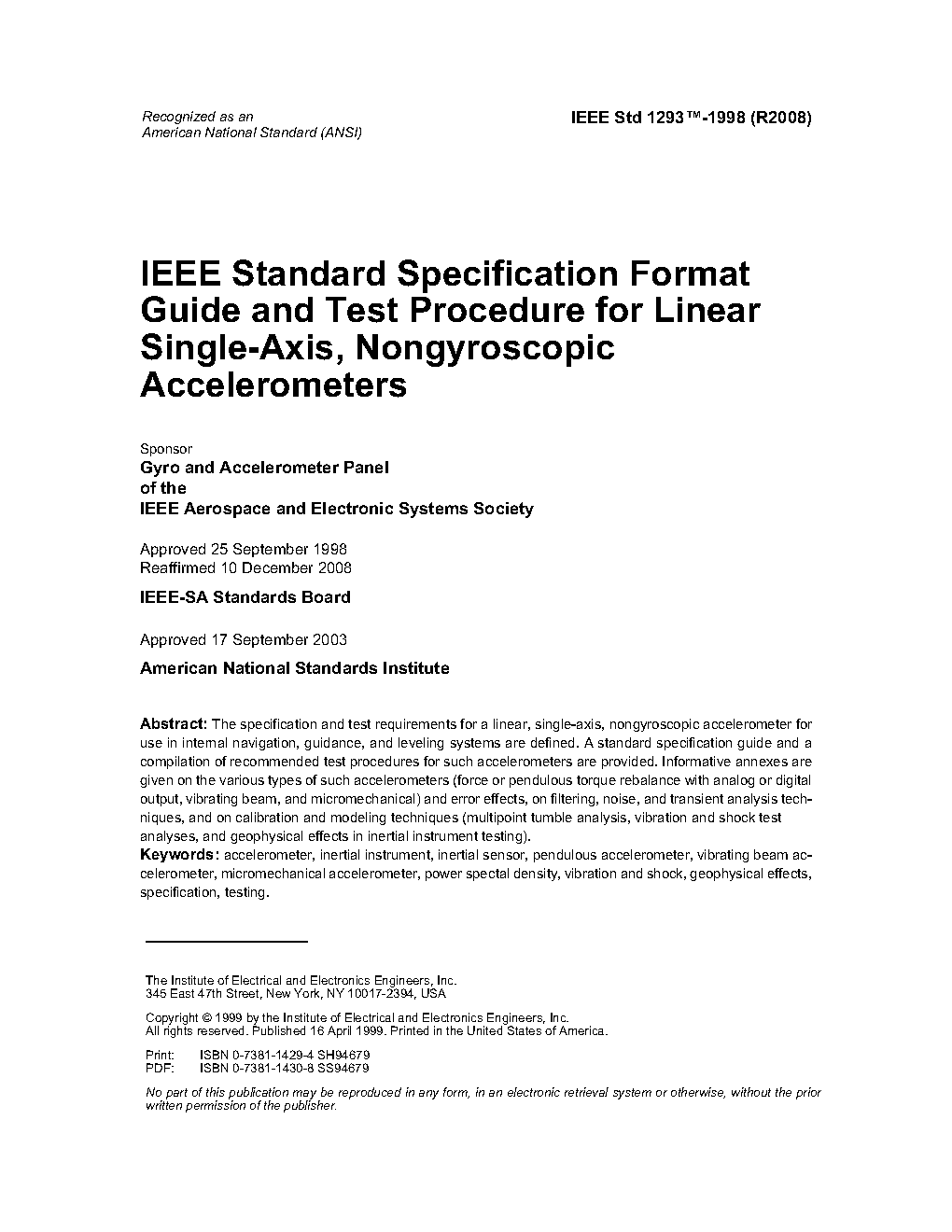
16/04/1999
Superseded
, Confirmed
Historical
Previous versions
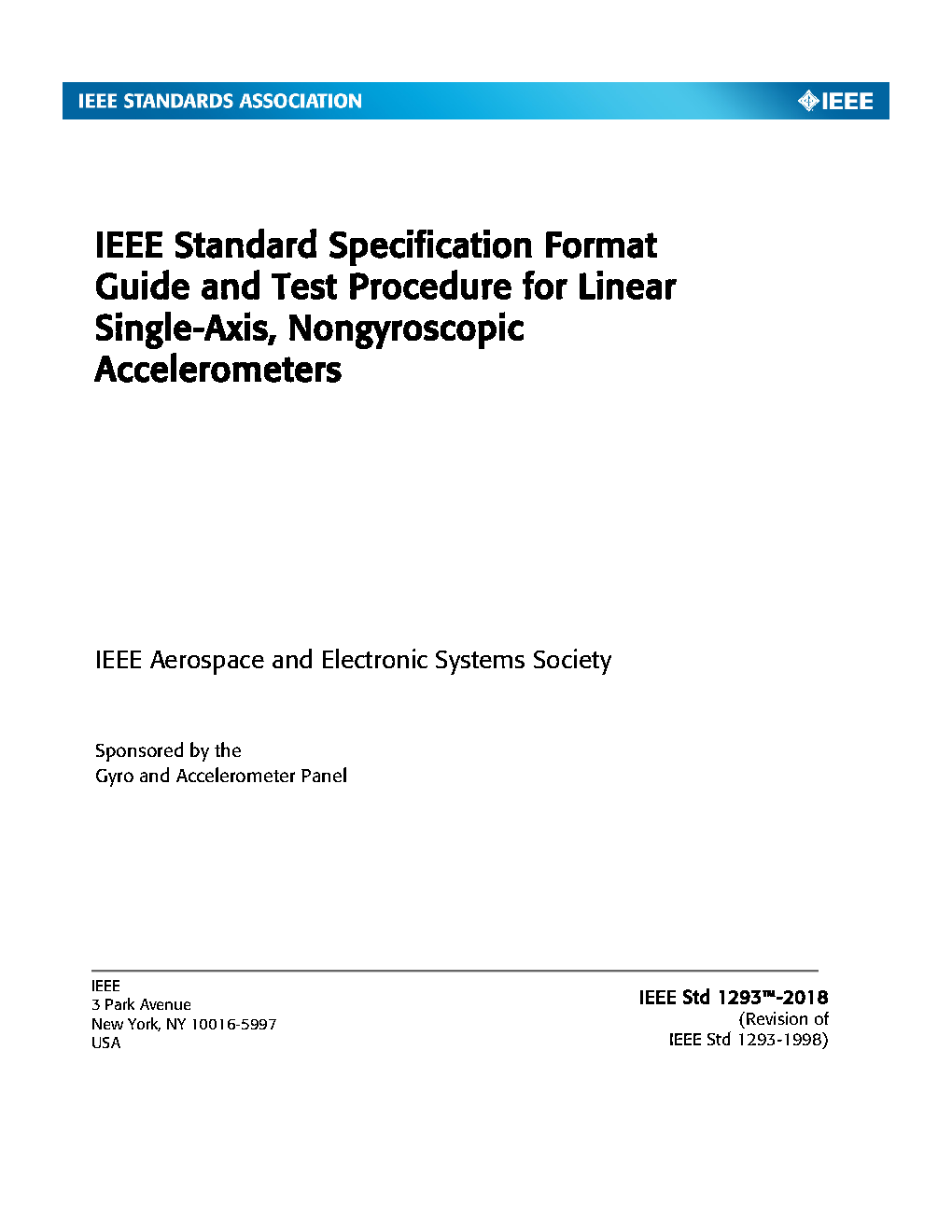
16/04/1999
Superseded
, Confirmed
Historical