Superseded
, Confirmed
Standard
Historical
IEEE 1062:1993 (R2002)
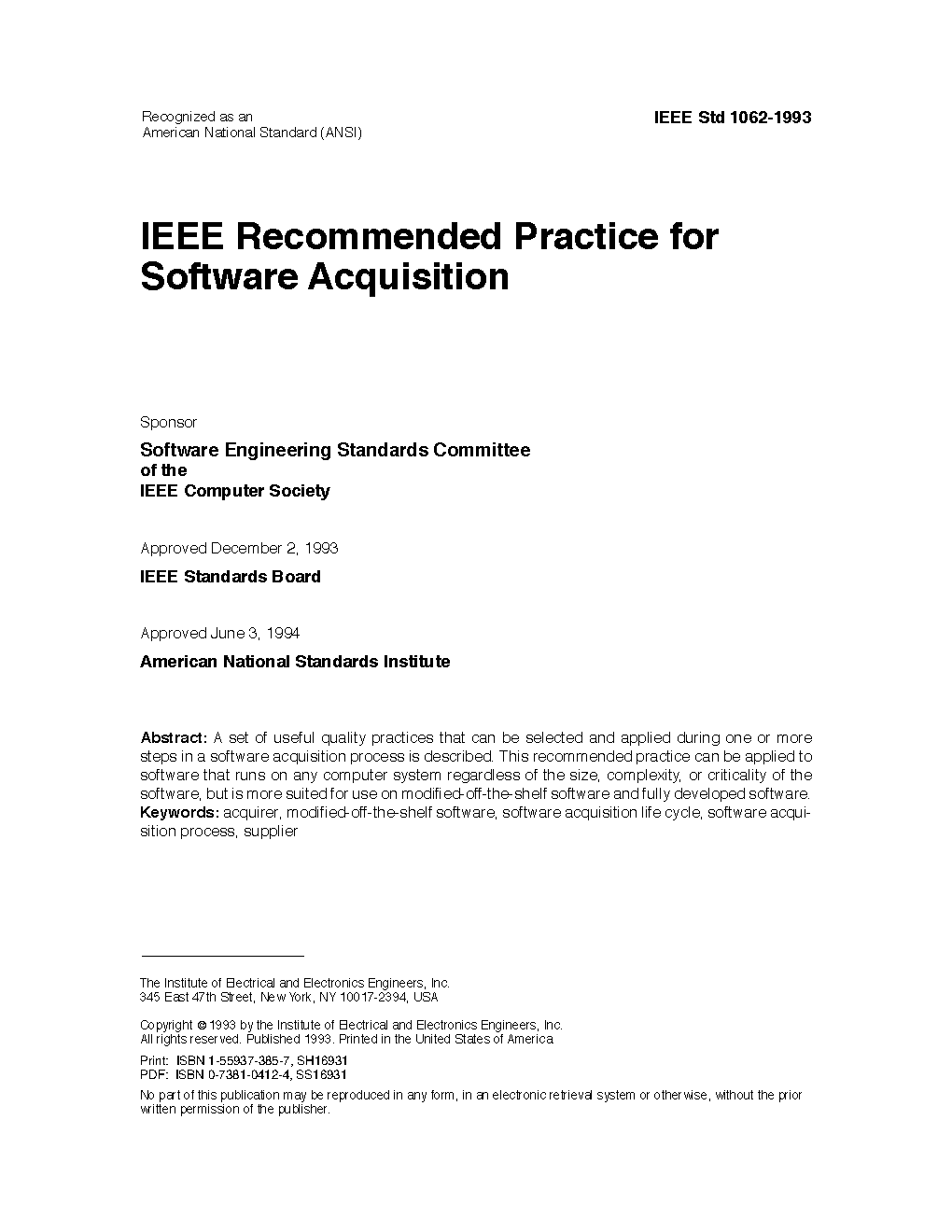
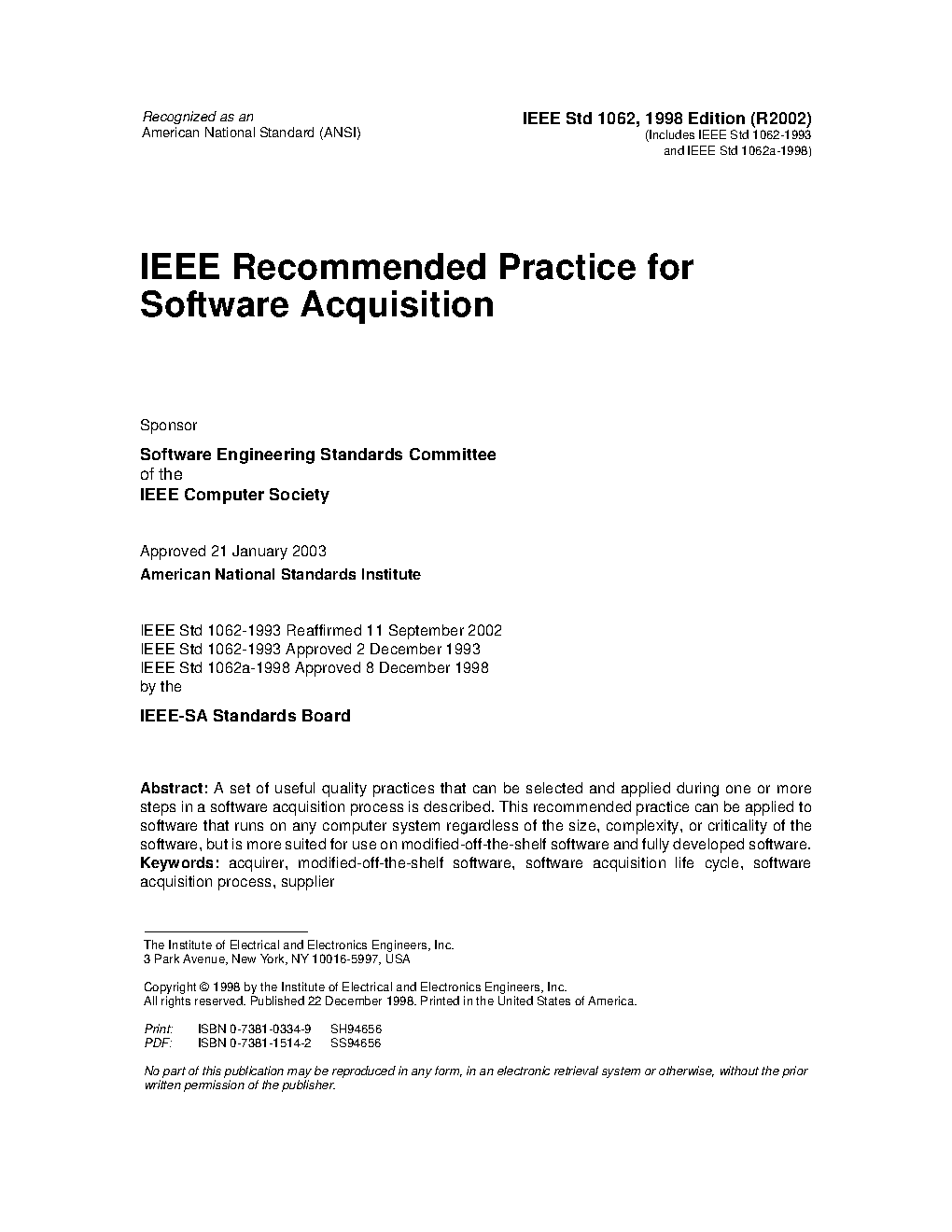
IEEE Recommended Practice for Software Acquisition

Summary
New IEEE Standard - Superseded.
Superseded by 1062-1998. A set of useful quality practices that can be selected and applied during one or more steps in a software acquisition process is described. This recommended practice can be applied to software that runs on any computer system regardless of the size, complexity, or criticality of the software, but is more suited for use on modified-off-the-shelf software and fully developed software.
This is a recommended practice for performing software acquisitions. It describes a set of useful quality practices that can be selected and applied during one or more steps in a software acquisition process.
In this recommended practice, software products have been classified according to the degree to which the acquirer may specify the features of the software. They are: commercial-of-the-shelf (COTS), modified-off-the-shelf (MOTS), and fully developed item.
Commercial-off-the-shelf (COTS) software is stable and is normally well-defined in terms of documentation and known capabilities and limitations. It usually comes with "how to operate" documentation. COTS software is defined by a market-driven need. It is commercially available and its fitness for use has been demonstrated by a broad spectrum of commercial users. Also, the COTS software supplier does not advertise any willingness to modify the software for a specific customer.
Modified-off-the-shelf (MOTS) software is similar to COTS software; however, the MOTS software does
advertise service to tailor the software to acquirer-specific requirements.
Fully developed software will often be unique for a specific application and will be produced on a one-of-akind or low-volume basis. The software typically will have the potential for future modification by the acquirer to meet changing needs. As a result, most of the documentation will be special to the project (with the exception of the supplier's standard documentation for the operating system, any standard application packages, and programming languages).
This recommended practice can be applied to software that runs on any computer system regardless of the size, complexity, or criticality of the software. However, this recommended practice is more suited for use on modified-off-the-shelf software and fully developed software. Each organization using this recommended practice will need to identify the classes of software to which this recommended practice applies and the specific quality characteristics and activities that need to be included within the acquisition process
Superseded by 1062-1998. A set of useful quality practices that can be selected and applied during one or more steps in a software acquisition process is described. This recommended practice can be applied to software that runs on any computer system regardless of the size, complexity, or criticality of the software, but is more suited for use on modified-off-the-shelf software and fully developed software.
This is a recommended practice for performing software acquisitions. It describes a set of useful quality practices that can be selected and applied during one or more steps in a software acquisition process.
In this recommended practice, software products have been classified according to the degree to which the acquirer may specify the features of the software. They are: commercial-of-the-shelf (COTS), modified-off-the-shelf (MOTS), and fully developed item.
Commercial-off-the-shelf (COTS) software is stable and is normally well-defined in terms of documentation and known capabilities and limitations. It usually comes with "how to operate" documentation. COTS software is defined by a market-driven need. It is commercially available and its fitness for use has been demonstrated by a broad spectrum of commercial users. Also, the COTS software supplier does not advertise any willingness to modify the software for a specific customer.
Modified-off-the-shelf (MOTS) software is similar to COTS software; however, the MOTS software does
advertise service to tailor the software to acquirer-specific requirements.
Fully developed software will often be unique for a specific application and will be produced on a one-of-akind or low-volume basis. The software typically will have the potential for future modification by the acquirer to meet changing needs. As a result, most of the documentation will be special to the project (with the exception of the supplier's standard documentation for the operating system, any standard application packages, and programming languages).
This recommended practice can be applied to software that runs on any computer system regardless of the size, complexity, or criticality of the software. However, this recommended practice is more suited for use on modified-off-the-shelf software and fully developed software. Each organization using this recommended practice will need to identify the classes of software to which this recommended practice applies and the specific quality characteristics and activities that need to be included within the acquisition process
Notes
Superseded
Technical characteristics
| Publisher | Institute of Electrical and Electronics Engineers (IEEE) |
| Publication Date | 11/30/1992 |
| Confirmation Date | 09/12/2002 |
| Edition | |
| Page Count | 48 |
| EAN | --- |
| ISBN | --- |
| Weight (in grams) | --- |
| Brochures |

|
No products.
Previous versions
29/12/1998
Superseded
Historical
30/11/1992
Superseded
, Confirmed
Historical