
Withdrawn
Standard
Most Recent
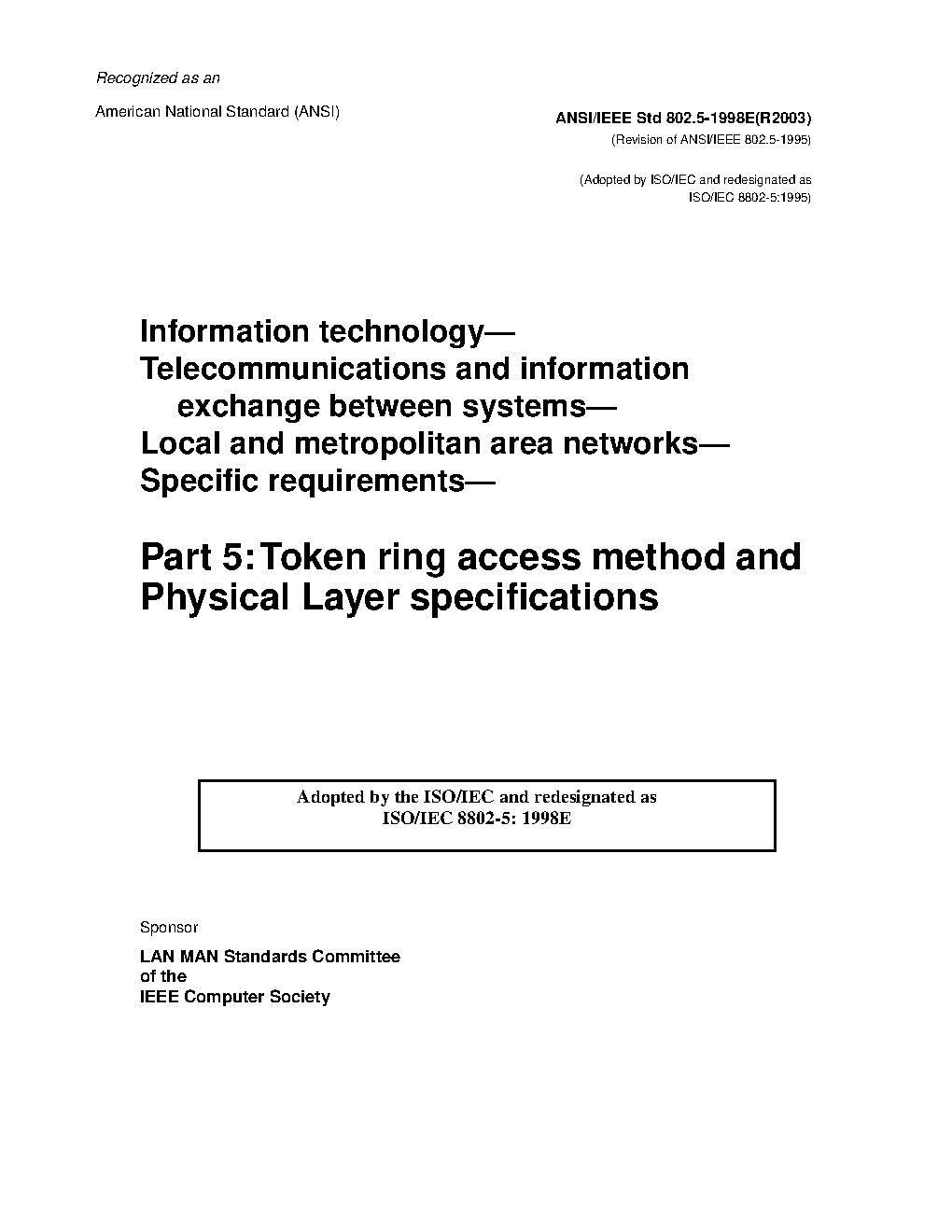
ANSI/IEEE 802.5:1998
IEEE Information Technology - Telecommunications and information exchange between systems - Local and metropolitan area networks - Part 5: Token ring access method and physical layer specifications

Summary
Revision Standard - Inactive-Withdrawn.
This Local and Metropolitan Area Network standard, IEEE 802.5-1998, is part of a family of local area network (LAN) standards dealing with the physical and data link layers as defined by the ISO/IEC Open Systems Interconnection Basic Reference Model. Its purpose is to provide compatible interconnection of data processing equipment by means of a LAN using the token-passing ring access method. The frame format, including delimiters, addressing, and priority stacks, is defined. The medium access control (MAC) protocol is defined. The finite state machine and state tables are supplemented with a prose description of the algorithms. The physical layer (PHY) functions of symbol encoding and decoding, symbol time, and latency buffering are defined. The services provided by the MAC to the station management (SMT) and the services provided by the PHY to SMT and the MAC are described. These services are defined in terms of service primitives and associated parameters. The 4 and 16 Mbit/s, shielded twisted pair attachment of the station to the medium, including the medium interface connector (MIC), is also defined. The applications environment for the LAN is intended to be commercial and light industrial. The use of token ring LANs in home and heavy industrial environments, while not precluded, has not been considered in the development of the standard. A Protocol Implementation Conformance Statement (PICS) proforma is provided as an annex to the standard.
a) Provides a general description of the token ring local area network (LAN) architecture (clause 2); b) Defines the frame format, including the delimiters, address fields, information field, and framecheck sequence (FCS). Defines the Medium Access Control (MAC) frames, timers, and error counters (clause 3); c) Defines the MAC protocols including finite state machines and state tables (clause 4); d) Defines the system level Physical layer (PHY) signaling specifications that are specific to a ring station (clause 5); e) Defines the managed objects necessary to manage the service and protocol elements that are involved in the management of a token ring station (clause 6); f) Defines the PHY station attachment specification for 4 and 16 Mbit/s operation. This includes the transmitter, receiver, medium interface connector, and transmission channel for both shielded twisted pair (STP) and unshielded twisted pair (UTP) media (clause 7); g) Defines the concentrator, incorporating multiple trunk coupling units (TCUs), for the attachment of a group of stations to the ring (clause 8);
This Local and Metropolitan Area Network standard, IEEE 802.5-1998, is part of a family of local area network (LAN) standards dealing with the physical and data link layers as defined by the ISO/IEC Open Systems Interconnection Basic Reference Model. Its purpose is to provide compatible interconnection of data processing equipment by means of a LAN using the token-passing ring access method. The frame format, including delimiters, addressing, and priority stacks, is defined. The medium access control (MAC) protocol is defined. The finite state machine and state tables are supplemented with a prose description of the algorithms. The physical layer (PHY) functions of symbol encoding and decoding, symbol time, and latency buffering are defined. The services provided by the MAC to the station management (SMT) and the services provided by the PHY to SMT and the MAC are described. These services are defined in terms of service primitives and associated parameters. The 4 and 16 Mbit/s, shielded twisted pair attachment of the station to the medium, including the medium interface connector (MIC), is also defined. The applications environment for the LAN is intended to be commercial and light industrial. The use of token ring LANs in home and heavy industrial environments, while not precluded, has not been considered in the development of the standard. A Protocol Implementation Conformance Statement (PICS) proforma is provided as an annex to the standard.
a) Provides a general description of the token ring local area network (LAN) architecture (clause 2); b) Defines the frame format, including the delimiters, address fields, information field, and framecheck sequence (FCS). Defines the Medium Access Control (MAC) frames, timers, and error counters (clause 3); c) Defines the MAC protocols including finite state machines and state tables (clause 4); d) Defines the system level Physical layer (PHY) signaling specifications that are specific to a ring station (clause 5); e) Defines the managed objects necessary to manage the service and protocol elements that are involved in the management of a token ring station (clause 6); f) Defines the PHY station attachment specification for 4 and 16 Mbit/s operation. This includes the transmitter, receiver, medium interface connector, and transmission channel for both shielded twisted pair (STP) and unshielded twisted pair (UTP) media (clause 7); g) Defines the concentrator, incorporating multiple trunk coupling units (TCUs), for the attachment of a group of stations to the ring (clause 8);
Notes
Inactive-Withdrawn
Technical characteristics
| Publisher | Institute of Electrical and Electronics Engineers (IEEE) |
| Publication Date | 05/26/1998 |
| Edition | |
| Page Count | 260 |
| EAN | --- |
| ISBN | --- |
| Weight (in grams) | --- |
| Brochures |

|
No products.
Previous versions
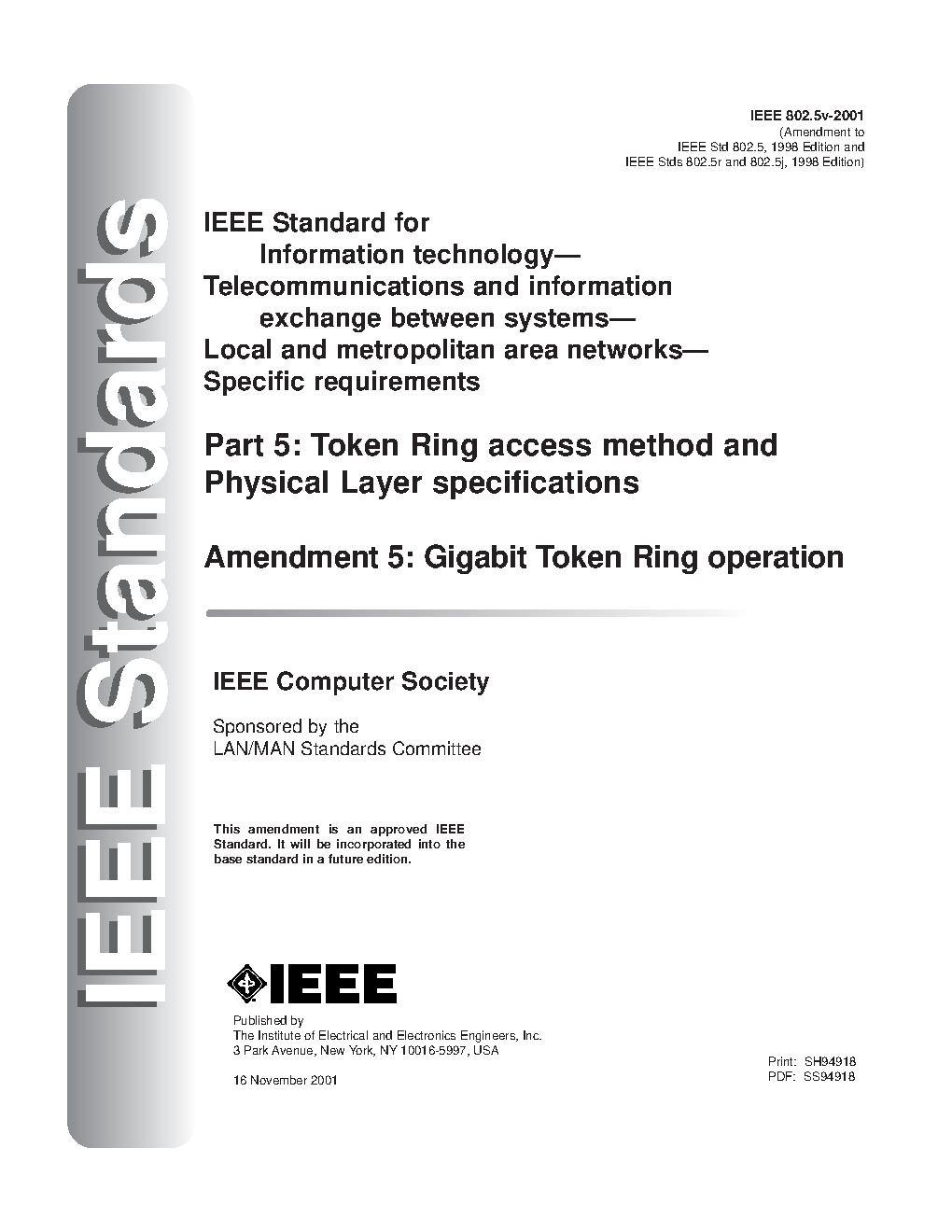
14/11/2001
Withdrawn
, Confirmed
Most Recent
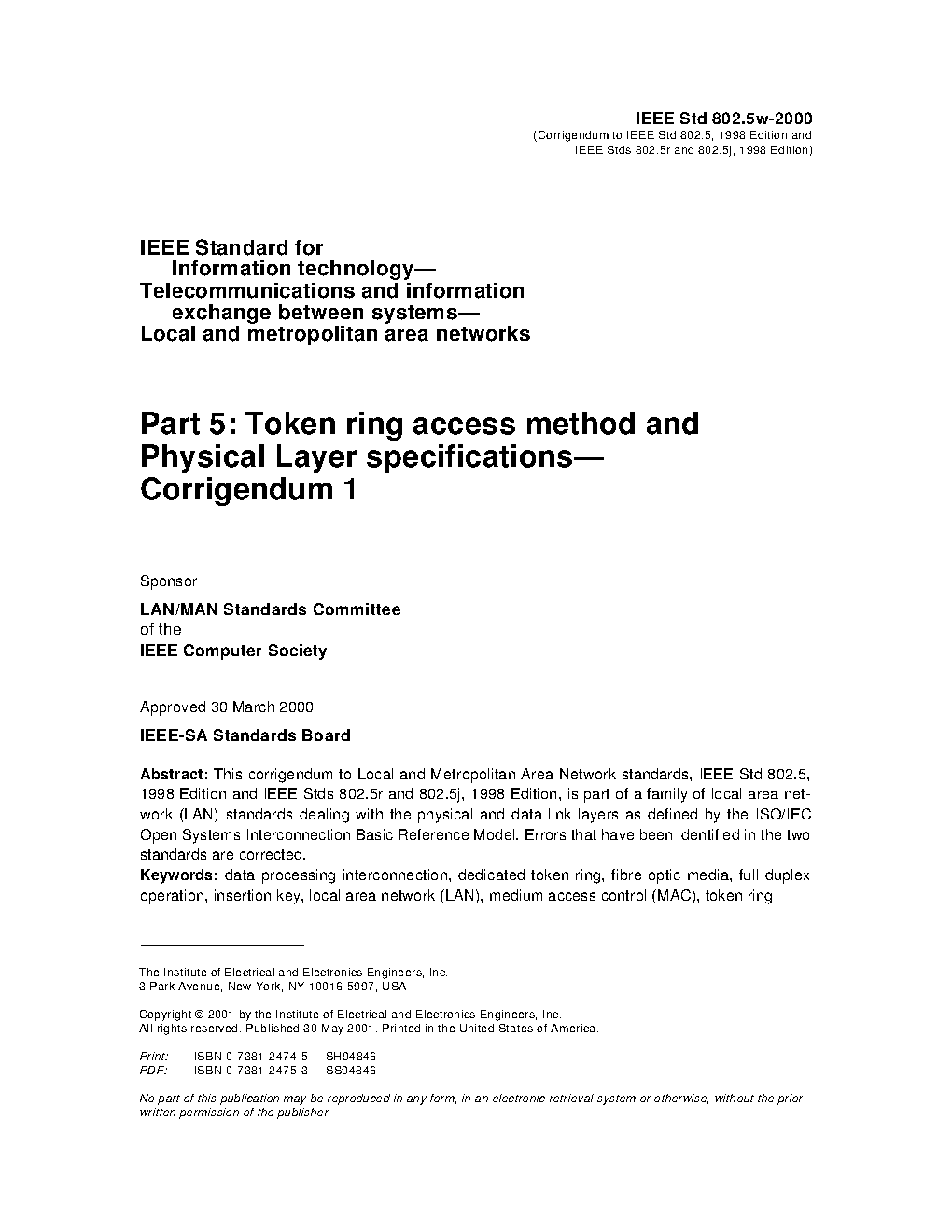
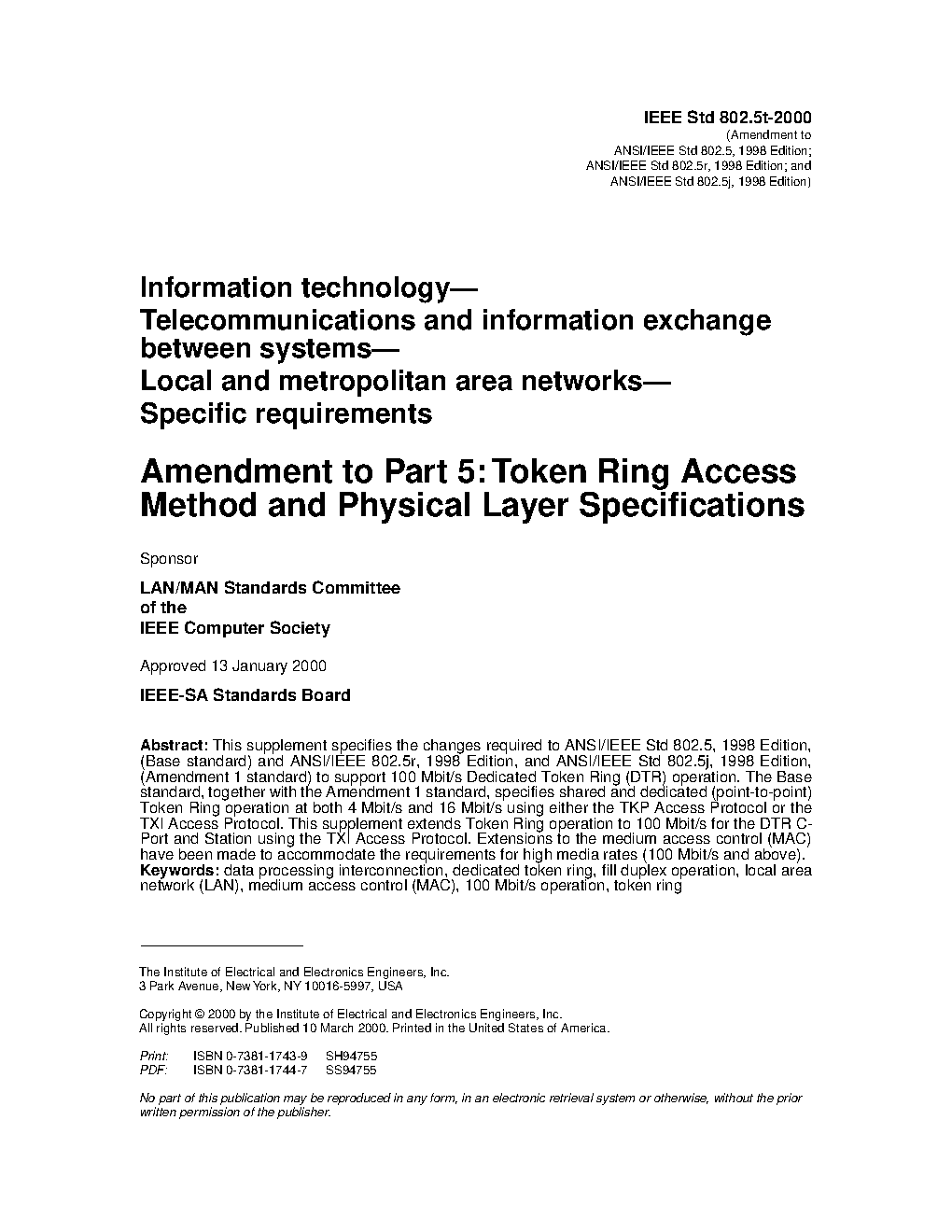
10/03/2000
Withdrawn
, Confirmed
Most Recent
29/12/1989
Superseded
Historical